Kettlebell Turkish Get-Up To Hand
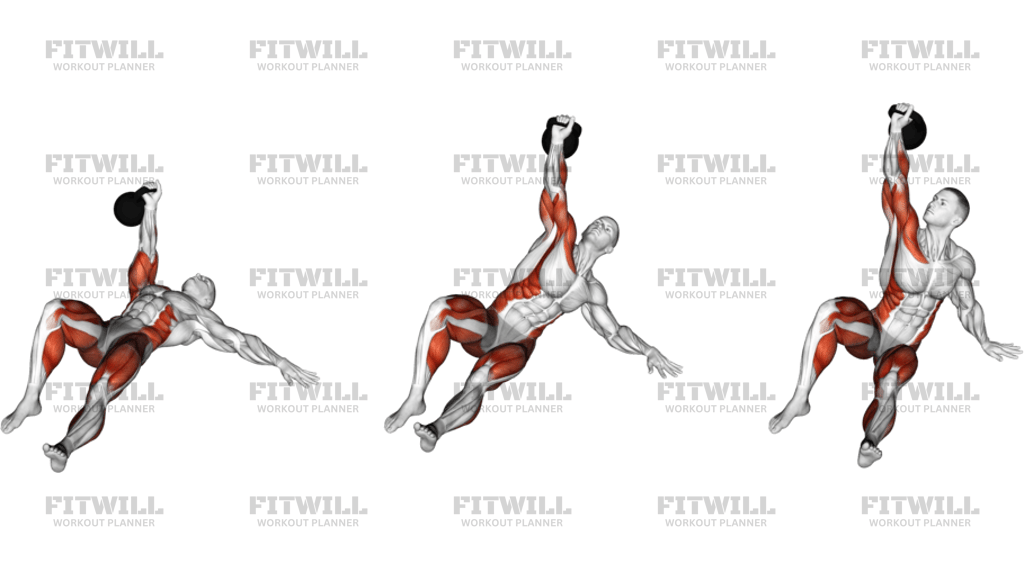
Kettlebell Turkish Get-Up To Hand is a partial get-up that teaches you how to move from the floor into a stacked, supported position while keeping the kettlebell locked overhead. It is usually trained as a technical strength drill rather than a fatigue exercise, because every rep asks the shoulder, trunk, and hips to stay organized while the body changes shape.
The movement loads the overhead shoulder, obliques, glutes, adductors, and quads, especially on the working side as you bridge, sweep, and post to your hand. Even though the current metadata labels the body area as thighs, the image shows a full-body stability pattern where leg drive, hip lift, and torso control matter just as much as the shoulder.
The setup matters because the bell must stay stacked over the wrist, elbow, and shoulder while the free leg and free arm create room to roll. Starting with a bent working knee, the opposite leg long, and the eyes fixed on the kettlebell keeps the first transition smooth and makes it easier to get onto the elbow and then the hand without twisting.
In the rep, use the floor to help you bridge the hips, sweep the straight leg, and post the elbow before you press to the hand. The goal is not to rush to a bigger range; it is to keep the kettlebell quiet, the rib cage controlled, and the torso tall enough that the shoulder never loses its stacked position.
Kettlebell Turkish Get-Up To Hand is useful for warm-ups, core work, shoulder-prep blocks, and unilateral strength sessions, especially when you want coordination without committing to the full stand. Because the movement is slow and positional, choose a light-to-moderate kettlebell and stop the set as soon as the overhead line, hand support, or hip bridge starts to deteriorate.
Fitwill
Log Workouts, Track Progress & Build Strength.
Achieve more with Fitwill: explore over 9600 exercises with images and videos, access built-in and custom workouts, perfect for both gym and home sessions, and see real results.
Start your journey. Download today!




Instructions
- Lie on your back with the kettlebell locked out above one shoulder, that knee bent, the opposite leg long, and the free arm angled out from the body.
- Keep the wrist straight, the elbow locked, and the shoulder packed before you start moving.
- Fix your eyes on the kettlebell so it stays stacked as you roll.
- Press through the bent foot and roll toward the free-side elbow without letting the bell drift behind your head.
- Sit up onto the elbow, then sweep the straight leg and planted foot so the torso can rotate cleanly.
- Bridge the hips high enough to make space, then post the free hand under the shoulder.
- Straighten the posted arm until you are balanced on the hand with the kettlebell still vertical overhead.
- Pause briefly in the hand-supported position with the ribs down and the neck long.
- Reverse the path under control back to the floor, returning from hand to elbow and then to the starting position before switching sides.
Tips & Tricks
- Choose a kettlebell you can keep perfectly vertical during the elbow-to-hand transition; this is a position drill, not a max-strength test.
- If the bell starts to drift behind your shoulder, shorten the rep and re-stack the wrist, elbow, and shoulder.
- Keep the straight leg long and light while you sweep it; yanking it under the body usually twists the pelvis.
- Bridge first, then sit tall. If you try to sit before the hips rise, the low back usually takes over.
- Place the posted hand close enough to the shoulder that the arm can lock out without collapsing forward.
- Exhale through the roll and sit-up so the ribs do not flare and the kettlebell stays centered.
- A brief pause on the elbow and again on the hand makes the rep cleaner than rushing through both positions.
- Stop the set if the wrist bends back or the overhead shoulder loses its stack before the hand-supported position.
Frequently Asked Questions
What does Kettlebell Turkish Get-Up To Hand train most?
It trains overhead shoulder stability, trunk control, hip extension, and the ability to coordinate the legs and torso under load.
Is Kettlebell Turkish Get-Up To Hand easier than a full get-up?
Yes. It stops at the hand-supported position instead of continuing all the way to standing, so it is a useful progression.
How do I keep the kettlebell from wobbling overhead?
Keep the wrist stacked, the elbow locked, and your eyes on the bell while you move from the elbow to the hand.
Should my free leg stay straight during Kettlebell Turkish Get-Up To Hand?
It usually starts straight so you have room to roll and post, then it sweeps with control as you transition.
Where should I feel Kettlebell Turkish Get-Up To Hand?
Most people feel it in the shoulder, obliques, glutes, and the working leg. If the low back dominates, the ribs are probably flaring.
Can beginners use Kettlebell Turkish Get-Up To Hand?
Yes, but it should start very light and slow. Beginners usually need to practice the positions before adding load.
What is the biggest mistake in Kettlebell Turkish Get-Up To Hand?
Rushing from the elbow to the hand and losing the overhead stack is the most common problem.
Do I need to lower back down under control?
Yes. Reversing the hand-to-elbow-to-floor path builds the same control you used on the way up.