Bar Band Standing Behind Head Military Press
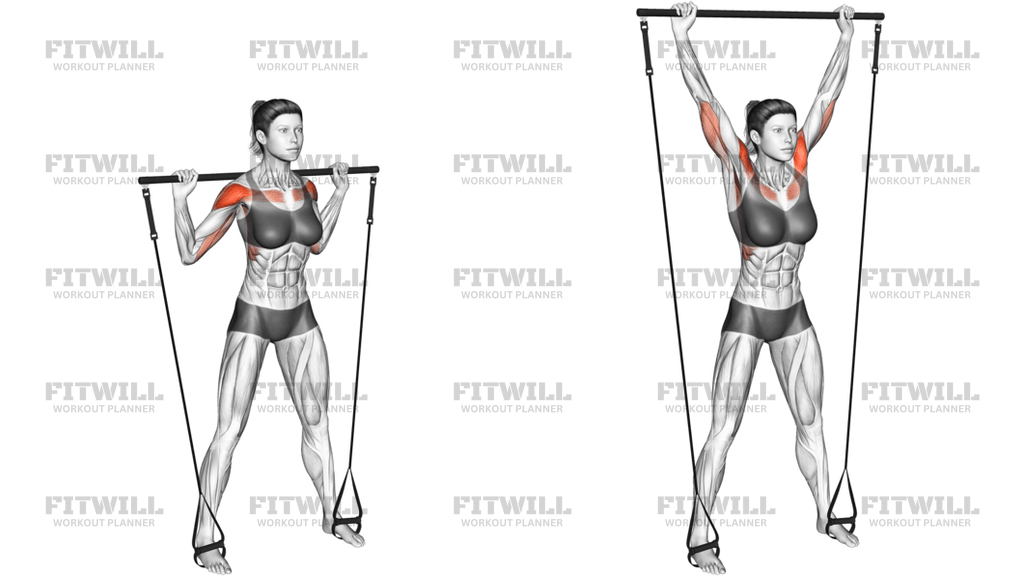
Bar Band Standing Behind Head Military Press is a standing overhead press performed with a straight bar and band resistance anchored under the feet. The bar starts behind the head at upper-trap or neck level, which makes the exercise feel more demanding on shoulder mobility, upper-back control, and clean bar path than a standard front press. The band adds resistance as the bar rises, so the top half of the rep usually feels harder than the bottom half.
The main training emphasis is the delts, especially the front and side portions, with the triceps helping to finish the press and the upper back working to keep the shoulder girdle stable. The image shows the bar held symmetrically across both hands, which helps keep each side pressing evenly and reduces the chance of one shoulder drifting ahead of the other. The band tension also forces the torso to stay organized instead of leaning back and turning the movement into a standing incline press.
The setup matters here more than in many other shoulder exercises. Stand on the band so the tension is even, keep your feet about shoulder width, and bring the bar to a stable starting position behind the head before each rep. Your ribs should stay stacked over your pelvis, your neck should stay long, and your elbows should track under the wrists rather than flaring wildly behind the body. If the bar starts too low, too high, or too far behind the neck, the press gets sloppy fast and the shoulders take over in a less efficient way.
Press the bar up in a controlled line until the arms are straight and the bar finishes overhead. Lower it back to the behind-the-head start with the same control, resisting the pull of the band on the way down. The goal is not to bounce the bar or lean back to cheat the range; it is to keep the torso quiet while the shoulders and triceps do the work. Exhale through the press, inhale as the bar returns, and reset the shoulder position before each rep.
This variation works well as an accessory press for shoulder strength, overhead stability, and higher-rep hypertrophy work when you want a fixed hand position and a strong top-end challenge. It can be useful in home gyms or band-only settings, but it is not the best choice for lifters with irritated shoulders or limited behind-the-neck mobility. If the starting position causes pinching or the bar cannot move smoothly, reduce the resistance or switch to a front press variation instead.
[ Workout Log & Planner ]
Put your next workout in Fitwill
Keep your plan and training log ready when you are.


Instructions
- Stand on the center of the band with your feet about shoulder width apart and hold the bar slightly wider than your shoulders.
- Bring the bar to rest behind your head at upper-trap level, with your elbows bent and your forearms angled under the bar.
- Stack your ribs over your pelvis, soften your knees, and keep your neck long before the first press.
- Brace your midsection and set your shoulders so the bar starts evenly across both hands.
- Press the bar upward in a smooth line until your arms are straight and the bar finishes overhead.
- Keep the torso tall and avoid leaning back as the band tension increases near the top.
- Lower the bar slowly back behind your head until it returns to the starting level at the upper traps.
- Reset the shoulder position, inhale, and repeat for the planned number of repetitions.
Tips & Tricks
- Use a band tension that lets you keep the bar steady behind your head; if the band pulls you out of position, the resistance is too high.
- Keep your hands just outside shoulder width so the bar stays balanced and both shoulders press together.
- Do not turn the press into a standing backbend; if your ribs flare, reduce the load or shorten the set.
- Let the elbows travel slightly forward on the way down instead of forcing them far behind the body.
- Pause for a moment with the bar stable behind the head before each press so the rep starts from control, not momentum.
- Move the bar smoothly through the sticking point instead of bouncing off the bottom position.
- If one wrist or elbow drifts higher than the other, lighten the band tension and re-center the grip.
- Stop the set if the shoulders pinch or if the bar path starts to wobble under fatigue.
Frequently Asked Questions
What muscles does Bar Band Standing Behind Head Military Press train most?
It primarily trains the delts, with the triceps assisting strongly and the upper back stabilizing the bar behind the head.
Why does the bar start behind the head instead of in front?
The behind-the-head start changes the shoulder angle and forces more control from the delts and upper back, which is why mobility and clean setup matter.
What should I feel at the top of the rep?
You should feel the shoulders and triceps finishing the press with the bar stacked overhead, not the lower back taking over.
Is this exercise suitable for beginners?
Yes, if the person can hold the behind-the-neck start comfortably and uses very light band tension with strict control.
What is the most common mistake with this press?
The biggest mistake is leaning back and turning the movement into a body English press instead of keeping the torso stacked and controlled.
How wide should my grip be on the bar?
Use a grip slightly wider than shoulder width so the bar stays level and the elbows can track comfortably under the wrists.
Can I replace this with a regular overhead press?
Yes, a front overhead press is the closest substitution if the behind-the-neck position bothers your shoulders.
Why does the band feel hardest near the top?
Band tension increases as the bar rises, so the lockout becomes more demanding than the start of the rep.