Negative Dragon Flag
Negative Dragon Flag is the eccentric half of the dragon flag performed on a flat bench. You start with your shoulders and upper back anchored on the pad, hands gripping the bench for support, and your body stacked in a straight line before lowering under control toward a horizontal position. The exercise is built around resisting spinal extension, keeping the torso and legs rigid as one long lever while the abs do the work of slowing the descent.
This movement places the greatest demand on the rectus abdominis, with the obliques and deep core muscles helping keep the pelvis tucked and the ribs down. The hip flexors help hold the legs straight, but they should not take over the rep. If the low back starts to arch or the legs separate, the lever is no longer being controlled and the set has gone past its useful range.
The bench setup matters because it gives you a secure anchor point for the shoulders and hands. A firm grip on the bench keeps you from sliding while the core stays braced. That stability lets you focus on a clean lowering path instead of using momentum, which is especially important in this exercise because the challenge is to control the body through the hardest part of the range.
Use Negative Dragon Flag as advanced core strength work, usually in a calisthenics session, accessory block, or dedicated trunk training day. It is not a volume-first ab exercise; it is a tension-first skill that rewards slow eccentrics, tight body positions, and conservative range of motion. If you cannot hold a rigid line, shorten the lever by bending the knees or use a regression until the descent stays smooth and controlled.
Finish each rep with the same discipline you start with. Lower only as far as you can keep the pelvis tucked and the shoulders pinned to the bench, then reset for the next rep without jerking or swinging. Done well, the movement builds serious anti-extension strength that carries over to harder calisthenics skills, bracing under load, and cleaner trunk control in other lifts.
Fitwill
Log Workouts, Track Progress & Build Strength.
Achieve more with Fitwill: explore over 9600 exercises with images and videos, access built-in and custom workouts, perfect for both gym and home sessions, and see real results.
Start your journey. Download today!




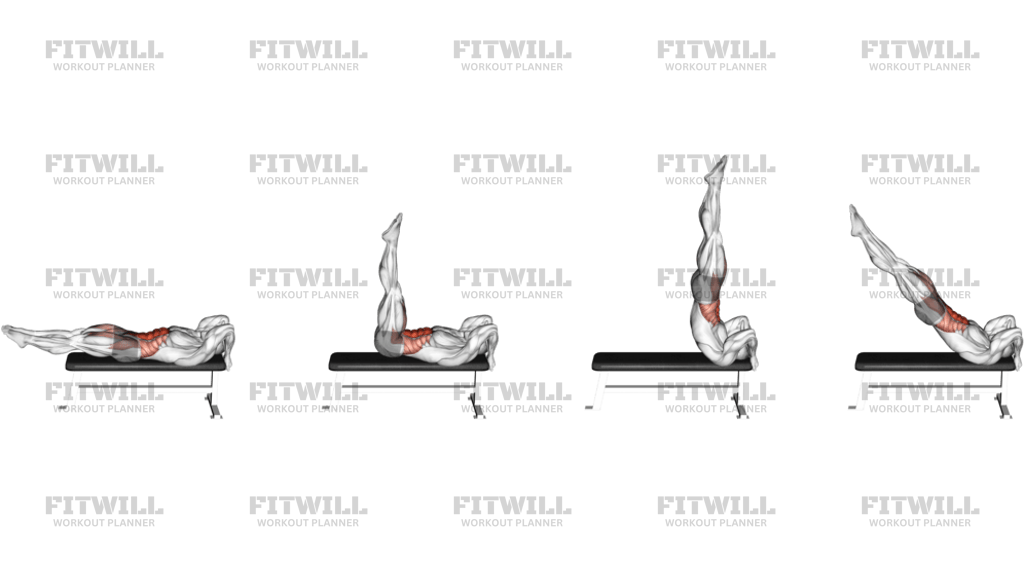
Instructions
- Lie on a flat bench and grip the bench edges beside or just behind your head so your shoulders and upper back stay anchored.
- Bring your legs together and raise them until your body is stacked in a straight line above the bench, with the pelvis tucked and ribs pulled down.
- Lock in your brace before the first rep and keep your neck long, chin lightly tucked, and eyes fixed upward.
- Start the descent by lowering your body as one piece, letting the hips move only because the abs are controlling the lever.
- Keep the knees straight and the thighs together so the legs do not fold or drift apart as you lower.
- Lower slowly toward horizontal, stopping before your low back arches or your shoulders start to peel off the pad.
- Pause for a moment in the lowest position you can control, then reset by returning to the top with assistance or a controlled kick-up if needed.
- Breathe out through the lowering phase and take a fresh brace before the next repetition.
Tips & Tricks
- Clamp the bench hard with your hands so your shoulders stay fixed while the legs lower.
- Think about curling the pelvis toward your ribs; that tuck is what keeps the body from folding at the lower back.
- A slow 3 to 5 second descent is usually more useful than trying to drop lower for the sake of range.
- If the straight-leg version breaks shape, bend the knees slightly and shorten the lever before chasing more depth.
- Keep the thighs together from start to finish; letting the legs drift apart makes the descent harder to control.
- Stop the rep the moment your lumbar spine starts to arch, even if that means the body is still above horizontal.
- Do not swing the legs back to the top between reps; each reset should look deliberate, not explosive.
- Leave a little margin in reserve because the form loss on this drill usually happens fast once fatigue sets in.
Frequently Asked Questions
What does Negative Dragon Flag train most?
It mainly trains the rectus abdominis and deep core muscles by forcing them to resist spinal extension while the body lowers.
Why is the bench support important in this version?
The bench gives your shoulders and hands a stable anchor so you can focus on controlling the lowering phase instead of fighting to stay in place.
How low should I lower on each rep?
Lower only as far as you can keep your low back from arching and your body from breaking into separate pieces.
Can I bend my knees if the straight-leg version is too hard?
Yes. A slight knee bend shortens the lever and is a good regression if you cannot keep a rigid line through the descent.
What is the most common form mistake?
The usual error is losing the pelvic tuck and turning the rep into a lower-back arch instead of a controlled core lowering.
Is this the same as a full dragon flag?
No. The negative dragon flag focuses on the eccentric lowering phase, which is usually easier to control and safer to learn first.
Should I feel it in my hip flexors?
Some hip flexor tension is normal because the legs stay straight, but the rep should still be led by the abs and not by a hip snap.
How do I progress this exercise?
Progress by lowering more slowly, using a straighter body line, and increasing range only when the descent stays perfectly controlled.