Kettlebell Sit-Up Press
Kettlebell Sit-Up Press combines a floor sit-up with an overhead press, so one rep asks the trunk and shoulders to work together instead of treating the core and upper body as separate pieces. The movement starts from a fully controlled lying position and finishes in a tall seated lockout, which makes it a useful drill for trunk flexion, shoulder stability, and coordination under light to moderate load.
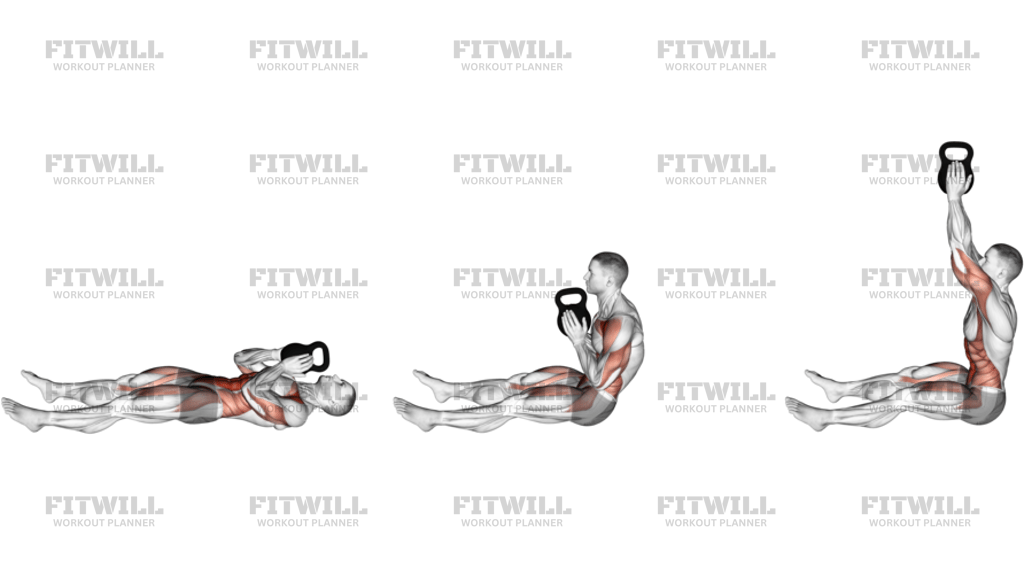
The image shows a kettlebell held close to the chest while the body rises from the floor, then pressed overhead once the torso is upright. That setup matters because the bell stays centered and manageable while the abs shorten through the sit-up, and the press happens only after the torso is stacked over the hips. If you rush either half, the exercise turns into a sloppy yank from the floor or a back-dominant press.
This is not a max-strength press and it is not a fast sit-up. It works best when each repetition is smooth, deliberate, and easy to repeat. Keep the ribs from flaring, let the pelvis stay heavy on the floor during the descent, and finish each rep with the bell directly over the shoulder, elbow locked, and the torso tall. The goal is control from the first inch off the floor to the last inch overhead.
Because the exercise blends two patterns, it can fit well as accessory work for general strength, core training, or conditioning sessions where quality matters more than load. It is especially useful when you want the abs to coordinate with the shoulder girdle instead of just burning through crunches. The lighter the bell, the cleaner the movement should look.
Use a range of motion you can own without jerking the bell, throwing the chest forward, or collapsing back to the floor between reps. If the press starts to drift behind the head or the sit-up needs momentum, the load is too heavy. Done well, Kettlebell Sit-Up Press builds strong midline control, better overhead positioning, and a more deliberate transition between the floor and seated position.
[ Workout Log & Planner ]
Put your next workout in Fitwill
Keep your plan and training log ready when you are.


Instructions
- Lie on your back on the floor with your legs extended and your feet relaxed, then hold the kettlebell close to your chest with both hands on the horns.
- Set your shoulders down and keep the bell centered over your sternum so it does not drift toward your face or one side.
- Brace your midsection, exhale lightly, and keep the ribs from flaring before you begin the sit-up.
- Press your feet into the floor only enough to keep your legs anchored while you roll your head, shoulders, and upper back off the ground.
- Continue the sit-up until your torso is tall and stacked over your hips, keeping the kettlebell tight to the chest as you rise.
- From the upright seated position, press the kettlebell straight overhead until your elbow locks out and the bell finishes over the shoulder.
- Lower the kettlebell back to the chest with control, then reverse the sit-up slowly until your back returns to the floor.
- Reset your breath and repeat for the planned number of repetitions without bouncing off the floor or using momentum.
Tips & Tricks
- Keep the kettlebell close to the chest during the sit-up so the long lever of a straight-arm raise does not pull you out of position.
- If the bell wobbles overhead, use a lighter load; the press should finish with the wrist, elbow, and shoulder stacked in one line.
- Do not yank your torso off the floor with a leg kick or chest thrust; the first part of the rep should still look like a controlled sit-up.
- Lower under control all the way back to the mat instead of dropping fast and rebounding into the next rep.
- Keep the chin slightly tucked so the neck does not lead the sit-up or crane toward the ceiling during the press.
- Exhale through the hardest part of the sit-up and press to help the ribs stay down and the torso stay organized.
- If the hip flexors take over and your low back arches, shorten the sit-up range or reduce the load.
- Stop the set when the bell no longer finishes directly over the shoulder or when your torso cannot stay tall at the top.
Frequently Asked Questions
What does Kettlebell Sit-Up Press work?
It mainly trains the abdominal wall and hip flexors through the sit-up, with the shoulders and triceps helping during the press.
Should the kettlebell stay at the chest during the sit-up?
Yes. Keeping the bell close to the chest makes the sit-up more controllable and makes the overhead press easier to balance.
How do I know if the press portion is too heavy?
If you cannot lock the bell out overhead without leaning back, twisting, or losing the stacked shoulder position, the load is too heavy.
Can beginners do this exercise?
Yes, but it should start very light so the sit-up and press both stay slow, smooth, and technically clean.
Why is my low back arching when I sit up?
That usually means the bell is too heavy, the descent is too fast, or the ribs are flaring as you try to muscle through the rep.
Do I need to keep my legs straight?
Straight legs match the pictured version and increase the demand on the abs, but a slight bend in the knees is fine if hamstring tension limits you.
What is the biggest mistake with this kettlebell movement?
The most common error is using momentum to pop up from the floor and then throwing the bell overhead instead of pressing it with control.
Where should the kettlebell finish at the top?
It should finish stacked over the shoulder with the elbow locked and the torso tall, not drifting behind your head.