Lateral Step-Up With Knee Drive
Lateral Step-Up With Knee Drive is a bodyweight lower-body exercise that builds strength, balance, and single-leg control through a sideways step onto a box or step. It places a clear demand on the thighs, glutes, and hip stabilizers while also asking the trunk to stay quiet as one leg supports the body and the other leg drives upward.
The lateral approach makes this exercise different from a straight-ahead step-up. Instead of simply climbing, you have to load the standing leg from the side, keep the pelvis level, and avoid letting the torso twist away from the working leg. That combination makes Lateral Step-Up With Knee Drive especially useful for athletes, recreational lifters, and anyone who wants better stair strength, knee control, and single-leg coordination.
Setup matters because the box height and foot placement decide whether the rep feels clean or awkward. Stand beside a low box with the foot closest to the step planted fully on top, the other foot on the floor, and your hips square to the front. Keep your chest tall, your ribs stacked over your pelvis, and enough space between the box and your standing leg that you can press straight through the foot without bumping the step.
Each rep should begin with pressure through the whole working foot, then a smooth drive up through the knee and hip. Stand up onto the box, finish tall through the support leg, and bring the opposite knee up to hip height without leaning back or yanking the leg forward. Pause briefly at the top, then lower the raised foot back down under control so the step-down is just as deliberate as the step-up.
Because this movement is mainly about control, it is a strong choice for warmups, accessory work, and unilateral strength blocks where clean mechanics matter more than loading heavy. It also teaches you how to own the descent, which is often where people lose position on stairs, box drills, and sport-specific lateral movements. If the box is too high, the knee drive turns into a hop or torso lean; if the box is appropriate, the standing leg does the work and the rep stays smooth.
Use Lateral Step-Up With Knee Drive when you want a simple but demanding drill that reinforces knee alignment, hip stability, and balanced lower-body force production. It should feel controlled from the first step onto the box to the final step back to the floor. When done well, it trains useful movement quality without needing external load, and it scales easily once your balance and position stay consistent.
[ Workout Log & Planner ]
Put your next workout in Fitwill
Keep your plan and training log ready when you are.


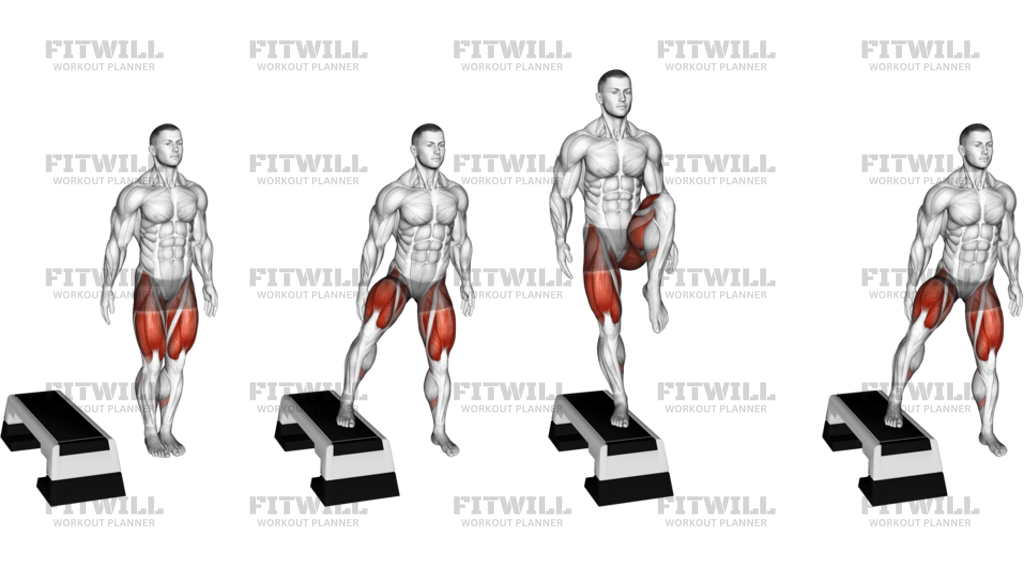
Instructions
- Stand beside a low box or step with the foot closest to it planted fully on top and the other foot resting on the floor.
- Square your hips to the front, keep your chest tall, and let both toes point mostly forward.
- Brace your core and shift your weight onto the foot that is on the box before you start the rep.
- Press through the whole foot on the box and step up sideways until the support leg is straight.
- Bring the opposite knee up to about hip height as you finish the step-up, without leaning your torso backward.
- Hold the top position for a beat so you are balanced on the working leg and the lifted thigh is under control.
- Lower the lifted foot back toward the floor slowly, keeping the knee of the support leg in line with the second toe.
- Reset with both feet stable, then repeat all reps on the same side before switching legs.
Tips & Tricks
- Pick a box height that lets you stand tall without hiking the hip or twisting the pelvis.
- Drive through the midfoot and heel of the foot on the box; if you feel the outside edge roll up, lower the step.
- Keep the floor leg light. It should help you balance, not spring you onto the box.
- The knee drive should come after the standing leg finishes extending, not at the same time as a hop.
- Pause at the top long enough to prove you are balanced on one leg before stepping back down.
- If your torso leans toward the step, reduce the box height and slow the ascent.
- Track the support knee over the second and third toes so it does not cave inward on the way up or down.
- Use a lower box before adding dumbbells or kettlebells; load should come after the side step is smooth.
Frequently Asked Questions
What muscles does Lateral Step-Up With Knee Drive work?
It mainly targets the thighs, especially the quads, while the glutes, hip stabilizers, and core help keep the body steady during the step and knee drive.
How high should the box be for Lateral Step-Up With Knee Drive?
Use a low box or step that lets you stand on top without losing hip level or leaning hard into the movement. If the knee drive turns into a hop, the step is probably too high.
Should the floor leg push me onto the box?
No. The foot on the box should do most of the work, and the floor leg should stay light so you are actually training the standing leg.
Why do I need to drive the knee up at the top?
The knee drive adds balance demand and hip flexion control, which makes the movement more athletic than a basic side step-up.
Can beginners do Lateral Step-Up With Knee Drive?
Yes, but start with a low step and no extra load. The goal is a smooth step-up, a clean knee drive, and a controlled step-down.
What is the most common mistake in this exercise?
Most people either push off the floor leg too much or let the torso twist away from the working side. Keep the hips square and let the box leg finish the rep.
Can I hold dumbbells during Lateral Step-Up With Knee Drive?
Yes, but add load only after you can keep the box leg stable and the knee drive quiet. Start light so the extra weight does not pull your shoulders or hips off line.
Is this different from a regular step-up?
Yes. The sideways approach changes the balance challenge and asks more of the hip stabilizers, so it feels less like a straight climb and more like a lateral control drill.