Incline Close-Grip Push-Up
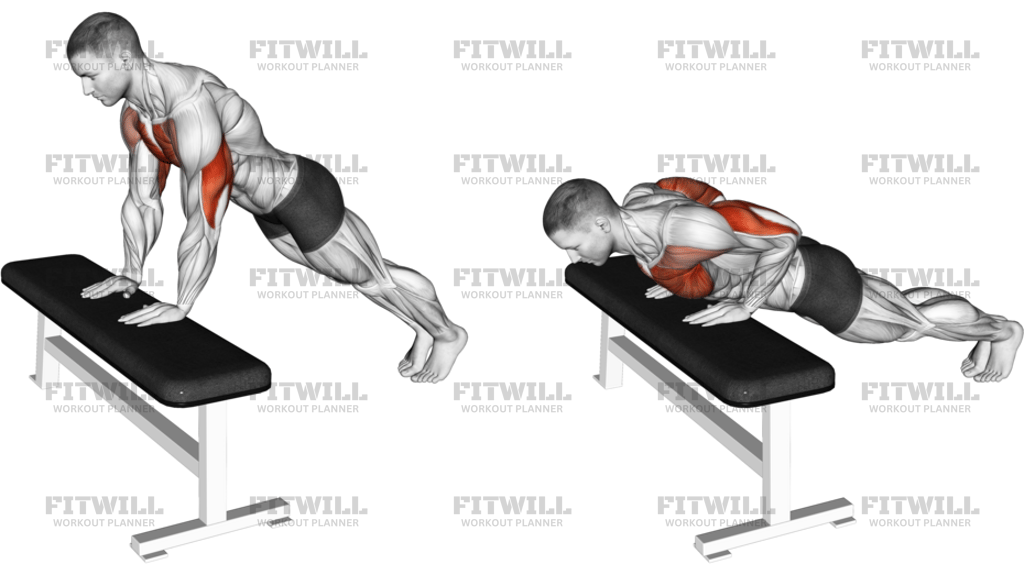
The Incline Close-Grip Push-Up is a body-weight pressing exercise performed with the hands on a bench or other elevated surface and the feet on the floor. The incline reduces the load compared with a standard push-up, while the close hand position shifts more of the work toward the triceps and keeps the pressing line compact. In the image, the hands are planted on the bench, the body stays in a straight line from head to heels, and the elbows track close to the ribs as the chest lowers toward the support.
This movement trains the chest, triceps, front delts, and core together, so it is useful when you want pressing strength without the full difficulty of a floor push-up. The primary technical driver is the Pectoralis major, with help from the Anterior deltoids, Triceps brachii, and Rectus abdominis. Because the hands are narrow and the upper body is slightly elevated, shoulder and wrist position matter more than with a wider, easier incline push-up. A stable setup keeps the shoulders from collapsing forward and helps the elbows travel in a controlled path instead of flaring out.
A good repetition starts with the bench height and foot distance. The higher the bench, the easier the exercise becomes; the lower the bench, the more body weight you have to press. Once the hands are set, step the feet back until the body forms one long line and the hips do not sag or pike. From there, lower under control until the chest is close to the bench, then press the body away by extending the elbows and keeping the shoulder blades controlled. The close grip should feel deliberate, not cramped; if the wrists or shoulders feel jammed, the hand spacing is too tight.
Use this exercise for general upper-body strength, pressing volume, or as a regression from a standard push-up when you want cleaner mechanics. It also works well in warmups and accessory blocks because it teaches scapular control, trunk stiffness, and coordinated pressing without needing external load. The best reps look smooth and repeatable: no bouncing off the bench, no head-first dipping, and no loss of line through the torso. If the set starts turning into a partial-range shrug or the hips begin to drop, the bench is too low or the set is too heavy for the current level.
For safety, keep the neck long, the ribs from flaring, and the wrists stacked under the shoulders or only slightly inside them. The exercise should feel like a controlled press from a rigid plank, not a loose dip or an aggressive dive toward the bench. That balance of incline support and close-grip pressing makes it a practical choice for building pressing capacity while keeping the movement clean and joint-friendly.
[ Workout Log & Planner ]
Put your next workout in Fitwill
Keep your plan and training log ready when you are.


Instructions
- Place both hands on a flat bench or box, fingers pointing forward, with the hands shoulder-width apart or slightly narrower.
- Step your feet back until your body forms a straight line from head to heels, then lock in a firm plank with your glutes and abs.
- Stack your shoulders over your hands and keep your wrists straight before you start the first rep.
- Inhale, then bend your elbows and lower your chest toward the bench while keeping your elbows tucked close to your ribs.
- Keep your torso rigid as you descend; do not let your hips sag or your head drop toward the bench first.
- Lower until your chest is just above the bench or lightly touches it without bouncing.
- Exhale and press through your palms to straighten your arms, driving your body away from the bench in one smooth line.
- Finish each rep with your shoulders controlled and your elbows fully extended but not hyperextended.
- Reset your foot position if your plank breaks, then continue for the planned number of repetitions.
Tips & Tricks
- A higher bench makes the movement easier; lower the bench only when you can keep the same straight-body line.
- Keep the elbows close to your ribs so the press stays triceps-heavy instead of turning into a wide chest push-up.
- If your wrists feel strained, move the hands a little wider rather than forcing an ultra-narrow grip.
- Think about bringing your chest toward the edge of the bench, not dropping your head between your hands.
- Keep the ribs down as you press; excessive arching usually means the core has lost tension.
- Use a slow lowering phase so you can control the bottom position instead of bouncing off the support.
- Stop the set when your hips start to sag or your shoulders roll forward past your hands.
- Keep your neck neutral and look slightly ahead of your hands rather than tucking the chin hard.
- For more load, slow the tempo or lower the bench before you try to add external weight.
Frequently Asked Questions
What muscles does the Incline Close-Grip Push-Up train?
It mainly trains the chest and triceps, with the front delts and core helping to stabilize the body.
Is the bench height important for this push-up?
Yes. A higher bench makes the exercise easier, while a lower bench increases the load and challenge.
Why are the hands placed close together?
The narrower hand position shifts more of the effort toward the triceps and keeps the pressing path tight and controlled.
How low should I go on each repetition?
Lower until your chest is close to the bench or lightly touches it, but do not bounce or collapse through the shoulders.
Can beginners use the Incline Close-Grip Push-Up?
Yes. It is often a good beginner pressing variation because the incline reduces body-weight load and makes the rep easier to control.
What is the most common form mistake?
Letting the hips sag or flaring the elbows wide usually turns the movement into a looser, less effective press.
What should I do if my wrists hurt on the bench?
Widen the grip slightly, keep the wrists stacked under the shoulders, and reduce the bench angle if the setup still feels uncomfortable.
How do I progress this exercise over time?
Lower the bench, slow the lowering phase, or add a pause near the bottom before you think about adding extra load.