Rear Shift Lunge From Deficit
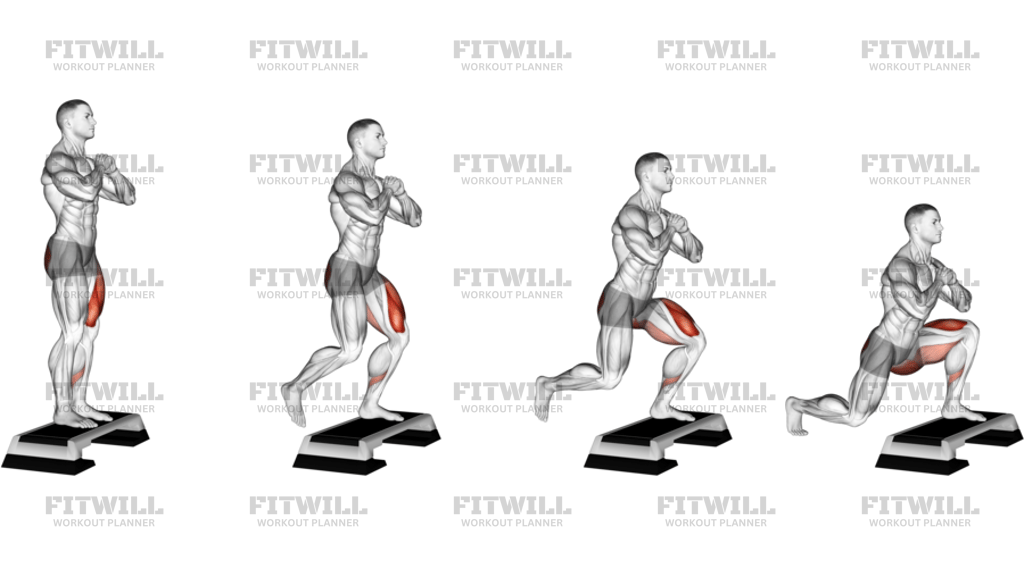
Rear Shift Lunge From Deficit is a bodyweight unilateral lower-body exercise that starts with the front foot on a low elevated surface and the rear foot on the floor behind you. The deficit changes the range of motion at the bottom of the lunge, so the front leg has to control more knee and hip flexion while the body stays balanced over a smaller base of support. That makes the movement useful for thigh-focused training, single-leg control, and clean lower-body mechanics.
The setup matters because the elevation changes how your weight shifts. Keep the front foot centered on the step or plate so the whole foot can stay planted, and place the rear foot far enough back that you can lower without crowding the hips. The image shows an upright torso with the hands held at the chest, which helps keep the trunk quiet while the legs do the work. A slight rearward shift of the hips loads the front leg without turning the rep into a forward tip.
Each repetition should descend under control until the rear knee approaches the floor and the front thigh gets a strong but manageable stretch. The front knee will travel forward as you lower, but it should stay lined up with the toes instead of collapsing inward. From the bottom, drive through the front heel and midfoot to stand back up without bouncing off the step or springing out of the bottom position. Breathing should stay rhythmic: inhale on the way down, exhale as you stand.
This exercise fits well in warm-ups, accessory blocks, and bodyweight leg sessions when you want a lunge pattern that is more demanding than a flat-floor reverse lunge. It is especially useful when you want more depth without adding external load right away. Start with a low deficit, slow tempo, and a smooth tempo before progressing height or resistance. If balance, knee comfort, or ankle mobility break down, shorten the stance or reduce the step height and keep every rep clean.
[ Workout Log & Planner ]
Put your next workout in Fitwill
Keep your plan and training log ready when you are.


Instructions
- Place your front foot fully on a low step or plate and set your rear foot on the floor behind you.
- Stand tall with your hands at your chest, hips square, and your front foot centered so the heel and toes stay grounded.
- Take a small rearward shift through the hips, then unlock both knees before descending.
- Lower straight down and slightly back until the rear knee approaches the floor and the front leg is working through a deep bend.
- Keep the front knee tracking over the second and third toes instead of letting it cave inward.
- Pause briefly at the bottom without bouncing or losing balance on the platform.
- Drive through the front heel and midfoot to stand back up to the starting position.
- Reset your balance at the top, then repeat for the planned repetitions before switching sides.
Tips & Tricks
- Start with a very low deficit; if the step is too high, the pelvis will tuck and the rear leg will lose room to move.
- Keep the front foot tripod planted on the step so the big toe, little toe, and heel all share pressure.
- Let the torso stay tall and stacked instead of folding forward to chase depth.
- A small rearward hip shift is enough; if you sit too far back, the front heel usually starts to lift.
- Do not tap the rear knee hard into the floor; stop just short of contact or use a soft, quiet touch.
- If the front knee caves inward, shorten the stance and slow the descent before adding more reps.
- Inhale as you lower and exhale as you stand to keep the trunk steady through the transition.
- Progress by adding a small amount of height or load only after every rep looks the same from the first to the last.
Frequently Asked Questions
What muscles does Rear Shift Lunge From Deficit train most?
It mainly challenges the front-leg quadriceps and glute, with the adductors, calves, and trunk helping to stabilize the elevated stance.
What makes this a lunge from a deficit?
Your front foot starts on a low step or plate, which increases the bottom range of motion compared with a flat-floor lunge.
How low should the rear knee go?
Lower until the rear knee is close to the floor and the front leg is working hard, but do not bounce out of the bottom.
Should my front knee stay behind my toes?
No. Some forward travel is normal on this setup, as long as the knee tracks over the toes and the heel stays down.
How high should the step be?
Use a low platform first. If the elevation is too high, balance and pelvis position usually break down before the legs are properly challenged.
Can I hold dumbbells with this lunge?
Yes, once the bodyweight version feels stable. Add load only if you can keep the front foot planted and the torso quiet.
Is this the same as a reverse lunge?
It uses the reverse-lunge pattern, but the elevated front foot changes the range of motion and usually makes the front leg work harder at the bottom.
What should I do if I feel this in my lower back?
Shorten the stance, reduce the deficit, and keep the ribs stacked over the pelvis so the movement stays in the hips and legs.
Can beginners do Rear Shift Lunge From Deficit?
Yes, if they start with a low step, slow tempo, and bodyweight only until each rep is balanced and controlled.