Bottle Weighted Halo
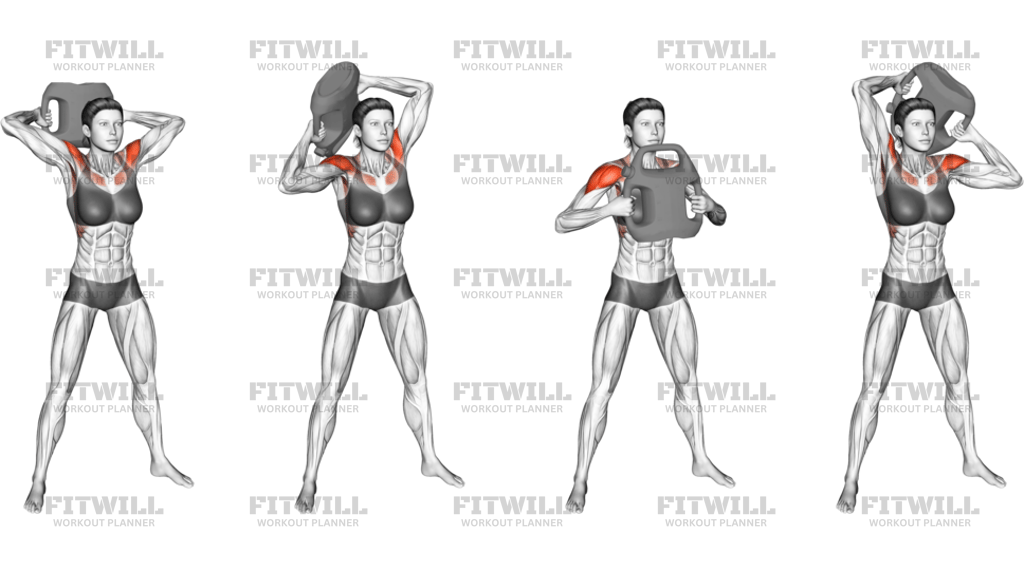
Bottle Weighted Halo is a standing shoulder-control exercise where you move a single weighted implement in a smooth circle around the head and return it to the front or chest. The image shows a tall stance with the weight held in both hands, elbows bent, and the load traveling close to the scalp and upper shoulders. That tight path matters because the exercise is meant to challenge shoulder mobility, upper-back control, and trunk stability at the same time.
It is not a power movement. The value comes from keeping the torso quiet while the shoulders guide the weight around the head. As the load passes beside one ear, behind the head, and up the other side, the scapulae and rotator cuff have to organize the motion without letting the ribs flare or the neck jut forward. A light to moderate load is usually enough; if the weight drifts far from the head, the set usually turns into a shrugging, back-bending compensation drill instead of a clean halo.
The setup is simple but important. Stand with your feet about hip to shoulder width, squeeze the weight securely with both hands, and start with it in front of the chest or just below chin height. From there, guide the implement around the crown of the head in a controlled circle, keeping the elbows slightly forward and the path close enough that you can see and feel the arc without bumping yourself. Finish the circle by bringing the weight back to the start position before beginning the next rep.
Use Bottle Weighted Halo as part of a warm-up, shoulder prep sequence, accessory block, or core-and-posture circuit. It is especially useful before pressing, overhead work, throwing, or any session where you want the shoulders to feel organized and mobile. The exercise should feel smooth and deliberate, with no jerking at the transitions and no strain in the neck or low back.
If the movement feels pinchy, shorten the circle and lower the load. The best repetitions are the ones that stay controlled from one side of the head to the other, with steady breathing and a stable stance throughout.
[ Workout Log & Planner ]
Put your next workout in Fitwill
Keep your plan and training log ready when you are.


Instructions
- Stand tall with your feet about hip to shoulder width and hold the weight with both hands in front of your upper chest.
- Keep your ribs stacked over your pelvis, chin neutral, and elbows slightly forward before you start the circle.
- Brace your midsection and keep the weight close to your face as you guide it toward one shoulder.
- Circle the implement behind the head without tipping the torso or letting the elbows flare way out.
- Bring the weight around the other side of the head in the same tight path, staying smooth and symmetrical.
- Return the weight to the front of the chest under control before starting the next rep.
- Breathe steadily through the full circle and avoid holding your breath as the load passes behind your head.
- If the path gets messy, stop the rep, reset your posture, and make the next circle smaller.
Tips & Tricks
- Start with a very light load; the goal is smooth shoulder control, not brute strength.
- Keep the circle close to your head so the shoulders work without your lower back taking over.
- Let the elbows stay bent and slightly forward instead of forcing a wide, straight-arm arc.
- If you feel your ribs popping up, shorten the range and slow the rep down.
- A clean halo usually looks the same on both sides; if one side is harder, use that as your form check.
- Move the weight slowly enough that you could stop it at any point in the circle.
- Keep your neck long and relaxed so the implement clears the head without you reaching your chin forward.
- Use this before pressing or overhead work when your shoulders feel stiff and need controlled motion.
Frequently Asked Questions
What does Bottle Weighted Halo train most?
It mainly trains shoulder control and mobility, with extra work from the upper back, arms, and trunk.
What should the weight do during a halo rep?
The weight should travel in a tight circle around the head and return to the front without banging the skull or drifting far away.
How heavy should the implement be?
Use a light load that lets you keep the circle smooth and close to your head; if you have to lean or shrug, it is too heavy.
Can beginners do this exercise?
Yes, beginners can usually do it well with a very light plate, bottle-style weight, or other easy-to-control implement.
Why do my ribs flare during the halo?
That usually means the circle is too big or the load is too heavy. Shorten the path and keep your pelvis and rib cage stacked.
Should my elbows straighten during the movement?
No. Keeping a soft bend helps the circle stay controlled and keeps the load close enough for good shoulder mechanics.
What is a common mistake with Bottle Weighted Halo?
The biggest mistake is turning it into a fast, swinging movement that arches the lower back and shrugs the shoulders.
When is this exercise most useful?
It works well in a warm-up, shoulder prep sequence, or accessory circuit before pressing, overhead work, or upper-body training.