Ardha Matsyendrasana Yoga Pose
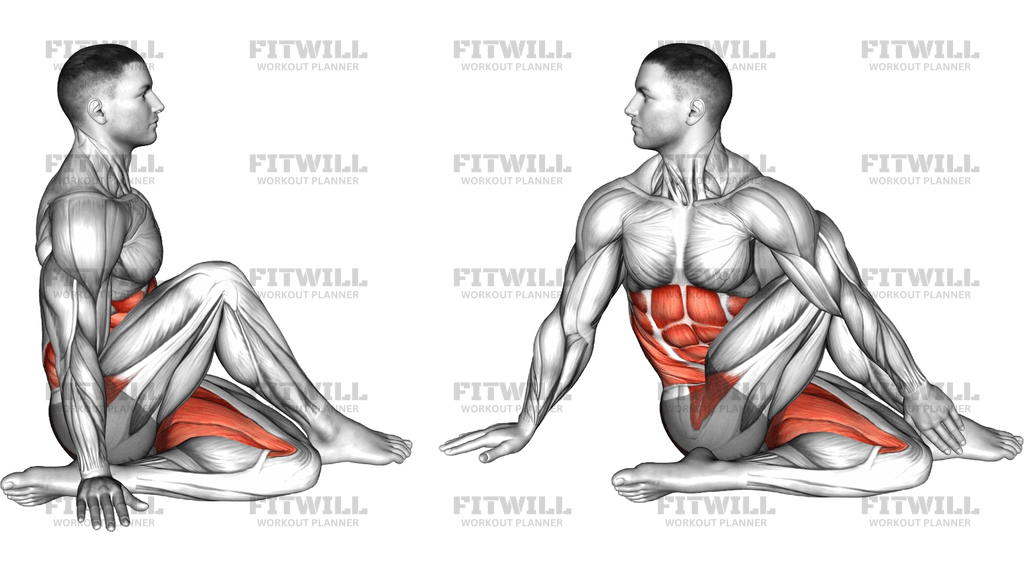
Ardha Matsyendrasana, often called Half Lord of the Fishes or the seated half spinal twist, is a classic yoga posture performed entirely on the floor with no equipment beyond a mat. You sit with one leg folded underneath and the other foot crossed over the outside of the opposite thigh, then rotate the spine toward the top knee while one hand grounds behind the hip and the opposite arm braces against the raised knee. The result is a deep rotational stretch that travels from the base of the spine up through the ribcage.
This pose is especially useful for people who spend long hours sitting at a desk or driving. Prolonged sitting tends to stiffen the mid back and shorten the hip rotators, and a seated twist addresses both areas at once. It also features in most yoga sequences as a counter-pose after backbends or forward folds, because rotation helps reset the spine between more linear movements.
The primary work happens in the obliques and deep spinal rotators, which lengthen on one side and contract on the other during the twist. The crossed-over leg places a strong stretch through the glutes and outer hip of the top leg, while the folded bottom leg opens the hip and knee in a different plane. The supporting arm holds you upright, so the shoulders and upper back stay quietly engaged throughout.
Setup matters more than most people expect. Your sit bones need to stay reasonably even on the floor before you twist; if one hip collapses, the rotation happens in the low back or the knee instead of the spine. Sit on the edge of a folded blanket if your hips are tight, and build the twist from the bottom up: lengthen the spine first, then rotate, and only then deepen with the arms.
Execution should feel like a spiral rather than a wrench. Inhale to grow taller through the crown of the head, exhale to rotate a little further, and let the breath repeat that cycle for several rounds. The gaze follows the twist only as far as the neck rotates comfortably.
Common mistakes are forcing the knee down, cranking on the neck, or rounding the back to appear more twisted. A modest, honest rotation with a long spine delivers far more benefit than an aggressive pull. Anyone with a recent back injury or significant knee problems should work with a qualified teacher before holding this pose for long periods.
[ Workout Log & Planner ]
Put your next workout in Fitwill
Keep your plan and training log ready when you are.


Instructions
- Sit on a mat with your legs extended in front of you and your sit bones grounded evenly.
- Bend your left knee and draw your left foot in so it rests on the floor outside your right thigh, sole down; tuck your right leg so the right heel sits near your left hip with the right knee pointing forward.
- Place your right hand on the floor behind your right hip and rest your left hand on your left knee to stabilize before twisting.
- Inhale and lengthen your spine, sitting as tall as you can so the twist will happen through the ribs and mid back rather than by rounding.
- Exhale and rotate your torso to the left, leading with your chest and ribs, keeping both sit bones heavy on the mat.
- Bring your left arm across so the outside of your left upper arm or elbow presses against the outside of your left knee, and use that contact to turn slightly deeper — do not shove the knee back with a straight, locked arm.
- Turn your head gently to the left, looking over your shoulder only as far as the neck moves freely.
- Hold for five to eight slow breaths, lengthening the spine on each inhale and rotating a fraction deeper on each exhale.
- Release on an inhale by unwinding from the top down, returning to center with both legs extended, then repeat the full sequence on the other side.
Tips & Tricks
- If your hips are tight and your pelvis tips backward, sit on a folded blanket or yoga block so the twist starts from a level pelvis instead of a rounded lower back.
- The most common error is pushing the raised knee toward the floor with a locked arm, which collapses the chest — bend the elbow and let the arm act as a brace, not a lever.
- Keep the weight even between both sit bones; if the hip under the raised knee lifts as you twist, back off the rotation slightly and re-ground first.
- Think of twisting from the ribcage, not the neck — the head turns last and adds only a small amount to the total rotation.
- Do not force the folded bottom knee toward the floor; it should rest wherever the hip allows, and padding under that knee helps if it hovers.
- If your hamstrings or low back grip during the hold, ease the twist back to about 70 percent of your maximum and focus on slow breathing instead of depth.
- The bottom supporting hand should press lightly to help you sit tall, not carry your torso weight — if you feel collapsed onto that arm, reduce the twist and lift the chest.
- Alternate sides with equal time even when one side feels tighter, so you do not build a rotational imbalance.
- Avoid bouncing or pulsing deeper into the twist; Ardha Matsyendrasana responds best to long, steady holds with the breath.
Frequently Asked Questions
Which muscles does Ardha Matsyendrasana stretch the most?
The obliques and deep spinal rotators take the main stretch, with strong work through the glutes and outer hip of the crossed-over leg. The lower back and chest also lengthen as the ribcage rotates.
Is Ardha Matsyendrasana suitable for beginners?
Yes, the seated half twist is accessible to most beginners. Sit on a folded blanket if the hips are tight and keep the rotation modest — depth will come with practice.
Why does my raised knee keep sliding forward in Ardha Matsyendrasana?
That usually means the opposite arm is straight and pushing rather than bracing. Bend the elbow, hug the knee with the upper arm, and initiate the turn from the ribs instead.
Should both sit bones stay on the floor during Ardha Matsyendrasana?
Ideally yes, because an even pelvis lets the twist travel up the spine instead of collapsing into the low back. If one hip lifts, elevate the hips on a blanket and ease off the rotation.
How long should I hold Ardha Matsyendrasana?
Five to eight slow breaths per side works well for most practitioners. Hold longer, up to a minute, if you are using it as a hip and spine mobility session.
Can Ardha Matsyendrasana help with stiff hips from sitting all day?
It is one of the better seated choices for that, since the crossed-leg position targets the glutes and hip rotators while the twist mobilizes the mid back. Keep the hold comfortable rather than forcing depth.
Is it safe to do Ardha Matsyendrasana with a knee injury?
Be cautious — the folded leg places the knee in deep flexion with rotation at the hip. If you feel any knee discomfort, straighten the bottom leg and twist toward the bent knee only, or skip the pose until cleared.
What can I use instead of Ardha Matsyendrasana if the seated position is uncomfortable?
A supine spinal twist, where you lie on your back and drop one knee across the body, offers a similar rotation with far less demand on the hips and knees.
Should I breathe in a particular way while holding Ardha Matsyendrasana?
Yes — inhale to lengthen the spine and exhale to rotate a little deeper. This rhythm keeps the twist gradual and prevents you from forcing the rotation.
Why does one side of Ardha Matsyendrasana feel much tighter than the other?
Most people have a natural rotational asymmetry from daily habits like driving or always crossing the same leg. Spend equal time on both sides rather than chasing depth on the easy side.