Sphinx Pose Twist
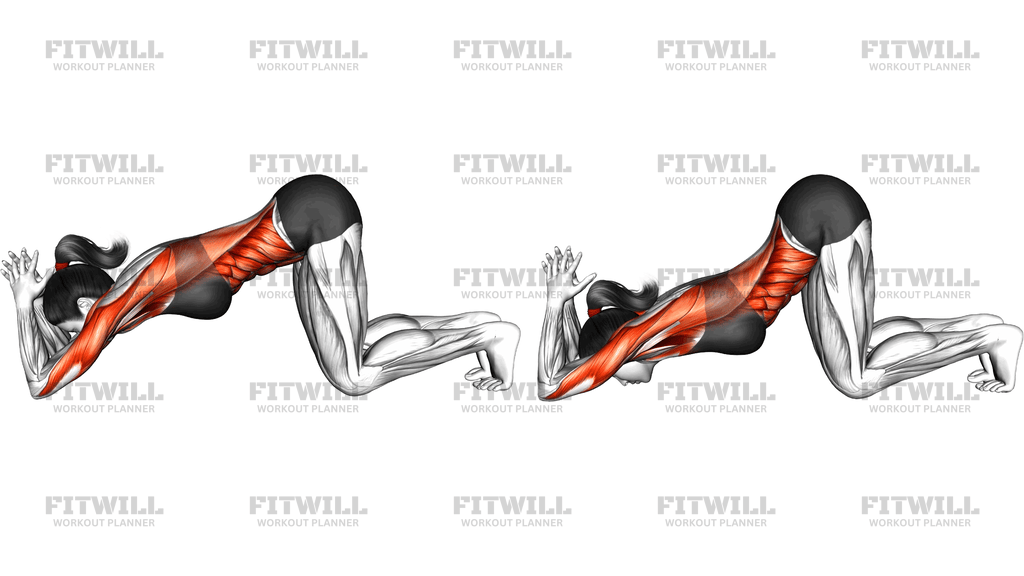
Sphinx Pose Twist is a prone mobility drill that starts from the classic sphinx position — lying face down with your forearms flat on the floor and your chest lifted — and adds a rotational reach with one arm. From the supported sphinx setup, you sweep one arm out to the side and up toward the ceiling, letting your torso rotate open while the opposite forearm stays planted. The result is a combined backbend and thoracic rotation that opens the chest and shoulders while gently loading the lower back through extension.
This movement is useful for anyone who sits for long hours, since prolonged sitting tends to lock up the mid back and shorten the hip flexors and abdominals. It is a common fixture in yoga sequences, warm-ups before pressing or overhead days, and cool-downs after heavy lifting. Because your forearms support most of your upper body, the extension is self-regulated — you can stay low and mild or press taller for a deeper stretch.
The twist component is where the exercise earns its place in a routine. Rotating open from a backbend stretches the obliques and the tissues along the front of the torso, while the stabilizing side's shoulder, upper back, and core work to keep you from simply collapsing toward the floor. The moving arm reaching toward the ceiling encourages full shoulder flexion, which many people lack from desk work.
Setup matters more than it looks. Placing your elbows directly under your shoulders and keeping your hips heavy on the mat determines whether the extension stays in the spine or turns into lower back compression. If your elbows drift forward, you lose the lift; if your hips hike up, you lose the stretch. A consistent, deliberate setup gives you the same reliable position every rep.
Execution should feel like a slow unwinding rather than a forced crank. Let the arm lead, let the eyes follow the hand, and let the torso rotate as far as it wants to — the range will improve over weeks, not minutes. Breathe steadily throughout, and ease back to center before switching sides so the spine returns through the same controlled path it traveled out.
Most people can do Sphinx Pose Twist safely with just body weight on a mat. The main cautions are the usual ones for spinal extension: if you feel pinching in the lower back rather than a stretch, reduce your elbow height and keep the hips grounded. Move smoothly, never bounce, and treat the top position as a place to breathe, not a position to force.
[ Workout Log & Planner ]
Put your next workout in Fitwill
Keep your plan and training log ready when you are.


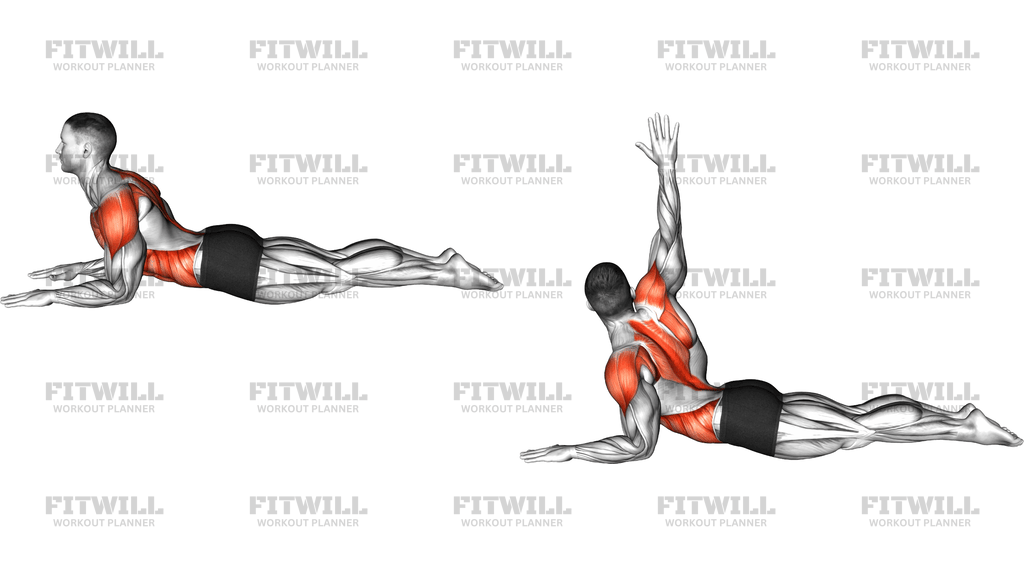
Instructions
- Lie face down on an exercise mat with your legs extended straight behind you and the tops of your feet resting on the floor.
- Prop yourself up onto both forearms so your elbows sit directly under your shoulders, forearms parallel and palms flat on the mat.
- Draw your shoulders down away from your ears and press the floor away lightly so your chest lifts into a supported backbend, hips staying heavy on the mat.
- Brace your core gently and keep your legs relaxed but long, with the fronts of your thighs and hips settling toward the floor.
- On an exhale, sweep your top-side arm out to the side and reach it up toward the ceiling, rotating your torso open as the arm travels.
- Follow your hand with your eyes and let your body rotate until you feel a stretch across your chest, obliques, and front of the shoulder, holding the top position for a breath or two.
- Keep the opposite forearm planted and your hips down — do not let the supporting shoulder shrug up toward your ear.
- Slowly lower the reaching arm and rotate back through the same path to the center sphinx position, controlling the descent rather than dropping.
- Inhale as you return to center, then repeat the twist on the other side, continuing to alternate for your desired number of repetitions.
- To finish, lower your chest and forehead toward the mat or press back to a child's pose position to reset your spine.
Tips & Tricks
- If you feel pinching in the lower back, walk your elbows slightly forward and reduce how high you press the chest — extension should feel like a lengthening, not a jam.
- A common mistake is letting the hips twist and hike off the mat as the arm reaches up; keep the hip on the reaching side heavy so the rotation comes from the upper back.
- Do not force the reaching arm straight toward the ceiling — if your shoulder limits you, let the arm hover at an angle overhead until range improves.
- Keep the supporting shoulder active by pressing the forearm into the floor; letting it collapse makes the twist feel unstable and shortens the stretch.
- Lengthen through the crown of the head rather than craning the neck back — the eyes follow the hand, but the neck stays long.
- Move with the breath: reach on the exhale, return on the inhale. Rushing the rotation is the usual reason people lose the end-range stretch.
- If your forearms want to slide, press the pinky edges of your hands into the mat for a more secure base on the supporting side.
- Tight quads and hip flexors can pull your posture out of line; a small towel pad under the hip points or a slightly wider foot stance can make the hold more comfortable.
- Treat this as a warm-up or cool-down drill, not a strength set — a few slow reps per side with brief holds beats cranking out fast repetitions.
Frequently Asked Questions
Which muscles and areas does Sphinx Pose Twist work on?
It primarily stretches the lower back, chest, obliques, and front of the shoulders, while the supporting forearm and planted-side upper back and core stabilize you. The extension also lightly engages the erector spinae along the spine.
Is Sphinx Pose Twist suitable for beginners?
Yes — you control the depth entirely through how high you press your chest and how far you rotate. Beginners can keep the reach modest and the elbow height low and still get a useful stretch.
How far should my reaching arm rotate toward the ceiling?
Only as far as it travels without your hips lifting or your shoulder shrugging. Many people start with the arm angled overhead rather than vertical, and the range naturally improves with practice.
Why do my hips keep lifting off the mat during the twist?
That usually means the rotation is coming from the lumbar spine instead of the upper back. Slow the reach down, keep the reaching-side hip heavy, and focus on rotating the ribcage open rather than swinging the arm quickly.
Can I do Sphinx Pose Twist if I have lower back discomfort?
Prone backbends are often tolerated, but reduce the range, keep your elbows further forward, and stay well inside a pain-free stretch. If discomfort sharpens or radiates, stop and consult a qualified professional before continuing.
When is the best time to include this exercise in a workout?
It works well as a warm-up before pressing or overhead movements and as a cool-down after heavy lower body or back training. The gentle extension helps offset time spent sitting or rounded over a desk.
How long should I hold each twist?
One to three calm breaths at the top of each reach is enough, alternating sides. For a deeper cool-down version, hold 20 to 30 seconds per side with slow breathing.
What can I use as a substitute if lying on my stomach is uncomfortable?
Try a standing or kneeling open-book style rotation, or the classic quadruped thoracic rotation, both of which train the same chest-opening twist without prone extension.
Should I feel this in my lower back or my chest?
The strongest sensation is usually across the chest, front of the shoulder, and obliques on the reaching side, with a mild working stretch through the lower back from the extension. Sharp or pinching low back sensation means you are extending too aggressively.
Do I need any equipment for Sphinx Pose Twist?
Just an exercise mat or another cushioned surface for your forearms, hips, and the tops of your feet. No additional equipment is required.