Bodyweight Low Split Squat
Bodyweight Low Split Squat is a bodyweight lower-body exercise that loads the front leg hard while the back leg acts mostly as a balance and range-of-motion aid. The long stance and deep bottom position make it especially useful for building quad strength, glute control, adductor stability, and single-leg coordination without the setup demands of a rack or machine.
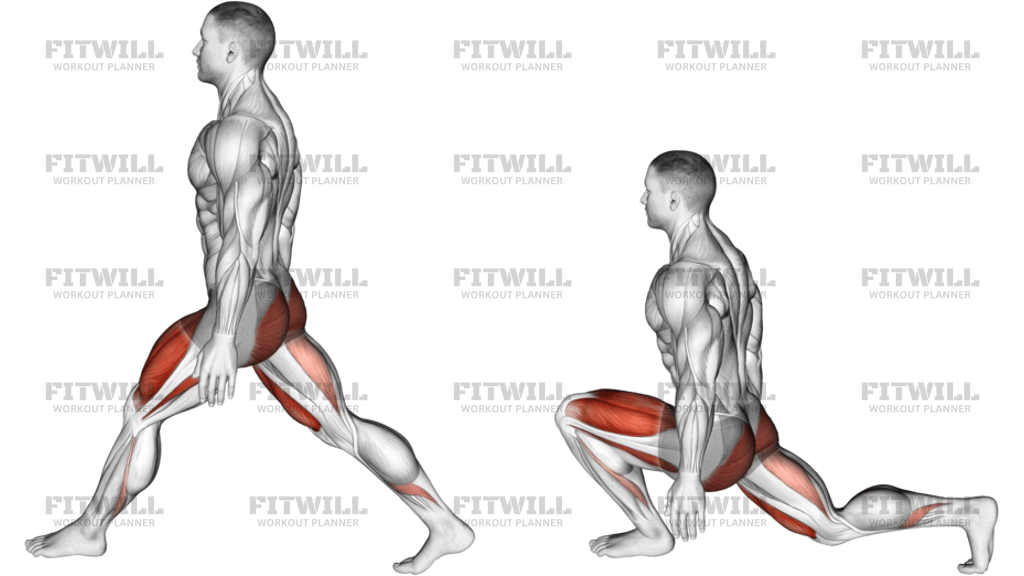
The movement looks simple, but the setup changes everything. A short stance turns it into a cramped knee-dominant squat; a very long stance can shift the work away from the front leg and stress the hips or low back. In the image, the torso stays tall, the front foot stays flat, and the back knee drops close to the floor so the front thigh can work through a deep, controlled range.
Use the exercise to strengthen one leg at a time, clean up asymmetries, and build tolerance for split stance work that carries over to lunges, step-ups, sports positions, and everyday deceleration. Because the rear leg is not driving the rep, the front heel, knee, and hip should do the majority of the work while the pelvis stays level and the trunk stays stacked over the hips.
Good reps are slow enough that you can keep the front knee tracking over the toes, the back knee hovering or lightly touching the floor, and the torso from folding forward. Lower under control, pause briefly if needed to own the bottom, then press through the front foot to stand back up without bouncing off the floor or letting the hips twist open.
This is a strong accessory or warm-up strength drill for beginners and experienced lifters alike, especially when you want single-leg work with minimal equipment. Keep the range pain-free, choose a stance that lets you stay balanced, and stop the set once the front knee caves in, the pelvis shifts, or the back leg starts to take over the rep.
[ Workout Log & Planner ]
Put your next workout in Fitwill
Keep your plan and training log ready when you are.


Instructions
- Stand in a long split stance with your front foot flat, your back heel lifted, and both feet pointed mostly straight ahead.
- Keep your torso tall, your ribs stacked over your pelvis, and your hands at your sides or lightly on your hips for balance.
- Lower straight down by bending both knees until the back knee comes close to the floor and the front thigh reaches a deep split-squat position.
- Keep the front heel planted and let the front knee travel in line with the second or third toe instead of collapsing inward.
- Pause briefly at the bottom if needed to keep the position controlled and avoid bouncing off the floor.
- Drive through the front foot to stand back up, finishing with the front hip and knee extended while the torso stays tall.
- Keep the back leg passive on the way up so the front leg does the majority of the work.
- Inhale on the way down, exhale as you stand, and reset your stance before each repetition if balance changes.
Tips & Tricks
- Choose a stance length that lets the front heel stay down and the torso stay upright at the bottom.
- If the front knee slides too far forward and the heel lifts, move the feet slightly farther apart front to back.
- Keep the pelvis level; a hip shift toward the front leg usually means you are losing balance or shortening the back side too much.
- A light tap of the rear knee on the floor is fine, but do not crash into the bottom position.
- Think about pushing the floor away with the front foot instead of pulling yourself up with the back leg.
- Let the front knee track over the toes rather than forcing it to stay frozen behind the ankle.
- Use a slow lowering phase so the front quad and glute stay loaded instead of using momentum to drop into the bottom.
- If balance is the limiter, shorten the range slightly or hold onto a rack post with one hand while you learn the pattern.
Frequently Asked Questions
What does the Bodyweight Low Split Squat train most?
It strongly trains the front-leg quads and glutes, with the adductors and core working hard to keep you stable.
How is this different from a regular lunge?
Your feet stay planted in a split stance the whole time, so the rep is more of a vertical up-and-down squat pattern than a step.
Should my back knee touch the floor?
It can lightly tap the floor if that helps you control depth, but do not slam into it or relax at the bottom.
Why does the front heel need to stay down?
A planted front heel keeps the front leg loaded and helps you press through the quad and glute instead of shifting everything into the toes.
What is a common mistake in this exercise?
The most common error is leaning forward and turning it into a balance drill, which takes tension off the front leg.
Can beginners use the Bodyweight Low Split Squat?
Yes. It is a good starting point as long as the stance is comfortable and you can keep the torso tall and the knees controlled.
How deep should I go?
Go as deep as you can while keeping the front heel down, the torso stacked, and the front knee tracking cleanly over the toes.
How can I make it easier?
Shorten the depth, widen the stance slightly for balance, or hold a support with one hand until you can control the full split squat.