Resistance Band Side Plank Glute Raise
Resistance Band Side Plank Glute Raise is a side-plank hip stability exercise that combines an anti-rotation hold with a band-resisted leg lift. The setup in the image shows the body supported on one hand and one forearm-side line, with the lower body stacked and a loop band placed around the lower legs. From that position, the top leg lifts away against the band while the torso stays long and the hips stay controlled.
This movement is useful when you want more than a basic side plank. It asks the obliques to keep the trunk from folding or twisting while the glute medius and outer hip on the working side create the lift. That makes it a practical accessory for athletes, runners, and anyone who needs better pelvic control, single-leg stability, and side-chain endurance.
The key to the exercise is not height, but position. A clean repetition keeps the shoulder stacked over the support hand, the bottom hip lifted, the ribs drawn in, and the pelvis from rolling backward as the top leg opens. The band adds tension that makes cheating obvious: if the torso twists or the hip drops, the movement becomes easier to spot and harder to benefit from.
Use a band that lets you move the leg smoothly without losing the side plank. If the lift turns into a shove, the band is too heavy or the plank is too difficult for your current strength. Short, controlled sets work well here because form tends to break once the shoulder, waist, or outer hip gets tired. Reset fully between reps if needed so each lift starts from the same stacked position.
[ Workout Log & Planner ]
Put your next workout in Fitwill
Keep your plan and training log ready when you are.


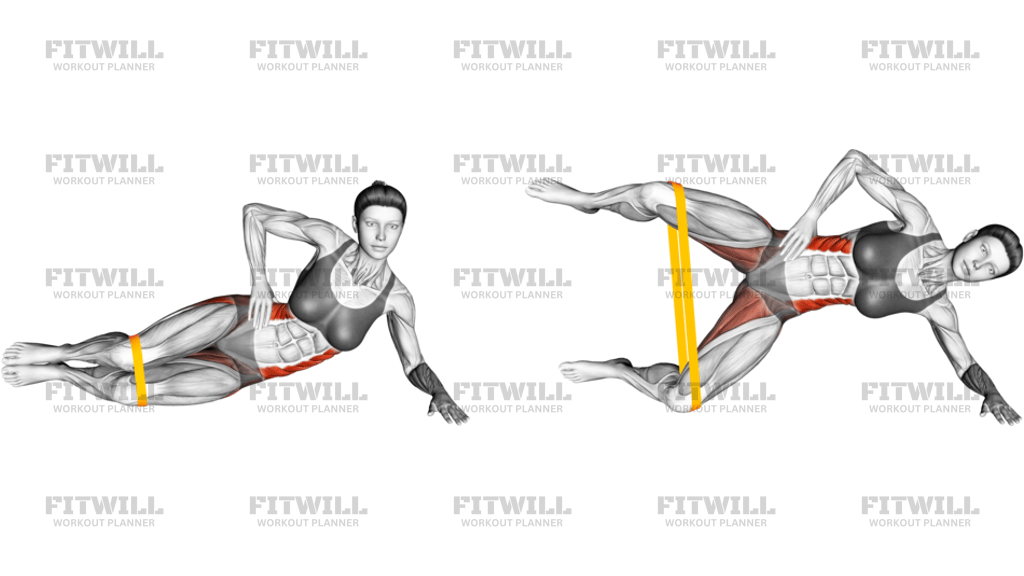
Instructions
- Place a loop resistance band around your lower legs or ankles and lie on your side with your lower elbow or hand under the shoulder, legs stacked, and feet slightly in front of the hips.
- Press the floor away, lift into a strong side plank, and keep the shoulders, ribs, and hips stacked in one line before you move the top leg.
- Set the top hand on your hip or reach it overhead if you can keep the torso steady; keep the neck long and the lower body braced.
- From the stacked plank, lift the top leg upward against the band until you feel the outer hip work without letting the pelvis roll backward.
- Keep the standing leg and support arm firm so the movement comes from the hip, not from swinging the whole body.
- Lower the top leg slowly until the band tension is still present and both legs are close to the start position.
- Exhale during the lift and inhale as the leg lowers, maintaining a steady side-plank brace the entire time.
- Finish the set by lowering the hips to the floor and removing the band only after you are out of the plank position.
Tips & Tricks
- Place the band low on the legs so the tension increases as the top leg opens, but not so high that it slips during the plank.
- Stack the shoulder directly over the supporting wrist or elbow; drifting forward or back makes the side plank less stable.
- Keep the rib cage pulled down instead of flaring open, or the lift will come from spinal rotation instead of the outer hip.
- Think about moving the top leg a small, clean distance rather than chasing a huge range that twists the pelvis.
- If your lower waist sags, shorten the set or raise the bench of support before the hip lift gets sloppy.
- Use a slower lowering phase to keep tension on the glute medius and to prevent the band from snapping the leg back together.
- Point the top toes slightly forward or neutral so the hip works through the lift instead of letting the thigh roll outward.
- Stop when the shoulder starts to shake or the body starts rocking; this exercise is about stacked control, not fatigue chasing.
Frequently Asked Questions
What does the Resistance Band Side Plank Glute Raise train most?
It mainly trains the outer hip on the working side, along with the obliques and shoulder that hold the side plank in place.
Where should the resistance band sit?
The band should wrap around the lower legs or ankles so it challenges the top leg without forcing you out of the side-plank stack.
Should my body stay straight during the lift?
Yes. Keep the shoulder, ribs, and hips stacked so the leg moves independently instead of the trunk twisting with it.
How high should I raise the top leg?
Lift only as high as you can without rolling the pelvis backward or letting the waist collapse; a smaller clean lift is better.
What is the most common mistake in this exercise?
The usual mistake is turning it into a twisting side plank with a big swing instead of a controlled hip-abduction lift.
Can I do this exercise if my side plank is weak?
Yes, but start with a short hold, a lighter band, or a modified side plank so you can keep the torso stacked.
Is this more of a glute or core exercise?
It is both: the glute medius drives the leg lift while the core and shoulder keep the side plank steady.
How do I make the exercise harder without losing form?
Use a stronger band, slow the lowering phase, or add a longer pause at the top while keeping the pelvis and ribs locked in place.