Dumbbell Standing Scapular External Rotation
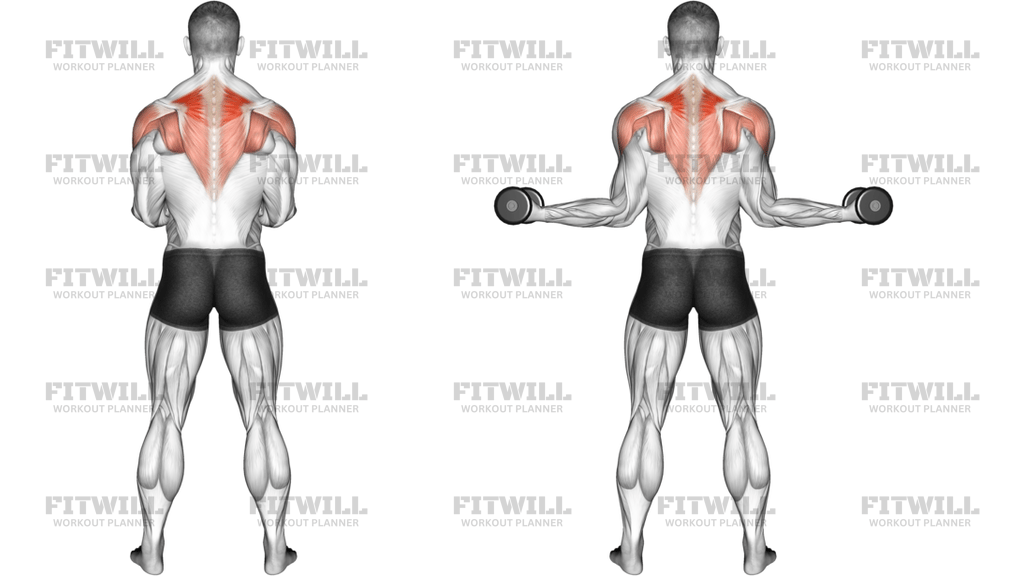
Dumbbell Standing Scapular External Rotation is a standing shoulder-accessory movement performed with light dumbbells, elbows pinned close to the sides, and the forearms rotating outward under control. The exercise is small and deliberate on purpose: it asks you to keep the upper arms quiet while the shoulder joint does the work, which makes it useful for teaching cleaner scapular and rotator-cuff control.
The setup matters more here than it does in many larger lifts. If the ribs flare, the elbows drift away from the torso, or the shoulders shrug up toward the ears, the movement stops being a focused external-rotation drill and turns into a loose upper-body compensation pattern. A stacked torso, quiet neck, and fixed elbow position let the back of the shoulder work without borrowing motion from the spine or traps.
Done well, this exercise trains the small stabilizers around the shoulder, especially the external rotators and the muscles that help keep the scapula organized while the arm moves. That makes it a useful warm-up, accessory, or prehab-style movement before pressing, pulling, or overhead work. Because the lever is long and the target muscles are small, the right load is usually lighter than people expect.
On each repetition, rotate the forearms outward smoothly, pause briefly in the open position, and lower back under control without letting the elbows leave the ribs. The movement should feel precise rather than explosive, with the breath staying calm and the torso staying still. If the range is painful or the shoulders feel pinchy, shorten the arc, lighten the dumbbells, or stop the set and reassess the setup.
[ Workout Log & Planner ]
Put your next workout in Fitwill
Keep your plan and training log ready when you are.


Instructions
- Stand tall with the dumbbells in each hand, elbows bent to about 90 degrees, and upper arms tucked close to your sides.
- Set your feet about hip-width apart and stack your ribs over your pelvis without leaning back or forward.
- Let your shoulders settle down, then keep the neck long and relaxed before you start the first rep.
- Keep both elbows pinned to your torso and begin with the forearms in front of your body, close to the midline.
- Rotate the forearms outward until the dumbbells move away from the stomach and line up with the sides of your body.
- Pause for a brief moment at the open position while the elbows stay fixed to your ribs.
- Bring the forearms back in slowly, stopping before the shoulders roll forward or the elbows drift.
- Breathe out as you rotate open, breathe in as you return, and repeat for the planned reps.
Tips & Tricks
- Choose very light dumbbells; this is a small-joint drill, not a strength test.
- If your elbows leave your ribs, the load is too heavy or the range is too big.
- Keep the wrists neutral so the dumbbells do not bend the forearms into a cocked-back position.
- Stop the rep before the shoulders shrug upward toward the ears.
- Think about rotating from the shoulder, not swinging the hands away from the body.
- Use a slower return than the outward phase so the rotator cuff has to control the load.
- Keep the ribcage quiet; arching the lower back usually means you are compensating for poor shoulder control.
- Work only in a pain-free range and shorten the motion immediately if the front of the shoulder pinches.
Frequently Asked Questions
What muscles does Dumbbell Standing Scapular External Rotation train?
It mainly trains the external rotators of the shoulder and the stabilizers that keep the scapula organized during arm rotation.
Can beginners perform this exercise?
Yes. Beginners usually do best with very light dumbbells and a short, strict range of motion.
Should my elbows move away from my sides?
No. Keep the upper arms pinned to the torso so the forearms do the rotating.
Where should I feel the exercise?
You should feel it around the back and side of the shoulder, not in the neck or lower back.
How heavy should the dumbbells be?
Light enough that you can keep the elbows glued to your sides and move without shrugging or twisting.
Is this the same as band external rotation?
The arm action is similar, but dumbbells make grip and forearm control more demanding because the load hangs below the hand.
What is the most common mistake with this movement?
Most people turn it into a shrug or a torso sway instead of a clean shoulder rotation.
What should I do if the front of my shoulder feels pinched?
Reduce the range, drop the load, and reset the elbow position; if the pinch stays, stop the set.