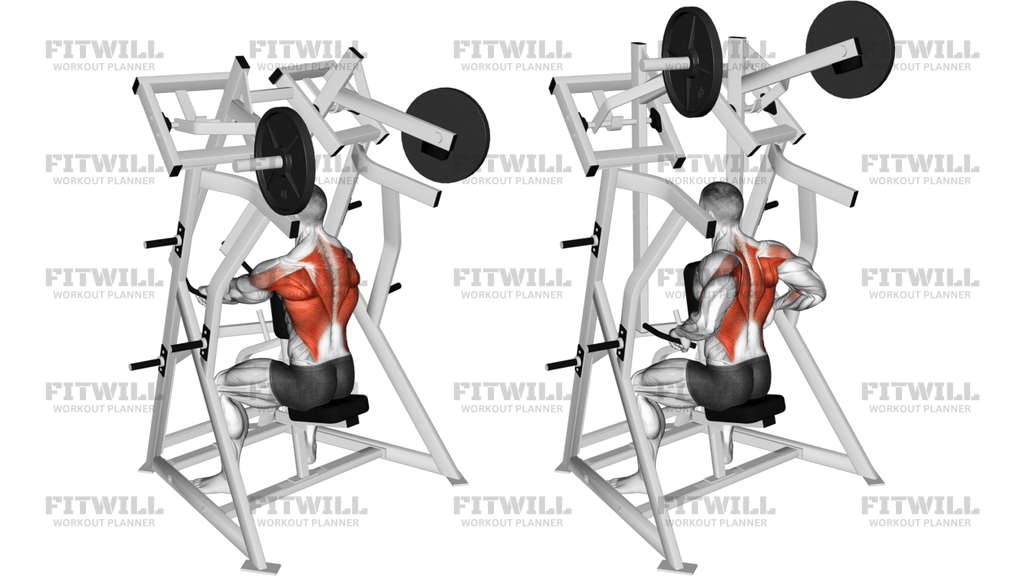
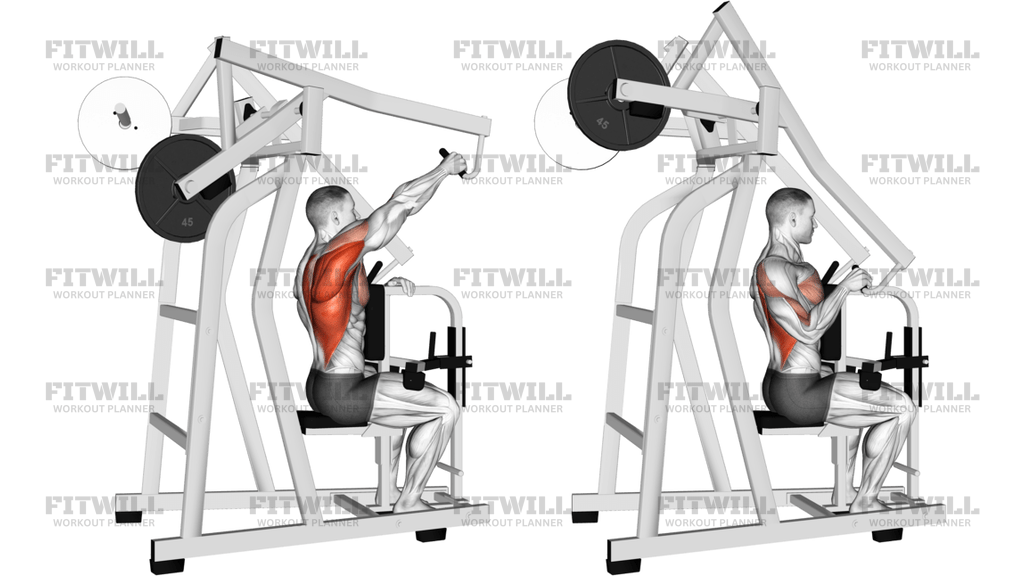
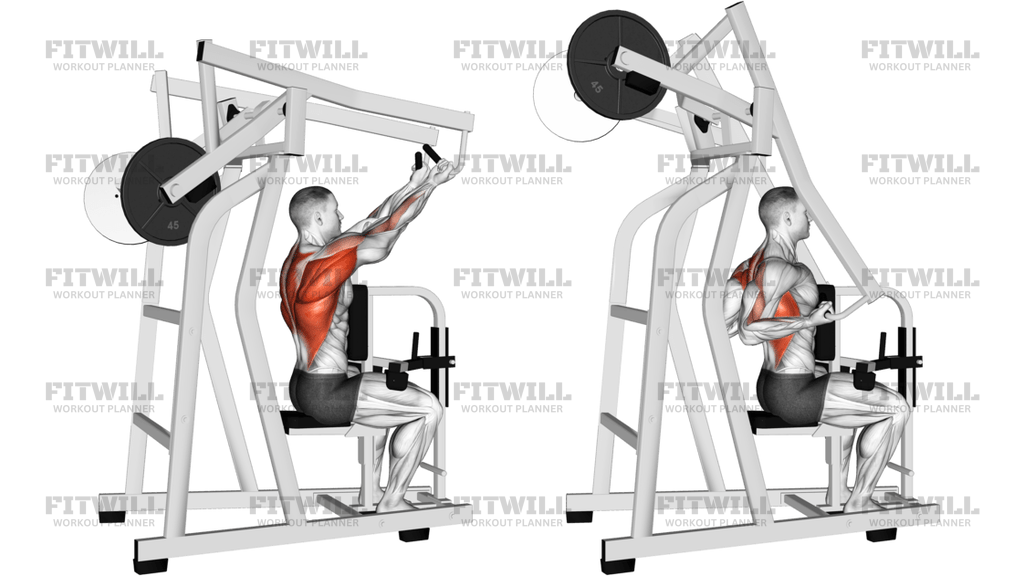
Lever One Arm Lateral High Row
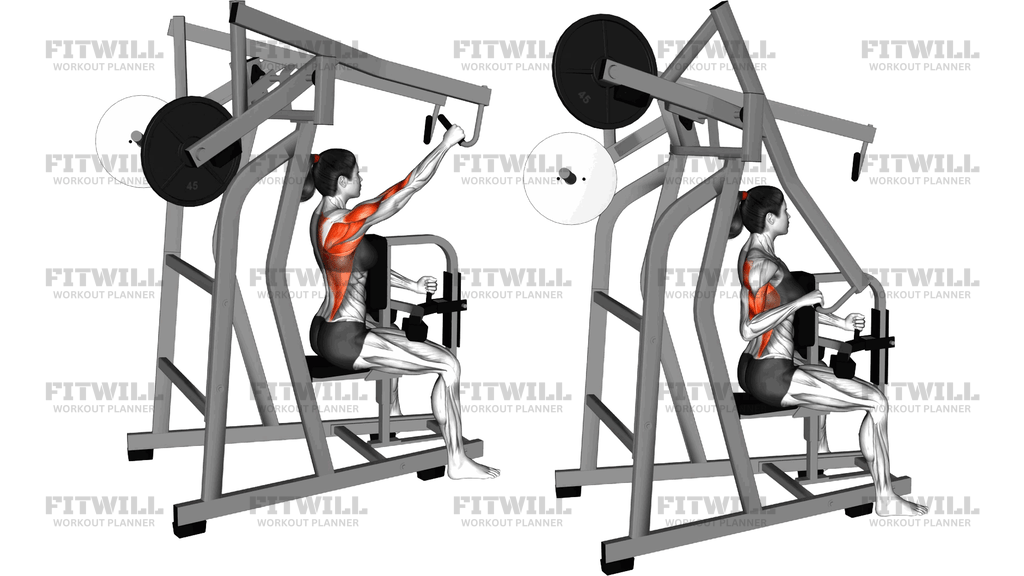
The Lever One Arm Lateral High Row is a machine-based pull performed on a plate-loaded leverage station. You sit braced against the chest pad with one hand gripping a high handle, then pull your elbow down and in toward your side so the handle travels from an overhead position down past shoulder level. Because the arm works alone and starts from above the shoulder, the movement blends the feel of a lat pulldown with the finishing path of a lateral row, driving tension through the lats as the arm comes down and through the upper back as the shoulder blade retracts at the end.
The one-arm setup is the main reason to choose this exercise. Working one side at a time exposes left-to-right differences in strength and control, and lets you rotate slightly into the pull to get a longer, more complete lat contraction than a two-hand machine pull usually allows. The fixed path of the leverage arm also removes the balance demand of a free-weight row, so you can put all of your attention into driving the elbow and squeezing the shoulder blade.
Muscularly, the lats do most of the work during the downward pull, with the teres major, rear delts, and mid-traps taking over as the handle approaches your side and the shoulder blade draws back. The biceps and forearms assist as pulling muscles and work isometrically to hold the grip. The chest pad keeps your torso upright and supported, which means the lower back is largely unloaded compared with a bent-over row.
This exercise suits lifters who want focused lat volume without stressing the spine, anyone correcting a strength imbalance between sides, and trainees who struggle to feel their lats in rows because the arms or upper traps take over. It also fits well as a finishing movement after heavier pulldowns or rows, since the machine lets you push close to fatigue safely.
Setup quality matters more than it looks. Seat height should place the handle at or slightly above shoulder height with the working arm nearly straight at the start, and your chest should stay firmly against the pad for every rep. If the seat is too low you turn the movement into a shrug; too high and you lose the stretch at the top. Take a moment to plant your feet and set your grip before the first pull.
To execute it well, lead with the elbow rather than the hand, keep the wrist neutral, and pull until the upper arm is close to your ribs with the shoulder blade drawn back. Pause briefly, then let the arm travel back up under control until you feel a full stretch through the lat. Avoid jerking the weight from the top or letting the stack slam back, and keep the free hand anchored on the machine for stability rather than leaning away from the pad.
[ Workout Log & Planner ]
Put your next workout in Fitwill
Keep your plan and training log ready when you are.


Instructions
- Sit on the machine facing the chest pad and slide your torso firmly against it, with your feet flat on the floor and knees bent.
- Grip the high handle with one hand using a neutral or overhand grip, and place your free hand on the machine's fixed handle or frame for support.
- Adjust the seat so the working arm is almost fully extended overhead at the start, with the shoulder under a mild stretch.
- Brace your core, keep your chest in contact with the pad, and settle your shoulder down away from your ear before pulling.
- Pull the handle down and in toward your side by driving your elbow down and back, keeping the wrist straight and the elbow pointing outward slightly.
- Continue until your upper arm is close to your ribs and your shoulder blade is pulled back, holding the contracted position for a moment.
- Slowly let the arm travel back up along the same path until the lat is fully stretched and the arm is extended overhead again.
- Exhale as you pull down and inhale as you return the handle to the top.
- Complete all repetitions on one side, then switch hands and match the rep count on the other arm.
Tips & Tricks
- If your shoulder rises toward your ear during the pull, you are shrugging instead of pulling; drop the weight slightly and consciously press the shoulder down before each rep.
- A common error with this setup is letting the chest peel off the pad as you pull hard. Reduce the load so you can keep full torso contact through every repetition.
- Think of the elbow as the moving part. If you curl the hand toward your face, the biceps take over and the lat loses tension.
- Use the top position as a training tool: pause for a beat with the arm extended to feel the lat stretch before starting each pull.
- Do not lock out violently or drop the arm back up quickly; the eccentric part of this movement is where the lats do a lot of their work.
- Keep a slight bend in the elbow at the top rather than yanking the joint fully straight, which keeps the shoulder in a comfortable position under load.
- Match reps and effort between sides, and always start with your weaker arm so both sides get the same quality of work.
- If your grip gives out before your back does, use a full palm grip with the thumb wrapped around the handle instead of a fingertip hold.
- Because the pad supports your torso, this is a good place to train close to fatigue, but stop the set as soon as your form breaks rather than leaning or twisting to finish reps.
Frequently Asked Questions
What muscles does the Lever One Arm Lateral High Row work?
The lats are the primary movers, supported by the teres major, rear delts, and mid-traps as the shoulder blade retracts. The biceps and grip muscles assist throughout the pull.
Why pull with one arm instead of both at once?
Training one side at a time reveals and helps correct imbalances, and the slight torso rotation available in the single-arm position often produces a stronger lat contraction than a two-hand pull.
How high should the seat be for the Lever One Arm Lateral High Row?
Set the seat so the handle sits at or slightly above shoulder height with your working arm nearly straight. This gives you a full lat stretch at the top without forcing the shoulder into an uncomfortable position.
Is the Lever One Arm Lateral High Row good for beginners?
Yes. The machine's fixed path and chest pad make it easy to learn, and beginners can start with light weight to focus on feeling the lat pull before adding load.
Can I substitute a cable one-arm lat pulldown for this exercise?
A seated one-arm cable pulldown is the closest free-cable alternative and trains similar muscles, but the leverage machine provides a more stable, guided path and lets you push harder near fatigue.
Should my chest stay on the pad during the entire set?
Yes. Keeping the chest against the pad prevents your torso from twisting or leaning into the pull, which keeps the work on the lats and upper back instead of momentum.
Why do I only feel this exercise in my biceps?
You are likely bending the elbow and pulling with the arm rather than driving the elbow down toward your ribs. Lighten the load, keep the wrist neutral, and focus on leading the movement with the elbow.
Is it safe to do the Lever One Arm Lateral High Row with shoulder issues?
The supported torso and controlled path are generally joint-friendly, but anyone with a current or past shoulder injury should use a pain-free range of motion and check the setup with a qualified professional first.
How does the high starting position change the exercise compared with a regular row?
Starting with the arm overhead puts the lat in a stretched position and shifts the early part of the pull toward a pulldown pattern, while the finish near your ribs brings in the rowing muscles of the upper back.
Where should this exercise fit in my back workout?
It works well after heavier compound pulls like pulldowns or rows, either as a secondary movement for focused lat work or as a finisher where the machine's support lets you train close to fatigue safely.