Weighted Front Raise
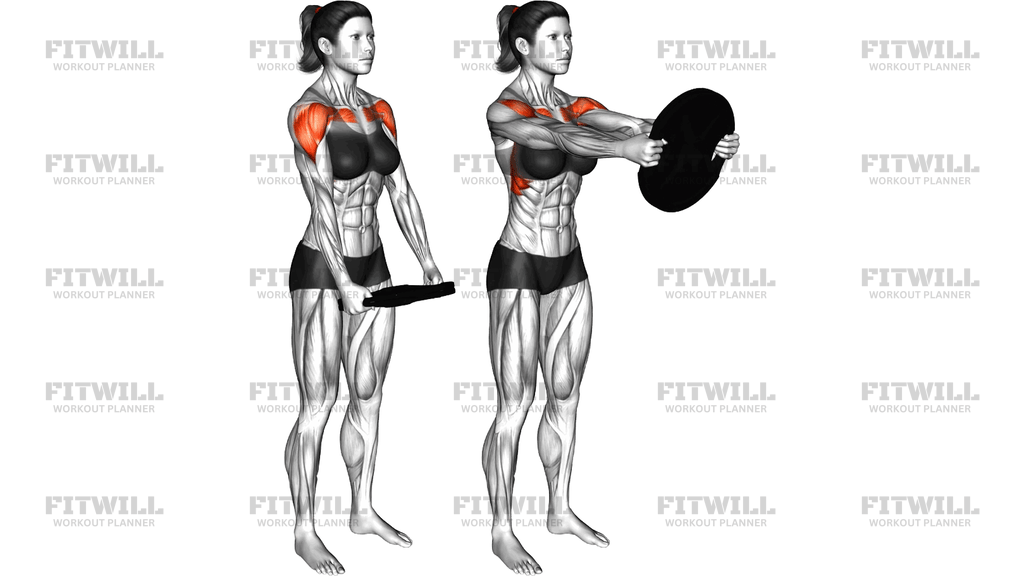
The Weighted Front Raise is a single-joint shoulder exercise where you lift a weight from thigh height straight out in front of your body to about shoulder level, keeping the arms essentially straight throughout. The weight shown here is a single weight plate held with both hands, which makes the movement easy to load progressively and keeps both arms working together on the same path.
The main muscle at work is the anterior deltoid, the front portion of the shoulder, with the clavicular head of the pecs assisting as the arm approaches shoulder height. Your traps, core, and forearms work isometrically to keep your torso upright, your spine neutral, and your grip secure on the plate.
This lift is useful for anyone who wants to build visible front-shoulder development, and for lifters whose pressing strength has stalled, since the front delts assist heavily in overhead and bench pressing. It also carries over to everyday actions like lifting objects to chest or shoulder height in front of the body.
Setup quality determines how much shoulder you actually get out of this movement. Stand tall with feet about hip-width apart, hold the plate at both sides with arms hanging down in front of your thighs, and keep your ribs stacked over your pelvis before the first rep. Because the weight sits far from your body at the top, any lean or swing at the start becomes exaggerated by the end of the lift.
To perform it well, raise the plate by moving at the shoulder joint only, with the elbows staying extended and the plate traveling straight up in front of your chest to roughly eye or shoulder height. Pause briefly at the top, then lower the plate under control back to your thighs rather than letting it drop.
Keep loads moderate. The front raise offers a short lever and a small prime mover, so the temptation to swing heavier plates is high, and that swing usually comes from the lower back rather than the shoulders. A controlled tempo with a weight you can pause at the top will build the delts faster than momentum-heavy reps ever will.
[ Workout Log & Planner ]
Put your next workout in Fitwill
Keep your plan and training log ready when you are.


Instructions
- Stand upright with feet about hip-width apart and hold a weight plate by its sides with both hands, letting your arms hang straight down in front of your thighs.
- Roll your shoulders back and down, brace your abdominal muscles lightly, and keep a soft bend in the knees with your weight balanced over midfoot.
- Squeeze the plate with your hands and set your grip so it feels secure before you start, since you do not want to adjust mid-set.
- Raise the plate straight out in front of you by moving at the shoulders, keeping the elbows extended but not locked and the palms facing each other or down.
- Lead with your hands so the plate travels along a vertical path in front of your chest, rather than drifting out to the sides.
- Stop when the plate reaches about shoulder or eye height, with your arms roughly parallel to the floor, and pause for a beat at the top.
- Lower the plate slowly back down along the same path until your arms hang in front of your thighs again.
- Exhale as you raise the plate and inhale as you lower it, keeping the breathing steady throughout the set.
- Reset your stance and brace between reps if you feel your torso start to lean back or your rhythm get sloppy.
- Complete the set by lowering the plate to your thighs, standing fully upright, and setting the weight down with both hands.
Tips & Tricks
- The most common error is leaning the torso back as the plate rises, which turns a front raise into a standing cheat swing. Think of pressing your lower ribs down and glutes tight so the torso stays vertical while the shoulders do the lifting.
- If you keep bending the elbows to hoist the weight, the load is too heavy; the arm should stay nearly straight so the shoulder, not the arm, moves the plate.
- Stop at shoulder height rather than raising the plate above your head. Going higher shifts work to the traps and upper back and loses tension on the front delts.
- Hold the plate at its sides rather than squeezing it flat against your chest, so it clears your torso and travels in front of you.
- A two-second lower, roughly a second up, pause at the top, gives far more shoulder tension than fast reps, especially on the way down where most people just drop the weight.
- Keep your wrists firm and neutral; a bent-back wrist at the top of the raise signals a grip that is not secure and loads the joint unnecessarily.
- If your lower back grumbles during or after sets, try a split stance or place your back against a wall to eliminate any chance of torso sway.
- Avoid shrugging as the plate rises. Keep the space between your shoulders and ears so the deltoid, not the upper traps, drives the movement.
Frequently Asked Questions
Which muscles does the Weighted Front Raise work?
The anterior deltoid at the front of the shoulder is the prime mover, with the upper chest assisting near the top of the lift. Your traps, core, and forearms work statically to hold your posture and grip the plate.
Why hold a weight plate instead of dumbbells for the Weighted Front Raise?
A single plate held with both hands keeps the arms locked to the same path and makes it easy to progress in small, meaningful jumps. Dumbbells also work, but the shared plate gives a slightly more stable, symmetrical feel.
How high should I raise the plate in the Weighted Front Raise?
Raise it to about shoulder or eye height so your arms are roughly parallel to the floor. Lifting beyond that point transfers effort away from the front delts and toward the traps.
Is the Weighted Front Raise good for beginners?
Yes, as long as the weight is light enough to raise and lower with no body swing. Beginners often benefit most from starting with a small plate and mastering the straight-arm, vertical path before adding load.
Why does my lower back feel the Weighted Front Raise?
That usually means your torso is leaning back to help swing the plate up. Brace your abs, squeeze your glutes, and reduce the weight until the lift comes purely from the shoulders.
How many sets and reps should I do for the Weighted Front Raise?
Two to four sets of 10 to 15 controlled reps works well as accessory shoulder work. Because the muscle is small, staying in that moderate range with a strict tempo beats grinding out heavy reps.
Can I substitute the Weighted Front Raise if I do not have a plate?
Yes, a single dumbbell or kettlebell held with both hands under the top head works the same way, or you can use a resistance band anchored behind you. The key is keeping the same straight-arm, front-facing lift to shoulder height.
Should my elbows be locked during the Weighted Front Raise?
Keep the elbows extended but not jammed fully straight. A tiny bend protects the joint and keeps the emphasis on the shoulder instead of the arm structure.
Where should I put the Weighted Front Raise in my workout?
Place it after your main pressing or overhead work, when it serves as a targeted finisher for the front delts. Doing it first would fatigue the same muscle you need for your heavier presses.