Rear Lunge Kickback
The Rear Lunge Kickback is a bodyweight lower-body exercise that chains two glute-focused actions into one continuous rep: you step back into a reverse lunge, then drive the same leg up and back into a straight-leg kick before returning to standing. Because the movement never puts the working foot down between the lunge and the kick, each rep challenges balance and single-leg control as much as raw strength. It requires no equipment and very little floor space, which makes it easy to slot into a home workout, a warm-up, or a finisher at the gym.
The main target is the glutes, especially the gluteus maximus during the kickback phase and the gluteus medius as it stabilizes your pelvis on the standing leg. The front leg's quadriceps and glutes take most of the load during the lunge portion, the hamstrings assist on the back-and-up drive, and the calves work to keep you grounded. Your core stays busy the entire time, since a hinged torso with one foot in the air constantly tempts you to rotate or round.
Setup matters more here than in a standard lunge. A narrow, tall starting stance gives you room to step back without crowding your balance, and a slight forward lean from the hips — not a rounded spine — sets your weight over the standing leg so the kick comes from the hip, not from swinging the whole body. If your torso wobbles or your lower back arches to fake extra leg height, the glutes stop doing the work and the rep loses its point.
To execute it well, sink the rear lunge until both knees reach roughly right angles, keep your front knee stacked over your ankle, and then push through the front heel to rise. As you come up, sweep the back leg off the floor and press it straight behind you, squeezing the glute at the top rather than flinging the leg upward. The kick should feel like the leg is lengthening back and slightly up, with your hips staying square to the floor.
This movement suits anyone who wants glute development without weights, lifters looking for a single-leg warm-up that wakes up the hips before squats or deadlifts, and people rebuilding strength and balance after long breaks from training. Because one side works at a time, it also exposes and helps correct left-right differences in strength and stability. Move slowly, keep the reps controlled, and switch legs only after completing all reps on one side.
[ Workout Log & Planner ]
Put your next workout in Fitwill
Keep your plan and training log ready when you are.


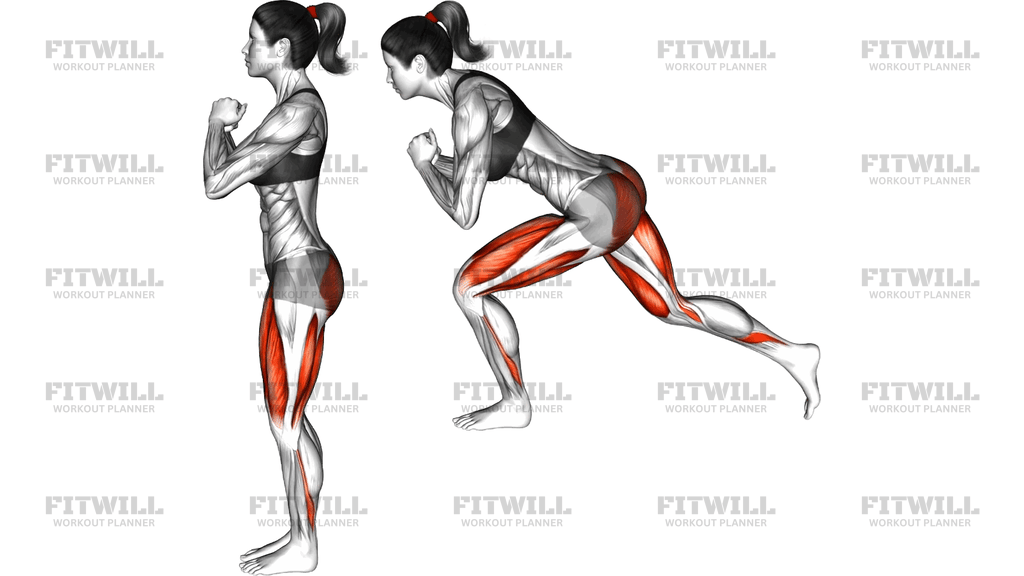
Instructions
- Stand tall with your feet hip-width apart, arms bent in front of your chest or hands on your hips, and your weight shifted slightly onto one foot so the other leg is free to move.
- Set your gaze on a fixed point at eye level a few feet ahead and brace your abs as if bracing for a light push.
- Step your free leg straight back and lower into a reverse lunge, dropping until both knees bend to about 90 degrees and your front knee sits over your ankle.
- Keep a slight forward hinge from the hips with a flat back, letting the lean come from your hips rather than rounding your lower back.
- Press through the heel of your front foot to stand up, and as you rise, sweep the rear leg off the floor behind you.
- Kick the moving leg straight back and slightly up, squeezing the glute of that leg at the top while your hips stay square to the floor.
- Without letting the leg drop heavily, bend the knee and lower the foot back down into the rear lunge position for the next rep.
- Exhale as you drive up and kick, inhale as you lower back into the lunge.
- Complete all reps on one leg, then reset your stance and perform the same number on the other side.
- If you lose balance, plant the moving foot briefly beside the standing foot, re-brace, and continue rather than rushing the rep.
Tips & Tricks
- The most common fault is kicking the leg up so high that your lower back arches and your torso tips forward — cap the kick at a height where your hips and ribs stay stacked.
- If your front knee caves inward during the lunge, think about spreading the floor with your front foot and tracking the knee over your second toe.
- A short rear step makes the kick feel awkward and crowds your balance; step back far enough that both knees can reach about 90 degrees.
- Hold onto a wall, chair, or rack with one hand for your first few sets if the balance demand outweighs the strength work — wean off it as your stability improves.
- Keep the kick slow and deliberate; the glute responds to a hard squeeze at the back, not momentum from swinging the leg.
- Avoid letting your torso come fully upright during the kick — keeping a small hip hinge keeps tension on the glute instead of shifting it to the lower back.
- Your working leg will shake on the standing side as stability builds; reduce the tempo before you reduce the reps so control stays ahead of fatigue.
- Do this exercise barefoot or in flat shoes — a cushioned, unstable sole makes the single-leg balance noticeably harder.
- Place a soft mat under the standing foot's area if you train on hard floors, since a wobble on the kick can lead to a stumble.
Frequently Asked Questions
What muscles does the Rear Lunge Kickback work?
The glutes are the primary muscle, with the gluteus maximus driving the kickback and the gluteus medius stabilizing the standing hip. The quads and hamstrings of the front leg handle the lunge, and the core works to keep your torso steady throughout.
Is the Rear Lunge Kickback good for beginners?
Yes, as long as the range stays modest at first. Beginners can shorten the rear step, reduce the kick height, or hold a wall for support until single-leg balance feels comfortable.
Why does my lower back hurt when I kick my leg back?
That usually means you are arching the lumbar spine to gain leg height instead of extending at the hip. Keep the kick lower, hold the small forward hinge from your hips, and focus on squeezing the glute rather than lifting the foot as high as possible.
Should I complete all reps on one leg before switching?
Yes. Doing all reps on one side keeps you in a rhythm and makes it easier to gauge and match the workload on the other leg. Briefly re-ground yourself between reps if balance breaks down.
Can I add weight to the Rear Lunge Kickback?
You can hold a light dumbbell in the hands at your chest once your balance is solid, but most people get plenty of stimulus from bodyweight. Balance and glute control tend to fail before load becomes the limiting factor.
How is this different from a regular reverse lunge?
A regular reverse lunge ends when the back foot returns to the floor. Here the back leg never touches down between phases — it moves straight from the lunge into a hip-extension kick, adding a dedicated glute contraction and a greater balance demand.
Can I use the Rear Lunge Kickback as a warm-up?
It works well as one. A set or two per leg at a controlled tempo raises the heart rate, opens up the hips, and pre-activates the glutes before squats, deadlifts, or running.
How many reps and sets should I do?
For strength and muscle, aim for 8 to 12 controlled reps per leg for 2 to 4 sets. For warm-up or balance work, 6 to 8 slow reps per leg for 1 to 2 sets is enough.
Is it safe for my knees?
The movement is generally knee-friendly because the rear step loads the hips more than a forward lunge. Keep the front knee tracking over the ankle and within a pain-free range, and stop if you feel sharp knee discomfort.
What can I substitute if the balance is too difficult?
Do the lunge and kickback as two separate movements — a reverse lunge followed by a supported standing kickback while holding a chair or wall. You lose some coordination demand but keep most of the glute work.