Standing Alternate Glute Kickback
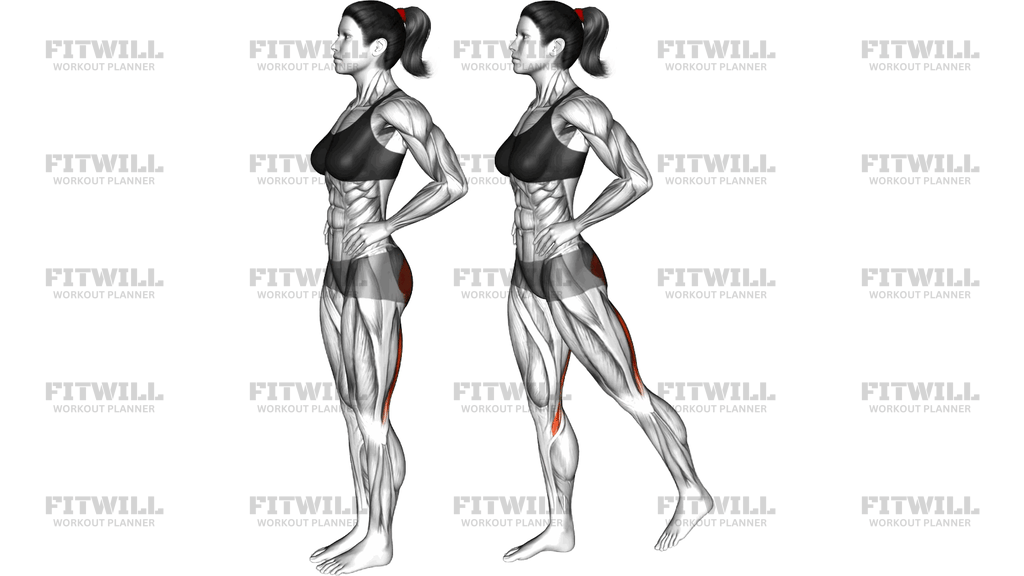
The Standing Alternate Glute Kickback is a bodyweight isolation movement performed from an upright standing position. You balance on one leg while sweeping the other leg straight back and up behind you, then switch sides without setting the foot down between reps if you want a continuous flow. Because it requires no equipment, it fits easily into warm-ups, home workouts, hotel room sessions, or finishers at the end of a leg day.
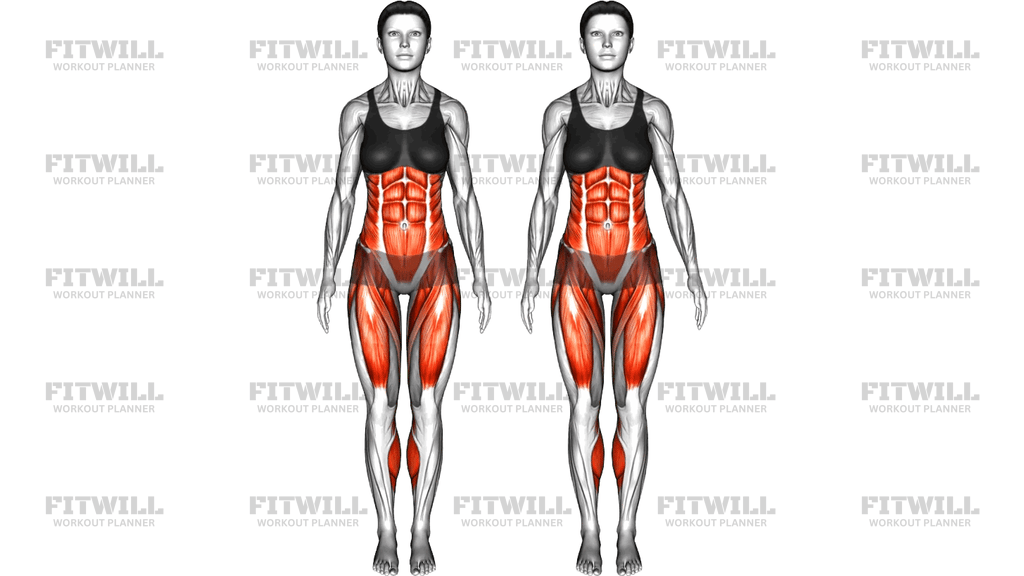
The primary target is the gluteus maximus, which drives hip extension as the leg travels behind the body. The hamstrings assist on the way back, while the gluteus medius and deeper hip stabilizers on the standing leg work the whole time to keep your pelvis level. Your core and lower back stay engaged to hold an upright torso, which is what separates this standing version from floor-based kickbacks done on all fours.
Setup matters more than it looks. Standing tall with the hand lightly placed on the hip for balance keeps the spine neutral and stops you from collapsing forward or arching excessively to fake extra range. The working leg should move from the hip, not from the lower back, so the knee stays soft and the foot travels a smooth arc behind you rather than swinging wildly.
To perform it well, shift your weight onto one leg, brace your abs, and push the opposite heel back and up while keeping the torso vertical. Stop when the leg reaches a comfortable height, usually just before you feel your lower back start to arch, then lower it under control and immediately repeat with the other side. The tempo should be deliberate: a strong squeeze back, a brief pause at the top, and a slow return.
This exercise is especially useful for people who sit a lot and need to reawaken the glutes, beginners building hip control before loading with cables or ankle weights, and anyone programming unilateral balance work. If you want more challenge later, add an ankle strap with light resistance or slow the tempo, but earn it with clean form first.
[ Workout Log & Planner ]
Put your next workout in Fitwill
Keep your plan and training log ready when you are.


Instructions
- Stand upright with your feet hip-width apart and place one hand lightly on your hip for balance.
- Shift your weight onto one leg, keeping a soft bend in that knee and your shoulders stacked over your hips.
- Brace your abdominal muscles and keep your ribcage down so your lower back stays neutral.
- Sweep the free leg straight back behind you, hinging only at the hip while the knee stays slightly bent.
- Lift the leg until your glute fully contracts, usually around 30 to 45 degrees behind you, without leaning your torso forward.
- Pause for one second at the top and squeeze the glute of the working leg.
- Lower the leg slowly and with control rather than letting it drop, keeping tension in the hip.
- Exhale as you kick back and inhale as the leg returns to the start position.
- Alternate legs for the desired number of reps, or complete all reps on one side before switching.
- Between sets, stand square on both feet and reset your posture before starting again.
Tips & Tricks
- The most common mistake is arching the lower back to make the leg go higher; cut the range short instead and let the glute do the work.
- If you wobble on the standing leg, grip the floor with your toes and find a fixed point ahead of you to stare at for balance.
- Do not lean your chest forward as the leg goes back; imagine a string pulling the crown of your head toward the ceiling.
- The knee of the working leg should stay mostly extended with a slight bend; bending it deeply turns this into a different movement and loads the hamstrings more.
- Keep the hand on the hip for balance only, not to push the torso sideways as you kick.
- Point the toes slightly or keep the foot neutral consistently; flicking the foot at the top adds nothing to glute activation.
- Slow the lowering phase to two or three seconds if you cannot feel the glute working, since most people only rush the return.
- Alternate legs rep by rep if your goal is balance and coordination, or do straight sets per leg if you want maximum glute focus.
Frequently Asked Questions
What muscles does the Standing Alternate Glute Kickback work?
The gluteus maximus is the main mover during the backward hip extension. The hamstrings assist, and the standing leg's hip stabilizers plus your core work to keep you upright and level.
Is the Standing Alternate Glute Kickback good for beginners?
Yes, it is one of the safest starting points for glute training because it needs no equipment and uses only your leg weight. Beginners should focus on a short, controlled range before chasing height.
How high should I lift my leg during a Standing Alternate Glute Kickback?
Lift only as far as you can without arching your lower back or leaning forward, which is typically 30 to 45 degrees behind you. Extra height usually comes from the spine, not the glutes.
Why do I feel this in my lower back instead of my glutes?
That usually means your torso is arching or tipping forward as the leg extends. Brace your abs, keep the ribcage down, and shorten the range until the contraction sits in the glute.
Can I add resistance to the Standing Alternate Glute Kickback?
Yes, once bodyweight feels easy you can attach a light ankle strap or ankle weight to the moving leg. Progress the weight slowly because balance demands rise at the same time.
How is the Standing Alternate Glute Kickback different from a quadruped kickback?
The standing version keeps your torso vertical and forces the standing leg's hip stabilizers to work, while the quadruped version supports your torso on hands and knees and lets you focus purely on the moving hip.
Should I alternate legs every rep or finish one side first?
Alternating every rep builds rhythm, balance, and coordination, while completing all reps on one leg gives a stronger isolated glute contraction. Both approaches work, so pick based on your goal.
How many reps and sets should I do?
For warm-up or activation, 2 to 3 sets of 10 to 15 reps per leg works well. For strength endurance as a standalone exercise, go up to 3 to 4 sets with a slow tempo.
Can I do the Standing Alternate Glute Kickback every day?
Because it is low load and low impact, most people can perform it frequently, even daily as activation work. Just stop if the standing leg's hip or the lower back feels strained rather than worked.