Forward Lunge Punch
The Forward Lunge Punch combines a bodyweight forward lunge with a straight punch, forcing your lower body and upper body to work together in one coordinated movement. You step into a split stance, drop your back knee toward the floor, and drive one fist forward at chest height while the opposite hand stays guarded near your face. It is a staple in boxing conditioning classes, bootcamps, and martial arts warm-ups because it links footwork, balance, and striking mechanics into a single flowing rep.
This movement trains far more than a standard lunge. The lunge portion loads the quads and glutes through a deep knee and hip bend, while the punch adds rotational demand through the core as the fist extends. Because you are standing on one and a half legs with a fist moving away from your center, your balance and trunk stability get challenged on every rep. Add the quick tempo this exercise is usually performed at, and your heart rate climbs fast, making it a useful tool for conditioning as well as strength endurance.
The setup matters because a Forward Lunge Punch only works well when the lower body and the punch stay synchronized. Step forward, sink straight down rather than drifting forward, and time the punch so the fist reaches full extension as you arrive at the bottom of the lunge. If your stance is too narrow or your torso leans toward the punching arm, the whole pattern falls apart and your knees and lower back absorb stress they should not.
This exercise suits beginners and advanced trainees alike, though for different reasons. Beginners use it to build coordination, single-leg control, and familiarity with striking mechanics without any equipment. More advanced lifters and fighters use it in high-rep intervals or as part of a circuit to build work capacity and leg endurance under fatigue. It is also a common warm-up drill before sparring or lower-body training because it raises body temperature while rehearsing movement patterns you are about to use.
From a safety standpoint, the main watchpoints are knee tracking and spine position. Your front knee should travel over the middle of your foot, and your back should stay tall and neutral rather than rounded or arched. Keep the punch controlled, not ballistic, until you have solid balance in the bottom of the lunge. Start with your bodyweight only, master the rhythm, and only then add speed or light resistance.
Fitwill
Log Workouts, Track Progress & Build Strength.
Achieve more with Fitwill: explore over 9600 exercises with images and videos, access built-in and custom workouts, perfect for both gym and home sessions, and see real results.
Start your journey. Download today!




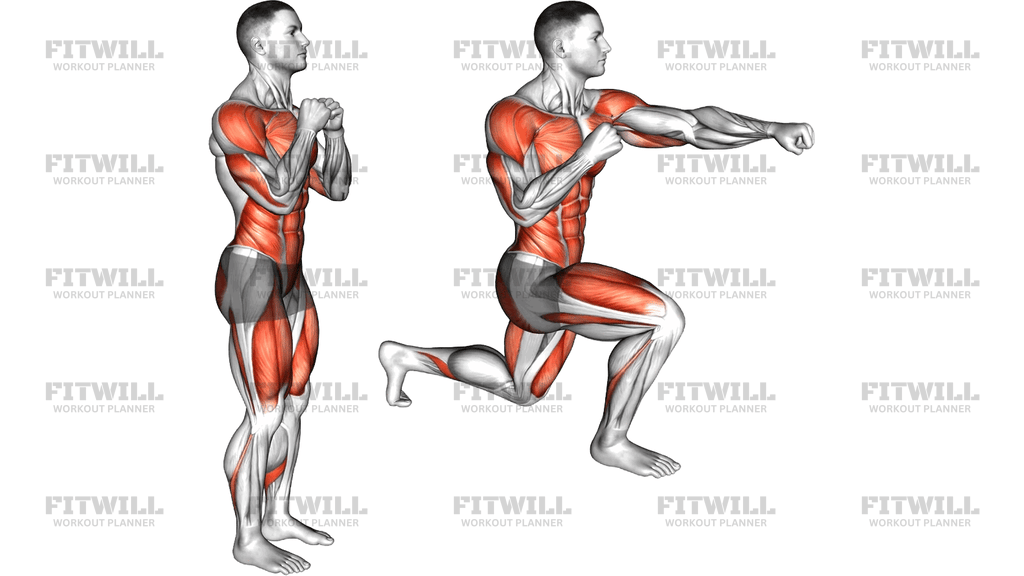
Instructions
- Stand tall with your feet hip-width apart and bring both fists up to guard position at chin height, elbows tucked close to your ribs.
- Brace your core and keep your chest lifted and shoulders relaxed away from your ears.
- Step forward with one leg into a comfortable stride, roughly two to three feet, keeping your torso upright.
- Bend both knees to lower into a lunge, sinking straight down until your front thigh is near parallel to the floor and your back knee hovers just above the ground.
- As you reach the bottom of the lunge, extend one fist straight forward at chest height, rotating the fist so the palm faces down at full extension, while the other hand stays at your face.
- Avoid letting your front knee collapse inward; keep it tracking over your toes.
- Press through the heel of your front foot to stand back up, retracting the punching hand to guard as you rise.
- Exhale sharply as you drop into the lunge and punch; inhale as you return to standing.
- Alternate the punching arm and stepping leg with each rep, or complete all reps on one side before switching.
- Reset your stance and guard position between reps if your balance drifts, then continue with the next lunge.
Tips & Tricks
- A common mistake is stepping too narrow, which turns the lunge into a tightrope walk; imagine your feet on two train tracks, not a single line.
- If your front knee shoots past your toes, take a slightly longer step and focus on sinking your hips straight down instead of lunging forward.
- Do not let the punching shoulder shrug or hunch toward your ear; drive the punch from the chest and shoulder while the neck stays long.
- Keep the non-punching hand glued to your face the entire time; letting it drop is a habit that undermines the boxing mechanics this drill builds.
- Time the punch to land at the bottom of the lunge, not before; punching early steals stability from your base.
- If you wobble at the bottom, slow the tempo down and pause for one breath in the lunge before standing; balance typically improves within a few sessions.
- Keep your back heel lifted naturally and drive through the ball of the back foot as you return to standing rather than dragging the back leg.
- Ground your front foot fully: heel, ball, and toes all in contact, to give the punch a stable platform.
- For a conditioning set, keep the transitions crisp but never sacrifice the depth of the lunge for speed.
Frequently Asked Questions
What muscles does the Forward Lunge Punch work?
The lunge primarily targets the quads and glutes, with support from the hamstrings and calves. The punch adds work for the shoulders, triceps, and chest, while the core stabilizes the torso throughout the combined movement.
Should I punch with the same arm as the leg I step forward with?
Either works, but punching with the arm opposite your forward leg creates a natural cross-body rotation that most people find more balanced. Consistency matters more than the choice, so pick one pattern and stick with it within a set.
Is the Forward Lunge Punch good for beginners?
Yes, because it requires no equipment and can be scaled easily. Beginners should start with a shallow lunge and a slow punch, focusing on balance and knee tracking before adding depth or speed.
How deep should the lunge be?
Aim for a front thigh near parallel to the floor with the back knee hovering just above the ground. If your form or balance breaks down at that depth, lunge shallower until your control improves.
Why do I lose my balance at the bottom of the lunge?
This usually comes from a stance that is too narrow or from rushing the punch. Widen your step to hip-width or slightly wider between feet, and time the punch to reach full extension only when you are settled at the bottom.
Can I add weights to the Forward Lunge Punch?
Light dumbbells can be held during the lunge, but they change the punching mechanics and are generally not recommended. If you want more challenge, increase reps, tempo, or add a light resistance band rather than loading the hands.
Is this a strength exercise or a cardio exercise?
It sits between the two. Performed slowly, it builds single-leg strength and coordination; performed in continuous high-rep sets, it becomes a conditioning drill that elevates your heart rate quickly.
How many reps should I do?
For strength and technique, 8 to 10 reps per side with a controlled tempo works well. For conditioning, try 30 to 45 seconds of continuous alternating reps with clean form as the limit.
Is the Forward Lunge Punch safe for my knees?
It is generally knee-friendly when the front knee tracks over the toes and the step is long enough to control the descent. If you have a knee injury or pain during the movement, shorten the range, reduce the tempo, or consult a qualified professional first.