Rotational Push Up Knee Tap
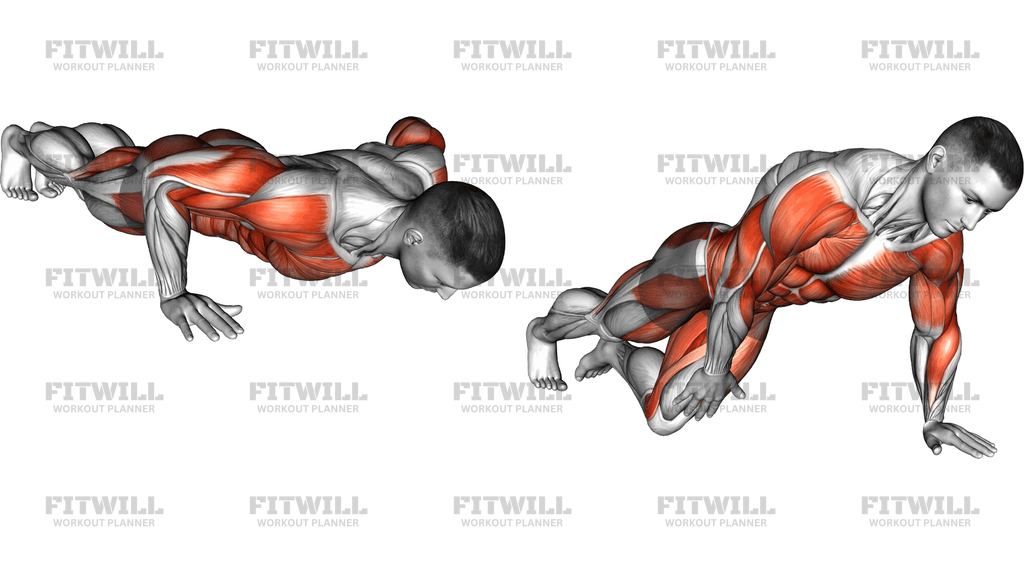
The Rotational Push Up Knee Tap combines two demanding bodyweight patterns into one flowing rep: a full push-up followed by a hip rotation that brings one knee across the body to tap near the opposite hand. The pressing portion builds the chest, triceps, and front shoulders, while the knee tap forces the obliques and deep core to control rotation under load. Because you move from a stable plank into a rotated, single-sided position and back again, the exercise also challenges shoulder stability far more than a standard push-up.
This movement suits anyone who has mastered regular push-ups and wants more core involvement without adding equipment. It is especially useful for combat athletes and field-sport players, since rotating the hips while supporting weight on one arm closely mirrors cutting, throwing, and grappling mechanics. General lifters can use it as a finisher on upper body days, or as a standalone core-and-press circuit move when training at home or while traveling.
Setup details matter more here than in a standard push-up. Your hands should be slightly wider than shoulder width, your body in one straight line from head to heels, and your feet set a little wider than hip width to give the rotation a stable base. If your feet are too narrow, the knee tap will pull you off balance; if your hips sag or pike, the rotation turns into a spinal twist instead of controlled trunk rotation.
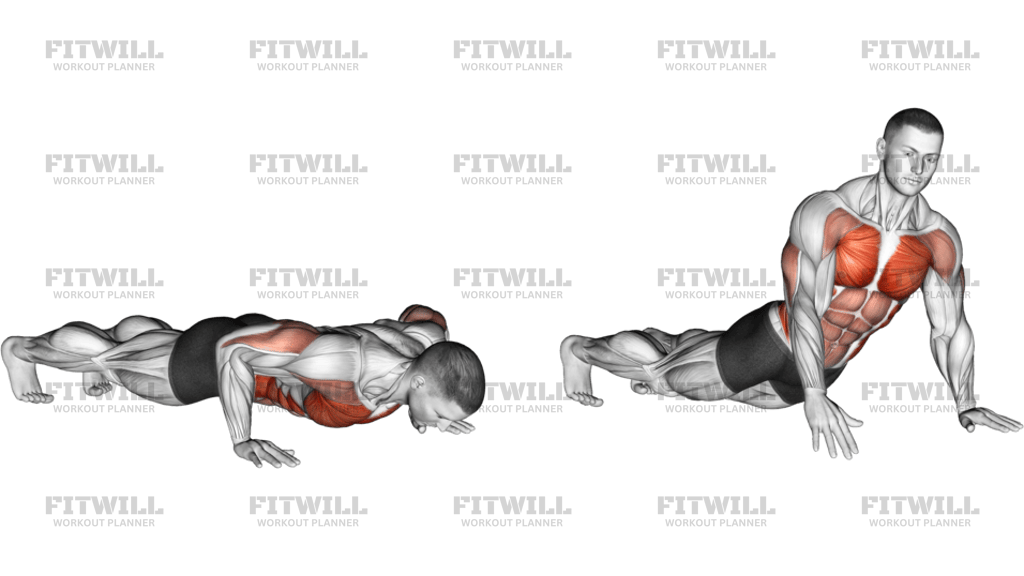
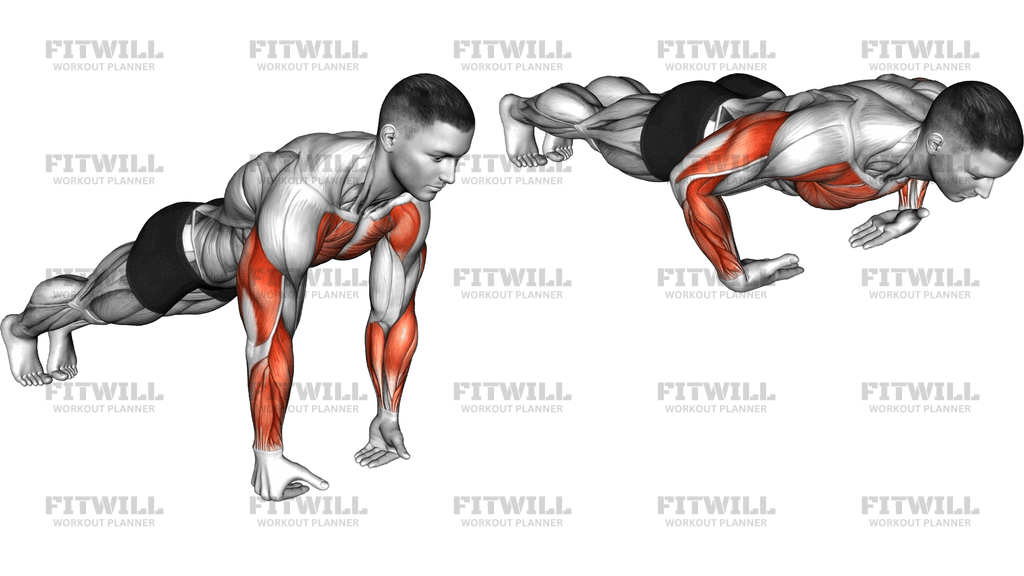
To execute well, lower into the push-up with elbows tracking at roughly 45 degrees from your torso, press back to the top, then lift the same-side hand slightly as you rotate and draw one knee forward across your midline toward the opposite hand. Tap lightly, reverse the motion, and alternate sides each rep or complete all reps on one side before switching. Move at a tempo you can control; the rotation phase should look smooth, not rushed.
A few practical safety points will keep this exercise productive. Keep your supporting shoulder stacked over the wrist whenever you rotate, and avoid letting the shoulders shrug toward the ears. If you feel strain in the lower back during the knee tap, reduce the range by tapping the knee closer to the same-side hand before progressing across the body. Work on a mat or smooth floor so your palms stay planted without slipping, and stop the set as soon as your hips start drifting out of line.
[ Workout Log & Planner ]
Put your next workout in Fitwill
Keep your plan and training log ready when you are.


Instructions
- Place an exercise mat on the floor and kneel behind it, then set your hands slightly wider than shoulder width with fingers spread and pointing forward.
- Step both feet back into a high plank so your body forms a straight line from head to heels, and set your feet a little wider than hip width for a stable base.
- Brace your abdominal wall, squeeze your glutes, and pull your shoulder blades down away from your ears before moving.
- Bend your elbows to lower your chest toward the floor, keeping the elbows at about 45 degrees from your ribs, until your upper arms are roughly parallel to the ground.
- Press firmly through your palms to return to the top of the push-up without letting your hips sag or pop upward.
- Shift your weight slightly into your left hand, rotate your hips, and draw your right knee forward across your body until it taps near your left hand.
- Reverse the rotation smoothly to bring the right foot back to the plank position, keeping the supporting shoulder stacked over the wrist.
- Exhale as you press up and rotate into the knee tap, and inhale as you lower into the push-up and return to plank.
- Repeat on the other side, tapping the left knee toward the right hand, and continue alternating for the desired number of reps.
- Between sets, sit back from the top position, shake out your wrists, and reset your plank alignment before the next set.
Tips & Tricks
- Widen your feet before you widen your hands: a slightly wider stance is what makes the rotational knee tap balanced, while a narrow stance will tip you sideways every rep.
- If your knee cannot reach across to the opposite hand, tap it toward the same-side hand first and gradually increase the rotation over several weeks rather than forcing the range.
- Watch for the hips twisting during the press itself; the push-up portion should stay square to the floor, and rotation should only begin once you are back at the top.
- Keep the tapping knee relaxed and let the hip do the work. Driving the knee hard toward the hand usually causes the supporting arm to collapse inward.
- Screw your supporting palm into the floor, fingers spread and middle finger pointing forward, to protect the wrist during the weight shift.
- Slow the knee tap down rather than the push-up if you have to choose; most people rush the rotation and lose trunk control at exactly that moment.
- If your lower back arches when the knee comes forward, exhale harder and shorten the tap distance until you can keep the ribs down.
- Place your hands on a mat or slightly textured surface; smooth floors encourage the palms to slide outward during the rotation.
- Warm up the wrists and shoulders with a few standard push-ups and plank shoulder taps before starting, since this variation loads both areas asymmetrically.
Frequently Asked Questions
What muscles does the Rotational Push Up Knee Tap work?
The press targets the chest, triceps, and front shoulders, while the knee tap brings the obliques and deep core in as the prime rotators. The supporting arm and shoulder also work hard to stabilize during the rotation.
Is the Rotational Push Up Knee Tap suitable for beginners?
It is best treated as a step up from standard push-ups. Beginners can start with knee push-ups paired with a short, same-side knee tap, then progress to the full across-the-body version as pressing and plank strength develop.
Why should my feet be wider than hip width during the Rotational Push Up Knee Tap?
A slightly wider foot stance widens your base of support so the hips can rotate toward the knee tap without tipping you sideways. With feet close together, most people lose balance and the rotation turns sloppy.
Should the knee tap happen during the push-up or after it?
After it. Complete the press back to the top of the push-up first, then rotate and tap. Mixing the two phases usually causes the hips to collapse during the pressing portion.
My knee cannot reach the opposite hand. What should I do?
Reduce the rotation and tap the knee near the same-side hand, keeping the hips square, then gradually increase the crossover range over time. The movement quality matters more than how far the knee travels.
Can I substitute the Rotational Push Up Knee Tap with another exercise?
A standard push-up paired with plank hip dips or shoulder taps covers similar ground in two separate moves. The combined version is simply more time-efficient and harder on trunk control.
How many reps of the Rotational Push Up Knee Tap should I do?
Because each rep includes a push-up plus a rotation, most people do well with 6 to 12 total reps per set, alternating sides. Stop the set when your hips can no longer stay level during the knee tap.
Why does my wrist hurt when I rotate in this exercise?
The supporting wrist takes angled load during the knee tap, so keep the palm flat, fingers spread, and the shoulder stacked over the hand rather than drifting behind it. A warm-up of easier plank work and, if needed, a slightly wider hand angle can help.
Do I need any equipment for the Rotational Push Up Knee Tap?
No equipment is required beyond an exercise mat or a non-slip floor surface for comfort and grip. Your body weight provides all the resistance.
Is it a problem if my hips sag during the Rotational Push Up Knee Tap?
Yes. Sagging hips shift stress to the lower back and reduce the core training effect, so reset your plank, squeeze the glutes, and shorten the knee tap range if you cannot hold a straight line.