Dumbbell Lateral Walk
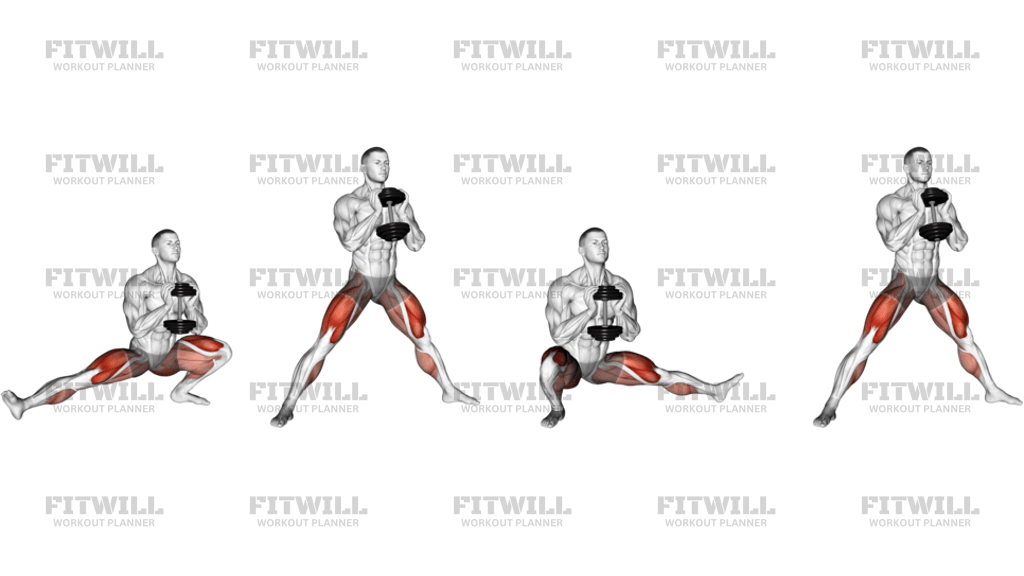
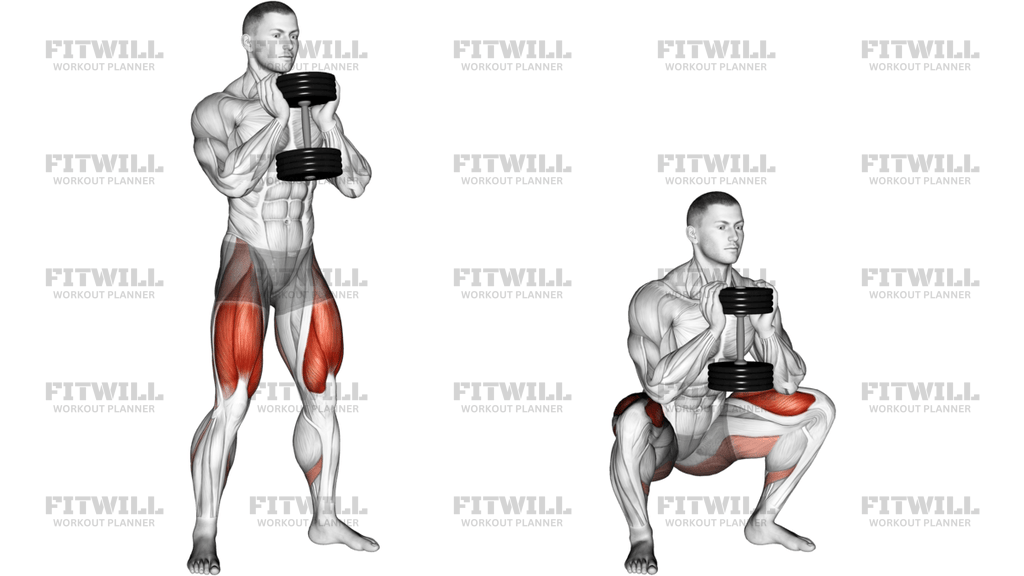
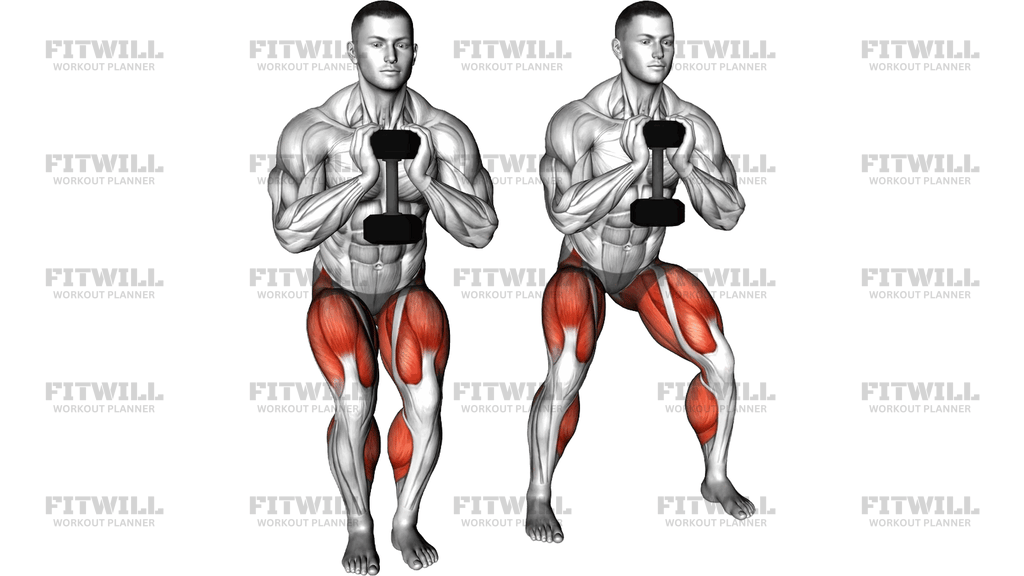
The Dumbbell Lateral Walk is a loaded side-shuffling drill performed in a partial squat position. You hold a single dumbbell in a goblet position at your chest, drop into a quarter squat, and travel sideways step by step, keeping that bent-knee height the whole way. The highlighted areas in the movement are the quads, glutes, inner thighs, and calves, which stay under continuous tension because your knees never fully straighten between steps.
This exercise is especially useful for training the gluteus medius and the muscles along the outer hip. Most lower-body work happens in a straight line — squats, lunges, deadlifts — while side-to-side movement is what actually builds the hip stability you rely on for cutting, changing direction, and keeping your knees tracking properly under load. The goblet-style dumbbell at the chest also forces your torso to stay upright, which quietly challenges your core and upper back.
Setup matters more than most people expect. Your stance width, squat depth, and foot position determine whether the work lands in your hips and thighs or leaks into your lower back. Sit into the squat with your weight spread across the whole foot, chest tall, and dumbbell tucked close to the body rather than drifting forward.
To execute it well, take controlled steps to one side, lead with the hip and knee of the working leg, and avoid letting your trailing foot collapse inward as it pulls in. Keep your squat depth constant — if you rise between steps, you lose the tension that makes the drill effective. Walk a set distance in one direction, then repeat facing the same direction to cover the opposite side, so both legs do equal work.
The Dumbbell Lateral Walk fits well as a warm-up activation before squats or deadlifts, as accessory work after heavy lower-body lifts, or as part of a circuit when you want continuous time under tension without heavy loading. Because it is low-impact and self-paced, it scales easily: use a lighter dumbbell and shorter distance when learning the pattern, and progress by adding weight or steps rather than speed.
From a safety standpoint, the main risks are small and avoidable — knees caving in toward the midline, the lower back rounding as fatigue sets in, or the dumbbell pulling you into a slouched posture. Keep the load modest at first, keep your knees pushed out over your toes, and stop the set when your squat position starts to degrade rather than when your legs feel finished.
[ Workout Log & Planner ]
Put your next workout in Fitwill
Keep your plan and training log ready when you are.


Instructions
- Hold a dumbbell vertically with both hands at chest height, elbows tucked down, in a goblet-style grip.
- Stand with your feet roughly hip-width apart, toes pointing forward or turned slightly out.
- Hinge slightly at the hips and lower into a quarter squat, keeping your chest up and your weight over the middle of your feet.
- Brace your core and push your knees outward so they track over your toes; hold this depth for the entire set.
- Step sideways with your lead leg, planting the whole foot flat, then pull your trailing foot in to reset your stance width.
- Keep your torso upright and the dumbbell close to your chest as you walk — do not let it drift forward or drop toward your hips.
- Continue taking controlled lateral steps for your target distance or rep count, maintaining the same squat height throughout.
- Breathe steadily through the set: inhale through the nose as you set up, and exhale in short breaths as you step, never holding your breath.
- Once you finish one direction, turn and repeat the same number of steps to the opposite side so both legs work equally.
- Stand up fully to rest between sets, reset your brace, and recheck your squat depth before the next set.
Tips & Tricks
- If your knees collapse inward on the pull-in step, think about pushing the floor apart with both feet on every rep — that cue keeps the glute medius active.
- A common mistake is bobbing up and down between steps. Pick a knee-bend height before your first step and hold it like you are sliding under a low bar.
- Keep the dumbbell pressed lightly against your sternum. When it drifts forward, your chest follows, your lower back arches, and the upright torso position is lost.
- Shorter steps are better than long ones at first. Oversized steps force your trailing leg to straighten, which kills the constant tension on the thighs and hips.
- If you feel this mostly in your calves or the front of your ankles, you are likely stepping onto the toes of the lead foot — plant the whole foot flat each time.
- Stay light enough that you can finish the distance without your squat depth changing. Depth that fades as fatigue builds is the clearest sign to reduce the load.
- Warm up with a bodyweight version for one set before adding the dumbbell; the loaded version should feel like a progression, not a discovery of the pattern.
- Do equal distance both ways while facing the same direction. Turning around to come back means one leg always leads, which hides side-to-side imbalances.
- If your lower back starts rounding as you tire, that is your brace failing — reset at a standing position rather than pushing through a compromised squat.
Frequently Asked Questions
What muscles does the Dumbbell Lateral Walk work?
The primary work comes from the glutes, especially the gluteus medius on the outer hip, along with the quads and inner thighs holding the squat position. The calves assist with each step, and your core stabilizes to keep the dumbbell upright at your chest.
How heavy should the dumbbell be for the Dumbbell Lateral Walk?
Choose a weight you can hold at your chest without your posture breaking while your legs do the work. Most people should start lighter than they expect, since the grip and upper back fatigue before the legs do.
Why hold the dumbbell in a goblet position instead of at my sides?
Holding it at chest height keeps your torso upright and adds a core and upper-back demand, while holding weights at your sides in a lateral walk tends to pull you forward and makes the squat position harder to maintain.
How deep should my squat be during the Dumbbell Lateral Walk?
A quarter squat is enough — roughly a 30 to 45 degree knee bend. The key is holding that same depth for every step; going deeper is fine if you can keep your chest up and knees out, but rising between steps defeats the purpose.
Is the Dumbbell Lateral Walk good for beginners?
Yes, it is beginner-friendly because the load is light and the movement is self-paced. Beginners should master a bodyweight lateral walk first, focusing on knees tracking over toes and steady hip height, then add the dumbbell.
How far should I walk in each direction?
A common starting point is 8 to 12 steps per side, or a distance of about 10 to 15 meters. The exact number matters less than keeping form consistent — when your squat depth or knee position degrades, the set is over.
Why do my knees cave inward when I pull my trailing foot in?
That is usually weak or under-activated glute medius, which is exactly what this exercise targets. Slow down, think about pushing both knees outward over your toes, and if needed practice bodyweight reps until the knee position holds.
Can I substitute a kettlebell or a weight plate for the dumbbell?
Yes. A kettlebell held by the horns or a plate held at the chest works similarly, as long as the load sits close to your sternum and your torso stays upright. A resistance band around the thighs is another useful variation that adds outward knee pressure.
Should I do the Dumbbell Lateral Walk before or after squats?
It works well before squats as an activation drill for the hips at a light weight, or after heavy lower-body lifting as accessory work. Doing it with a challenging load immediately before heavy squats would fatigue the stabilizers you need for those main lifts.
Is it normal to feel the Dumbbell Lateral Walk in the front of my calves or shins?
Some lower-leg work is normal since each step loads the calves, but sharp discomfort at the front of the shins usually means you are stepping onto the toes or chopping steps too quickly. Plant the whole foot flat and slow the pace down.