Suspender Lying Leg Raise
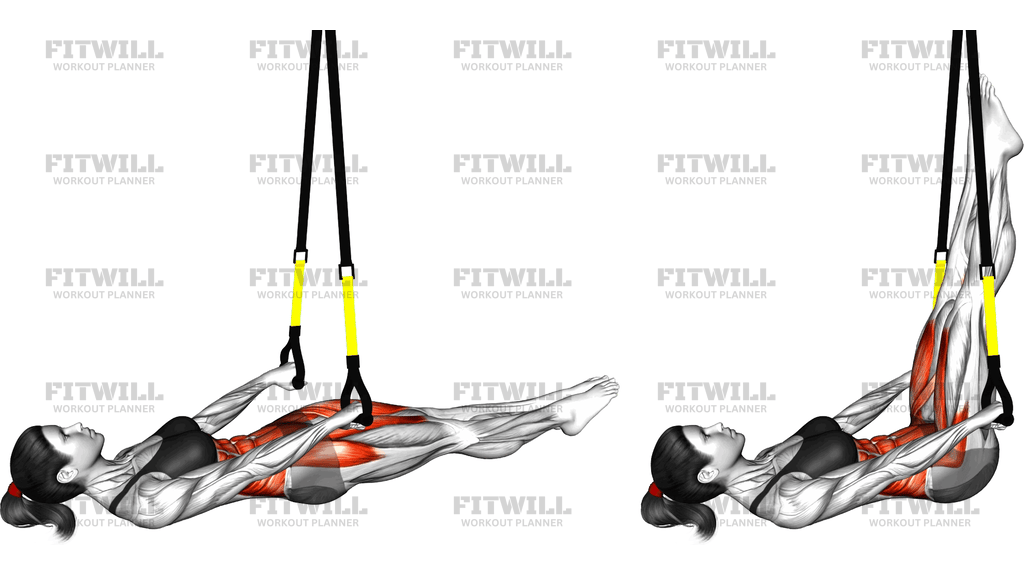
The Suspender Lying Leg Raise is a floor-based core exercise performed while lying on your back and gripping the handles of a suspension trainer for support. From a supine position with your legs extended, you raise both straight legs up until they point toward the ceiling, then lower them back down under control without letting them touch the floor. The straps act as an anchor point for your hands, which stabilizes your upper body and lets you focus entirely on moving your legs through the lift.
This movement is a step up from a standard lying leg raise. Because your legs stay fully straight, the lever arm is longer, which makes the lower abs and hip flexors work much harder through the entire range. The suspension handles also solve a common problem with floor leg raises: when the legs get heavy, many people press their arms into the ground or shrug their shoulders. Holding fixed handles keeps the arms in a stable, neutral position so the trunk does the lifting.
The primary work comes from the lower portion of the rectus abdominis, which pulls the pelvis toward the ribcage as the legs rise. The hip flexors, especially the iliopsoas and rectus femoris, drive the legs up from the hip joint, while the quads keep the knees locked straight. The deep core musculature works throughout to keep the lower back from arching off the floor, particularly as the legs descend.
Setup matters a lot in this exercise. The straps should hang low enough that you can grip the handles while lying flat with your arms alongside your body, and both straps need to be adjusted to equal length so the load stays even. If the anchor point is off-center or one strap is longer than the other, your torso will rotate or shift each rep, and the work drifts away from the abs.
To execute it well, press your lower back into the floor before each rep, keep the knees fully extended, and lift with the intention of bringing the pelvis toward the ribs rather than just swinging the feet upward. The return is just as important as the lift: lowering slowly, stopping a few inches above the floor, keeps constant tension on the abs and prevents lumbar strain.
This exercise suits people who already find lying leg raises with bent knees easy and want a harder anterior core challenge without adding weight. It fits well at the end of a workout as a finishing movement, in circuit training using suspension straps, or in gymnastics- and calisthenics-style programming where straight-leg core control is a priority. Anyone with lower back sensitivity should start with bent-knee versions and build up gradually.
[ Workout Log & Planner ]
Put your next workout in Fitwill
Keep your plan and training log ready when you are.


Instructions
- Anchor a suspension trainer at a low point and adjust both straps to equal length so the handles sit just above the floor.
- Lie flat on your back underneath the straps, reach back and take one handle in each hand, then extend your arms so your hands rest beside your hips.
- Straighten both legs fully and place your heels a few inches above the floor; press your lower back down and pull your ribs toward your hips to brace.
- Exhale and raise both straight legs up toward the ceiling, keeping the knees locked and the ankles together.
- Continue lifting until your legs are close to vertical, allowing the pelvis to tilt so the lower back stays flat against the floor at the top.
- Pause briefly at the top, then inhale as you lower both legs together in a slow, controlled arc back toward the floor.
- Stop the descent a few inches above the floor, keeping the lower back pressed down and tension in the abs.
- Begin the next rep from that hover position, and only rest your legs on the floor between sets.
- Keep your head relaxed on the floor and your grip on the handles firm but not squeezing so hard that your shoulders ride up.
- Complete your target reps without letting the knees bend or the lower back arch during the lowering phase.
Tips & Tricks
- If your heels tap the floor between reps, shorten the range by stopping higher on the way down rather than bending your knees to compensate.
- An arched lower back as the legs descend is the most common failure point here; slow the descent further or reduce the set length until you can keep the spine flat.
- Keep the kneecaps pulled tight so the legs stay straight — soft knees turn the movement into a shorter, easier raise and reduce the ab demand.
- If your grip or shoulders fatigue before your abs, lower the handles slightly or use a lighter grip so the forearms stay relaxed.
- Drive the lift by imagining you are pushing your pelvis toward the ceiling, not just moving your feet; this keeps the lower abs involved instead of the hips doing all the work.
- Pointing the toes gently upward can help you feel the quads keeping the knees extended and makes it easier to spot when they go slack.
- Avoid jerking the legs up using momentum; if the legs swing past vertical uncontrolled, pause longer at the top and cut the reps.
- Place a thin mat under your spine and head for comfort, but avoid a very thick pad that lets the pelvis sink and changes your starting angle.
- If one side feels heavier, check that both suspension straps are set to the same length before adjusting your technique.
Frequently Asked Questions
Which muscles does the Suspender Lying Leg Raise work the most?
The lower abs take the main load, with the hip flexors driving the legs up from the hips. The quads work to keep the knees straight, and the deep core stabilizes the lower back throughout.
Why hold suspension handles instead of keeping hands flat on the floor?
The handles give your arms a fixed anchor so you don't press into the ground or shrug as the legs get heavy. This keeps the upper body quiet and makes the abs and hips do the lifting.
Can beginners do the Suspender Lying Leg Raise?
It is a demanding variation, so beginners should first master bent-knee lying leg raises. Once those are solid for sets of 10 to 15 reps, straightening the legs and using the handles is a sensible progression.
How high should I raise my legs?
Lift until the legs are close to vertical and you feel your pelvis tilt toward your ribs. Going beyond that adds little and can pull the lower back off the floor.
Should my legs touch the floor between reps?
No — stop the descent a few inches above the floor so the abs stay under tension. Touching down between reps turns each rep into a fresh, easier lift and often brings the lower back into an arched position.
What is the most common mistake in this exercise?
Letting the lower back arch off the floor as the legs lower. Fix it by bracing before every rep, slowing the descent, and shortening the range if the arch still appears.
What can I use if I don't have a suspension trainer?
A pair of kettlebells or a sturdy bar to grip alongside your hips gives a similar anchor. Without any grip support, a standard lying leg raise with hands flat on the floor is the closest substitute.
Is it safe for my lower back?
When performed with the lower back pressed into the floor and a controlled lowering phase, it is generally well tolerated. If you have a history of back issues, start with bent knees and a shorter range and stop if you feel strain rather than muscle effort.
How many reps and sets should I do?
Because the straight-leg position is challenging, 2 to 4 sets of 6 to 12 controlled reps works well. Prioritize a slow, quiet descent over hitting a higher rep count.