Plank Alternate Knee Tuck
The Plank Alternate Knee Tuck is a bodyweight core exercise performed from a high plank position. From a straight-armed plank, you draw one knee in toward your chest, return it to the full plank, then repeat with the opposite knee, alternating side to side for the duration of the set. Because one leg leaves the floor at a time, your trunk has to resist rotation and sagging the entire way through, which makes this a genuine anti-rotation and stabilization drill rather than just a knee-drive movement.
This exercise earns its place in a routine by combining two jobs at once. The knee tuck itself works the lower portion of the rectus abdominis and the hip flexors as the thigh drives forward, while the plank position keeps the shoulders, chest, and triceps under constant load. The stabilization demand is where most of the benefit lives: every time one knee lifts, the opposite side of your body wants to twist or drop, and your obliques and deep core have to fight that pull. It is a efficient choice when you want meaningful abdominal work without equipment or floor space beyond a mat.
Setup matters more than most people expect. Your hands should sit directly under your shoulders with fingers spread, legs extended behind you, and your body forming one straight line from head to heels before you move at all. If you start in a sagging or piked position, the first knee tuck will exaggerate that fault and you will feel it in your lower back instead of your abs. A quick squeeze of the glutes and a firm exhale before the first rep sets the brace you will maintain throughout.
To execute it well, think of the knee traveling forward and slightly under your torso rather than dragging along the floor, and think of your hips staying level as the knee comes in. Move at a pace you can control: a quick drive in, a deliberate return. Rushing turns this into a bouncing mountain climber and strips away the stabilization work that makes it valuable. Breathe steadily, exhaling as each knee comes in and inhaling on the return.
This movement suits a wide range of trainees. Beginners can slow the tempo and limit the knee to a partial tuck, while more advanced lifters can pause the knee at the top for a beat or add a slight cross-body angle to bias the obliques. It fits naturally into warm-ups, core circuits, and home workouts, and it pairs well with static holds like the standard plank because it adds dynamic hip movement to an otherwise isometric position.
A few practical points will keep it productive and safe. If your wrists bother you in a straight-arm plank, a mat or slightly clenched fists can ease the angle, and if your lower back takes over, shorten the range and recommit to the brace before continuing. Stop the set the moment your hips start to rise or sag, because quality repetitions beat exhausted ones in every core exercise.
[ Workout Log & Planner ]
Put your next workout in Fitwill
Keep your plan and training log ready when you are.


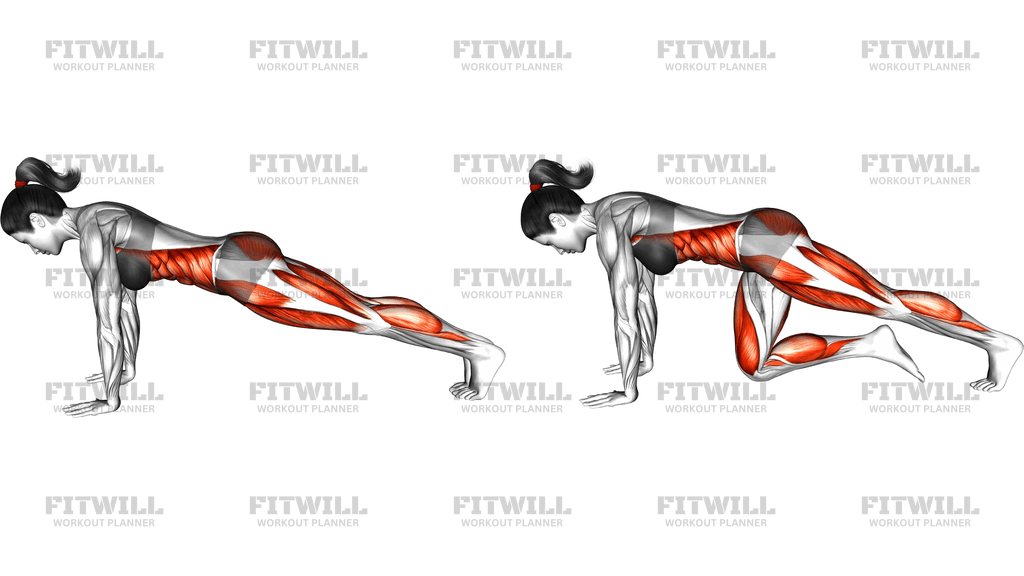
Instructions
- Set up on an exercise mat or firm floor in a high plank: hands directly under your shoulders, fingers spread, arms straight, and legs extended behind you with weight on the balls of your feet.
- Form a straight line from head to heels by squeezing your glutes, bracing your abdominals, and gently pulling your shoulder blades down away from your neck. Your gaze stays on the floor just ahead of your hands.
- Shift slightly more weight into your hands and take a firm breath in to set your brace before moving.
- Exhale and drive one knee forward toward your chest, letting the foot lift off the floor while keeping the other leg fully extended.
- Stop the knee just below or beside your chest, keeping your hips level and your shoulders stacked over your wrists the whole way in.
- Pause for a brief moment in the tucked position so the abdominal muscles, not momentum, control the end point.
- Inhale and slowly extend the leg back until the ball of the foot returns to the floor and you are back in a full plank.
- Repeat the tuck with the opposite knee, keeping the same controlled path, and continue alternating for your target number of reps.
- Maintain steady breathing throughout: exhale as each knee drives in, inhale as it returns.
- When the set is over, lower your knees to the mat to reset, shake out your wrists, and recheck your plank line before the next set.
Tips & Tricks
- If your hips twist toward the tucked side, imagine a glass of water balanced on your lower back; leveling that imaginary surface forces the obliques to do their job.
- A common mistake is dragging the foot along the floor instead of lifting it — the knee tuck only counts as core work when the leg actually leaves the ground.
- Keep your shoulders stacked directly over your wrists. If you drift back so your shoulders sit behind your hands, your wrists take the strain and the plank position falls apart.
- Avoid letting the tucked knee flare out to the side; driving it straight toward the chest keeps the hip flexors and lower abs in line rather than turning it into an external rotation.
- Slow down if you find yourself bouncing. A one-second pause with the knee tucked does more for your abs than five rushed reps, and it exposes whether your brace is holding.
- Do not hold your breath as fatigue builds. Matching one exhale to each knee drive keeps your intra-abdominal pressure manageable and your rhythm consistent.
- If your wrists ache, spread your fingers wider and grip the mat slightly, or use a folded towel under the heels of your hands to reduce the extension angle.
- Watch for the pelvis tipping into an arch as the leg extends back; re-squeeze the glutes on every return to keep the lower spine neutral.
- Start with fewer reps than you think you need. This exercise degrades quickly under fatigue, and hip sagging on rep twenty teaches your body a worse plank than stopping at twelve.
Frequently Asked Questions
What muscles does the Plank Alternate Knee Tuck work?
The primary work comes from the lower abs and hip flexors as each knee drives toward the chest. Your obliques and deep core stabilize the trunk against rotation, while the shoulders, chest, and triceps hold the plank position isometrically.
Is the Plank Alternate Knee Tuck suitable for beginners?
Yes, provided you can hold a basic high plank for at least 20-30 seconds. Beginners should slow the tempo, take a smaller knee tuck, and stop the set as soon as the hips start to sag or rise.
How is the Plank Alternate Knee Tuck different from mountain climbers?
Mountain climbers use a fast, continuous running rhythm where momentum does much of the work. The knee tuck emphasizes a deliberate drive, a pause at the top, and a controlled return, which shifts the emphasis from cardio toward abdominal control and anti-rotation strength.
Why do my lower back and not my abs feel this exercise?
That usually means your pelvis is arching as the knee tucks or as the leg extends back, letting the lumbar spine absorb the load. Re-squeeze your glutes before each rep, shorten the tuck range, and make sure your ribs stay drawn down toward your hips.
Should my hips stay completely level during the tuck?
Level hips are the goal, since dropping or twisting the pelvis defeats the anti-rotation purpose of the movement. A tiny amount of natural shift is fine, but if your hip on the tucking side visibly drops toward the floor, slow down and brace harder.
Can I do the Plank Alternate Knee Tuck every day?
Because it uses only your bodyweight and moderate resistance, frequent practice is possible, but your abs still need recovery like any other muscle. Two to four sessions per week within a broader core program is a sensible default.
What can I use instead if my wrists hurt during the plank position?
Try performing the tuck from your forearms on a mat, which removes the wrist extension entirely. Grip considerations aside, the core demand stays very similar, though the shoulder load increases slightly in a forearm position.
How many reps should I aim for?
A good target is 10-20 alternating tucks per set, counted as one rep per knee. Once you can complete all reps without your hips sagging, add a one-second pause at the top of each tuck instead of simply adding volume.
Can I add a cross-body element to work the obliques more?
Yes, driving the knee slightly toward the opposite elbow increases rotational demand on the obliques. Only add this once you can keep the hips level with the straight version, because the cross-body angle makes twisting much easier to slip into.