Kettlebell Contralateral Reverse Lunge
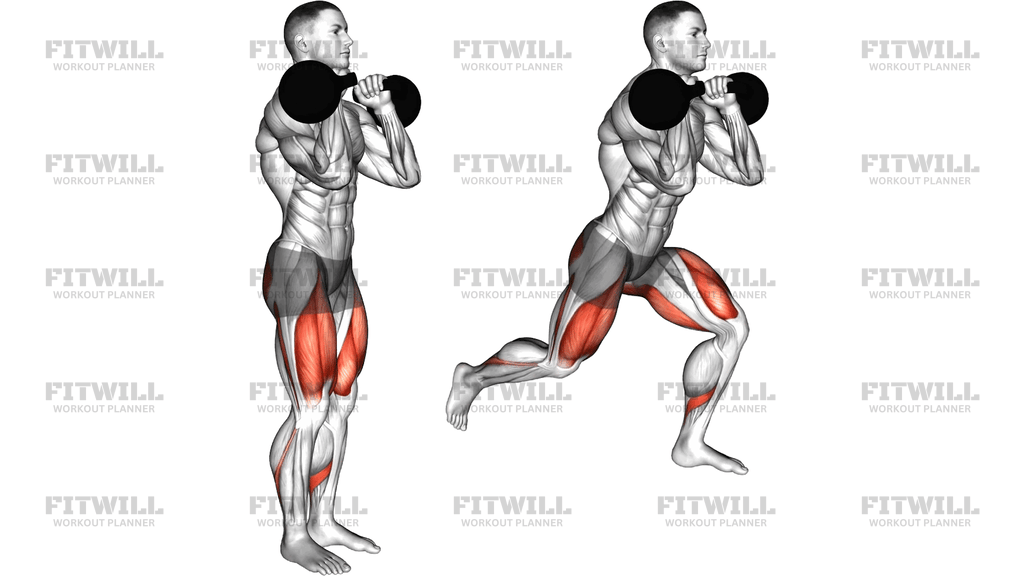
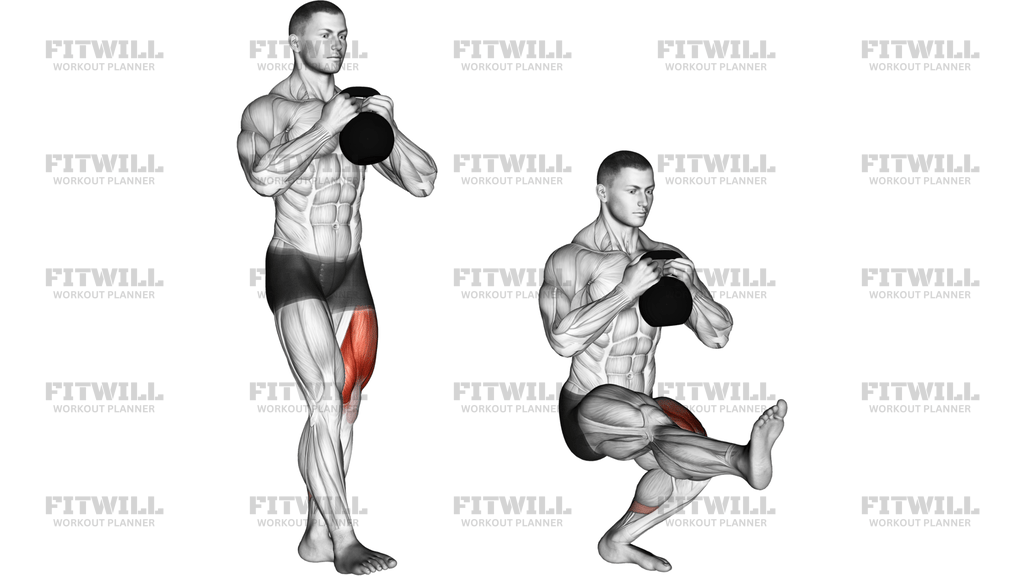
The Kettlebell Contralateral Reverse Lunge is a single kettlebell lunge performed with the bell held in the rack position on one shoulder while you step back with the opposite leg. That cross-body relationship is what makes this version different from a standard reverse lunge: the offset load on one side forces your trunk and hips to resist rotation and side-bending on every rep, so your legs do the squatting while your core does the steering.
The setup is simple but demanding. Clean a kettlebell to one shoulder so it rests against the outside of your forearm and shoulder with your elbow tucked close to your ribs, wrist straight, and knuckles facing inward. Your free arm hangs relaxed at your side. From a tall stance with feet about hip-width apart, you reach the leg opposite the bell straight back, lower until the front thigh is roughly parallel to the floor and the back knee hovers just above the ground, then drive through the front foot to stand. All reps are typically completed on one side before switching the bell to the other shoulder and lunging with the other leg.
This movement trains the quadriceps and glutes of the front leg as the primary drivers, with the hamstrings and calves assisting in the descent and the push back up. But the real value sits in the trunk: because the load sits entirely on one side, the obliques and deep core muscles on the opposite side of the body work hard to keep your hips square and shoulders level. That anti-rotation demand carries over well to running, throwing, carrying, and any sport where force travels diagonally across the body.
The contralateral setup also tends to improve lunge quality itself. Stepping back with the leg opposite the loaded shoulder naturally encourages you to sit down into the front hip instead of drifting the torso forward, and many lifters find they feel a cleaner stretch in the front-leg glute compared with an ipsilateral version.
This exercise suits intermediate lifters who are comfortable with a basic kettlebell clean and a bodyweight reverse lunge, and it is especially useful for athletes and desk-bound lifters who need unilateral leg strength plus trunk stability in one efficient movement. Start with a kettlebell you could comfortably front-rack for 30 to 60 seconds; the core challenge usually limits the load before the legs do.
Keep the working set honest: if the bell drifts off the shoulder, the torso twists toward the weight, or the front knee caves inward as you fatigue, stop the set, reset, or reduce the weight. Controlled depth with a square pelvis beats a deeper lunge performed with a rotating trunk.
[ Workout Log & Planner ]
Put your next workout in Fitwill
Keep your plan and training log ready when you are.


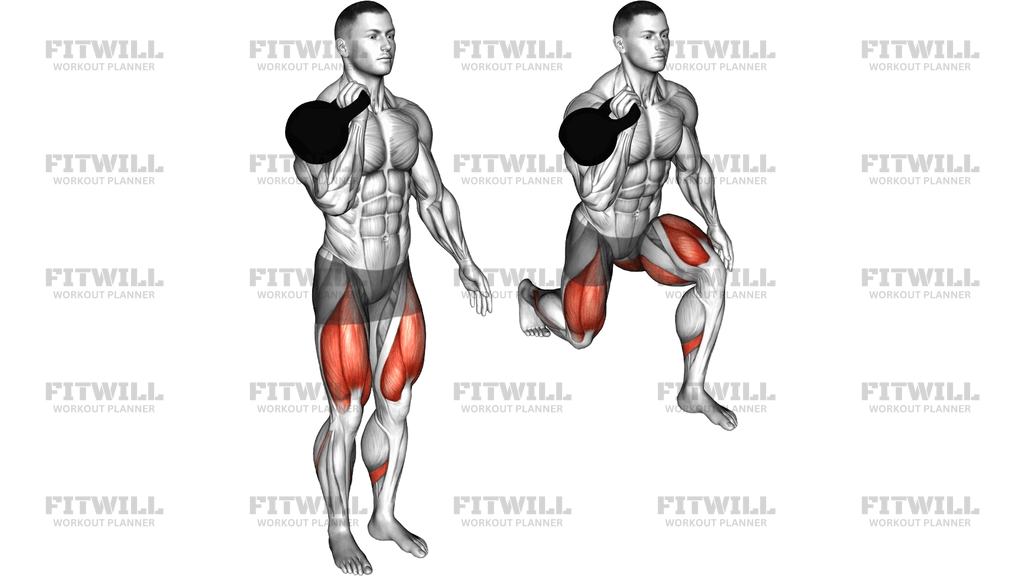
Instructions
- Clean a kettlebell to your right shoulder and settle it into the rack: bell resting on the outside of your forearm and shoulder, elbow pinned to your ribs, wrist straight, and grip relaxed.
- Stand tall with feet hip-width apart, shoulders level, and let your left arm hang loosely at your side.
- Brace your abdominals as if preparing for a light punch, and keep your ribcage stacked over your pelvis so the load cannot pull you into a lean.
- Step your left foot straight back into a long split stance, landing on the ball of that foot while your weight stays over the front leg.
- Bend both knees to lower under control until your right thigh is roughly parallel to the floor and your left knee is just above the ground, keeping your hips square to the front.
- Pause briefly at the bottom and check that your front shin stays close to vertical and your front knee tracks over your second toe.
- Drive through the heel and midfoot of the front leg to push the floor away and return to the tall standing position without leaning toward or away from the kettlebell.
- Exhale as you push up, inhale at the top before each descent, and keep the breath steady rather than holding it through the whole set.
- Complete all planned reps on this side, then clean the bell to the other shoulder and step back with the opposite leg for the same number of reps.
Tips & Tricks
- If the bell keeps rolling off the shoulder, the problem is usually a flared elbow; pin the elbow against your ribs and let the kettlebell rest on the forearm rather than gripping harder.
- Watch for the trunk twisting toward the loaded side at the bottom of the lunge. Cue yourself to press the free-side shoulder back and keep both hip points facing forward.
- Short back steps turn this into a knee-dominant grind with the front knee sliding far past the toes; take a long enough step that your front shin stays close to vertical at the bottom.
- Avoid slamming the back knee into the floor. Lower until it hovers a centimeter or two above the ground and touch down only if you are using a mat and need the tactile cue.
- Do not let the front foot roll outward as you push up. Keep the whole foot planted and think about spreading the floor with your front foot to keep the knee tracking straight.
- Excessive forward lean usually means the load is too heavy for your core right now; either drop the kettlebell weight or perform the lunge with the bell racked on the same side as the working leg first to build tolerance.
- Keep your free hand off your thigh and away from the bell. Reaching for support on every rep robs the obliques of the anti-rotation work that makes this exercise worthwhile.
- Reset your stance fully between reps if you find yourself stutter-stepping backward; a consistent step length keeps depth and balance repeatable.
- Finish the set when form changes, not when your legs are empty. A wobbly rack or twisting torso on the last two reps teaches the wrong pattern.
Frequently Asked Questions
What does 'contralateral' mean in the Kettlebell Contralateral Reverse Lunge?
It means the kettlebell is racked on one shoulder while you step back with the opposite leg. For example, the bell sits on the right shoulder and the left leg performs the reverse lunge.
Which muscles does the Kettlebell Contralateral Reverse Lunge work the most?
The quadriceps and glutes of the front leg do most of the work, with the hamstrings and calves assisting. The obliques and deep trunk muscles on the side opposite the bell work hard to keep your torso from rotating or side-bending.
Can beginners do the Kettlebell Contralateral Reverse Lunge?
Yes, if they can first perform a controlled bodyweight reverse lunge and hold a kettlebell in the rack position without discomfort. Beginners should use a light bell and shorter sets while they learn to keep the hips square.
Why rack the kettlebell on the shoulder opposite the working leg instead of the same side?
The cross-body setup creates an anti-rotation and anti-side-bend demand that a same-side hold does not, and it encourages you to sit down into the front hip rather than leaning toward the load.
How do I stop the kettlebell from pulling me sideways during the lunge?
Brace your trunk before you step back, keep your ribcage stacked over your pelvis, and actively press the shoulder on the unloaded side back so both shoulders stay level throughout the rep.
How deep should I go on each rep?
Lower until your front thigh is about parallel to the floor and your back knee is just above the ground. Depth that forces your trunk to twist or your front knee to collapse inward is too deep for your current control.
What can I substitute if I do not have a kettlebell?
A single dumbbell held vertically at the shoulder works as a close substitute. You can also perform a bodyweight reverse lunge with a band-resisted or offset one-arm carry position to keep some of the anti-rotation challenge.
Should I alternate legs every rep or complete all reps on one side?
Completing all reps on one side before switching is more common because the racked position is the limiting factor and re-cleaning every rep breaks your set. If balance is your limiter, alternating sides each rep is acceptable.
Is it safe for my knees if my front knee travels past my toes?
Some forward knee travel is normal in a lunge and not inherently a problem. What matters more is that the knee tracks over the toes without caving inward and that the movement stays controlled through the full range.
How heavy should the kettlebell be for this exercise?
Choose a weight you can hold in the rack for at least 30 to 60 seconds with a straight wrist and a tucked elbow. In this movement the trunk and grip usually fatigue before the legs, so a bell that feels easy for two-arm work may feel challenging here.