Cable Ipsilateral Glute Dominant Step Up
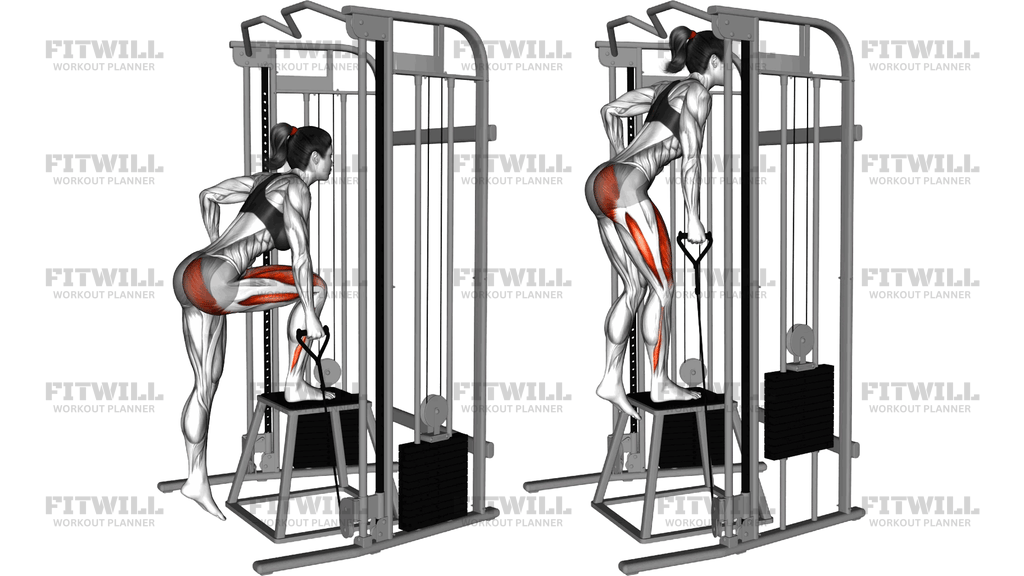
The Cable Ipsilateral Glute Dominant Step Up is a single-leg step up performed on a low platform while holding a cable handle with the hand on the same side as the working leg. The torso stays hinged forward throughout, which shifts the demand away from the quads and onto the glutes and hamstrings. Because the cable pulls diagonally across the body toward the low pulley, your same-side hip and trunk have to resist that pull on every rep, turning a simple step up into a genuine anti-rotation and hip stability exercise.
Setup matters more here than in a regular dumbbell step up. The low pulley position, the same-side grip, and the forward torso lean all work together: the lean lengthens the glutes and hamstrings of the lead leg, while the cable angle adds lateral and rotational force that a free-weight version cannot provide. If you stand too upright or hold the handle with the wrong hand, the exercise quietly becomes a quad-dominant step up and you lose the whole point of the setup.
Execution is straightforward once the position is right. Place your working foot flat on the box, hinge at the hips so your chest is angled toward the floor, and keep a soft bend in the free-hanging leg behind you. From there, drive through the whole foot — especially the heel and mid-foot — to extend the hip and bring your body to a tall stand on the box. Lower back down under control, letting the trailing leg hover rather than touch down, so the working side never gets a break.
This movement suits lifters who want more glute and hamstring emphasis without loading a barbell, as well as anyone rehabbing toward single-leg strength who needs a controlled, adjustable resistance. It is also useful for runners and field-sport athletes, since it trains hip extension and trunk stability in the same pattern used during sprinting and cutting.
Keep the weight modest at first. The cable's sideways pull is deceptively challenging, and most people fail here not because the step itself is hard, but because they cannot keep the hips square and the spine neutral while hinged. Master the position with light resistance before progressing, and stop the set as soon as your torso starts twisting or your hips start drifting toward the pulley.
[ Workout Log & Planner ]
Put your next workout in Fitwill
Keep your plan and training log ready when you are.


Instructions
- Set a step platform in front of a cable machine and attach a single handle to the low pulley.
- Grasp the handle with the hand on the same side as your working leg, and place that foot flat in the center of the platform.
- Hinge forward at the hips until your torso is angled noticeably toward the floor, letting the cable arm hang down toward the pulley, and allow the opposite leg to hang behind you with a soft knee.
- Brace your core and set your shoulders so the cable's pull is not rotating your chest toward the machine.
- Drive through the heel and mid-foot of the working leg to extend the hip and stand fully upright on the box, bringing the trailing leg up alongside if balance allows.
- Keep the hinged torso position through the entire rep rather than standing the chest up early and turning it into a quad-dominant step.
- Lower slowly by sitting the hips back and bending the working knee until the trailing foot lightly reaches or hovers just above the floor.
- Exhale as you press up to the top, inhale as you control the descent.
- Complete all reps on one side, then switch legs and re-grip the handle with the opposite hand.
- Step off the box carefully rather than hopping down, and reset your stance before the next set.
Tips & Tricks
- If your torso rotates toward the pulley on every rep, the weight is too heavy — the cable is steering you, not challenging you.
- Keep the working knee tracking over the middle of the foot; a knee that caves inward under the cable's pull means the glute medius needs lighter load and more attention.
- Do not let the trailing leg push off the floor between reps — hover it so the working hip does the work every single time.
- The height of the box changes the emphasis: a lower platform keeps tension on the glutes and hamstrings, while a higher one invites the quads to take over, so stay moderate.
- Push the floor away rather than pulling the handle — the arm should stay relaxed and long, acting as an anchor, not assisting the step.
- If your lower back rounds in the hinge, shorten the lean slightly until you can keep the spine neutral, then gradually increase the angle over time.
- A brief pause at the top with the glute squeezed hard is worth more here than extra weight, because the top is where hip extension actually finishes.
- Watch your foot placement on the platform — standing too far toward the pulley edge makes balance harder without adding glute benefit.
Frequently Asked Questions
Which muscles does the Cable Ipsilateral Glute Dominant Step Up work?
The glutes and hamstrings of the working leg do most of the hip extension, with the quads assisting to straighten the knee. The core and hip stabilizers on the same side as the cable also work hard to resist the diagonal pull.
Why does the exercise use an ipsilateral grip — same-side hand and leg?
Holding the handle on the same side as the working leg creates a diagonal resistance that forces that hip and trunk to stabilize against rotation. This loads the glutes and lateral hip musculature in a way a contralateral or dumbbell setup does not.
Is the Cable Ipsilateral Glute Dominant Step Up suitable for beginners?
Yes, provided the starting weight is light and the box is a moderate height. Beginners should first practice a bodyweight hinged step up to learn the torso position before adding the cable's sideways pull.
How far forward should my torso lean during this step up?
Far enough that you feel a stretch along the back of the working hip, usually somewhere around a 30 to 45 degree hinge. If your lower back rounds or you lose balance, reduce the lean and build back up.
What is the most common mistake with this movement?
Standing the chest up early and turning it into a quad-dominant step up, or letting the cable twist the torso toward the pulley. Both are fixed by hinging first, bracing, and using less weight until the position holds.
What can I use instead of a cable machine for this exercise?
A resistance band anchored low can reproduce the same-side diagonal pull reasonably well. Without any cable, a plain hinged step up still trains the glutes, but you lose the anti-rotation demand.
How high should the step platform be?
A moderate height — roughly knee level or slightly below — keeps the emphasis on the glutes and hamstrings and makes balance manageable. Very high boxes shift work toward the quads and make the hinge position harder to hold.
Should the trailing leg touch the floor between reps?
Ideally no — let it hover or tap down lightly only if you need balance support. Pushing off the trailing foot removes tension from the working glute and turns two-legged work into one-legged work.
Is it safe for the knees?
When performed with the knee tracking over the foot, a controlled descent, and an appropriate box height, it is generally a knee-friendly way to load the lower body. If you have a current knee issue, clear any new exercise with a qualified professional first.
How many sets and reps work best for this exercise?
Two to four sets of 8 to 12 reps per side works well, staying strictly on one side before switching. Because balance and torso control are limiting factors, prioritize clean reps over heavy weight.