Weighted Front Raise Hold
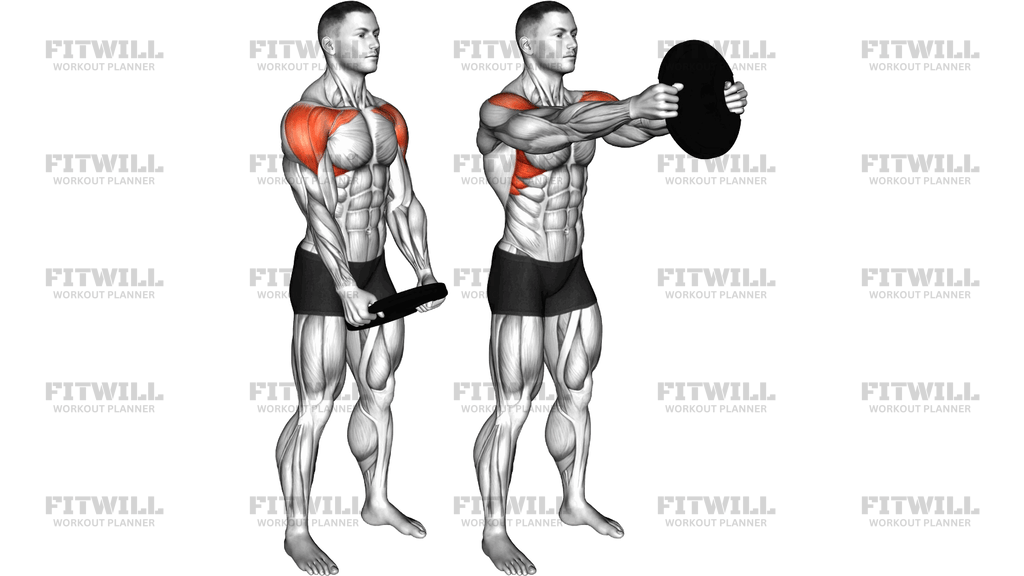
The Weighted Front Raise Hold is an isometric-focused shoulder exercise where you lift a weight plate with both hands to shoulder height in front of your body and hold it there. Instead of repeatedly raising and lowering the weight, you raise it once, park your arms parallel to the floor, and fight gravity for time. The image shows the two key positions: the plate hanging at your thighs with straight arms, and the finish position with the plate held out at shoulder level, elbows extended, torso upright.
This movement primarily targets the front shoulders, with supporting work from the upper chest, upper traps, and the muscles of the forearm and grip that keep the plate from slipping. Because you are holding a single plate with both hands at one fixed height, the demand is constant the entire set — there is no lockout or sticking point where the load eases off. That makes it an efficient way to build shoulder endurance and teach the anterior deltoid to work under sustained tension.
The setup matters more than people expect. Since you stand freely with no back support, your core and lower back must hold your torso upright while your shoulders do the lifting. If you lean back, shrug, or swing the plate up, you steal work from the front delts and turn an isolation exercise into a sloppy full-body effort. Keep the plate held by its edge with both hands, arms straight but not locked, and raise along a vertical path directly in front of your chest.
This exercise suits lifters who want to finish a shoulder session with a burnout, athletes who need sustained overhead or forward-reaching shoulder endurance, and anyone whose regular front raises stall at the top portion of the rep. It is also a good teaching tool: the static hold makes it obvious when your form drifts, because the plate drops or your torso starts to sway.
Use a weight you can genuinely hold, not just lift. A hold at shoulder height is far harder than the same weight in a dynamic raise, so most people need a lighter plate than they expect. Start with short holds of 15 to 30 seconds, keep your ribs down and glutes lightly engaged to protect your lower back, and lower the plate under control rather than letting it fall back to your thighs.
[ Workout Log & Planner ]
Put your next workout in Fitwill
Keep your plan and training log ready when you are.


Instructions
- Stand with your feet roughly hip-width apart, holding a weight plate by its edge with both hands in front of your thighs, palms facing down and knuckles forward.
- Set your posture before moving: chest tall, shoulders pulled gently back and down, ribs stacked over your hips, and a soft bend in your knees.
- Brace your core lightly as if preparing for a light push to the stomach, and take a breath in.
- Raise the plate straight up in front of your body, keeping your arms nearly straight and leading the movement with your shoulders rather than your hands.
- Stop when the plate reaches shoulder height and your arms are parallel to the floor, forming a straight line from shoulder to hand.
- Hold this top position with steady tension, keeping the plate level and your elbows extended without shrugging your upper traps toward your ears.
- Breathe in short, controlled breaths throughout the hold; do not hold your breath for the entire duration.
- After your target time, lower the plate along the same vertical path back to your thighs under control, taking two to three seconds.
- Reset your posture, shake out your shoulders and grip if needed, then begin the next hold.
Tips & Tricks
- Pick a plate weight for the hold, not the lift — a plate you can curl easily may still be too heavy to hold at shoulder height for 20 seconds.
- If your torso leans back during the hold, the weight is too heavy or your core is disengaging; lighten the load and squeeze your glutes to keep your hips stacked.
- Watch for the plate drifting above shoulder height — raising higher shifts work toward the traps and reduces the front delt tension you are trying to hold.
- Grip the plate by its edge with fingers underneath and thumbs wrapping over the top; re-gripping mid-hold with sweaty hands is a common drop risk.
- Keep a slight bend in the elbows rather than hyperextending them; straight, soft arms keep the tension on the shoulders.
- If you feel it in your neck, you are likely shrugging — consciously press your shoulder blades down and think of lifting from the shoulder itself.
- Use time as your progression tool: add 5 seconds per hold before adding plate weight, since endurance gains come first in this movement.
- The Weighted Front Raise Hold pairs well at the end of a pressing day, when the front delts are pre-fatigued and a light static hold finishes them without heavy joint stress.
Frequently Asked Questions
What muscles does the Weighted Front Raise Hold work?
The front shoulders are the main movers, held under constant tension during the static hold. The upper chest, upper traps, forearms, and grip assist, and your core stabilizes your upright torso.
How is the Weighted Front Raise Hold different from regular front raises?
Regular front raises move through repetitions, while this version parks the plate at shoulder height and holds it isometrically. The tension never drops, so the shoulders work continuously for the length of the set.
Is the Weighted Front Raise Hold good for beginners?
Yes, provided the weight is light. Beginners often benefit from starting with a small plate or even body-weight holds to learn the correct shoulder height and torso position before adding load.
How long should I hold the plate at shoulder height?
Start with 15 to 30 seconds per set and rest about a minute between holds. When you can hold clean form past 40 seconds, add time first and weight second.
Why does my lower back ache during the Weighted Front Raise Hold?
That usually means your torso is arching or leaning back to help support the load. Brace your core, squeeze your glutes lightly, and reduce the weight so your shoulders, not your spine, carry the effort.
Should my arms be completely straight during the hold?
Keep them nearly straight with a soft elbow bend. Fully locked elbows can stress the joint, while bent arms shorten the lever and make the hold easier than intended.
Can I use a dumbbell or kettlebell instead of a plate?
You can, but a plate gripped by both hands at its edge matches the intended setup and keeps the load balanced. A single dumbbell held vertically by one head is the closest substitute.
What is the most common mistake with this exercise?
Using a plate that is too heavy and compensating by shrugging, swinging, or leaning back. The hold should be a shoulder endurance challenge performed with a still torso and level plate.
Where should the Weighted Front Raise Hold go in my workout?
Place it near the end of a shoulder or upper-body session as a finisher. Because it is a sustained static effort rather than a heavy lift, it works best when the shoulders are already warm.