Standing Split Yoga Pose Urdhva Prasarita Eka Pada
The Standing Split Yoga Pose, known in Sanskrit as Urdhva Prasarita Eka Padasana, is a deep single-leg forward fold in which you balance on one leg while the other leg lifts high behind you toward the ceiling. From a standing forward fold, your fingertips or palms rest on the floor as your standing leg becomes the support pillar and the lifted leg rises until the hips approach vertical stacking. It is a signature balancing stretch that blends flexibility, stability, and body awareness into one shape.
This pose is most valuable for people with tight hamstrings, restricted hips, or stiff calves, and it is a favorite among runners, cyclists, and anyone whose daily routine involves prolonged sitting. Yoga practitioners use it as a preparation stage toward full standing splits and handstand entries, while general trainees can use it to restore hamstring length and hip mobility that conventional stretching often misses. Because it is loaded with body weight only, you can practice it anywhere without equipment.
The primary work happens in the standing leg, where the hamstrings are stretched under tension while the glutes, calves, and small stabilizers of the ankle and foot keep you anchored. The lifted leg is drawn upward by the glutes and hamstrings of that same side, and the deep core works quietly to keep the torso from twisting. Rather than forcing height in the back leg, the goal is a long, even stretch through the posterior chain.
Setup quality determines everything in this pose. Where you place your hands, how you square or intentionally open the hips, and how much weight you load into the standing heel all decide whether you get a clean hamstring stretch or a strained lower back. Keeping a soft micro-bend in the standing knee is usually the safer and more effective choice, especially if your hamstrings are not yet very open.
To execute it well, hinge from the hips with a long spine rather than rounding the back to reach the floor, then shift weight steadily into one foot before the other foot peels away. Lift the back leg from inner thigh to heel rather than swinging it up with momentum, and let the torso stay heavy and relaxed. Most lifters and yogi practitioners hold the pose for five to ten breaths per side, repeating two to three rounds as part of a flexibility or cool-down session.
Practically, the Standing Split Yoga Pose fits well at the end of leg workouts, after runs, or as part of a regular yoga flow. Treat it as a stretch with a balance challenge rather than a contest for leg height. If your hands cannot comfortably reach the floor, placing them on yoga blocks keeps the spine long and makes the pose accessible at nearly any flexibility level.
[ Workout Log & Planner ]
Put your next workout in Fitwill
Keep your plan and training log ready when you are.


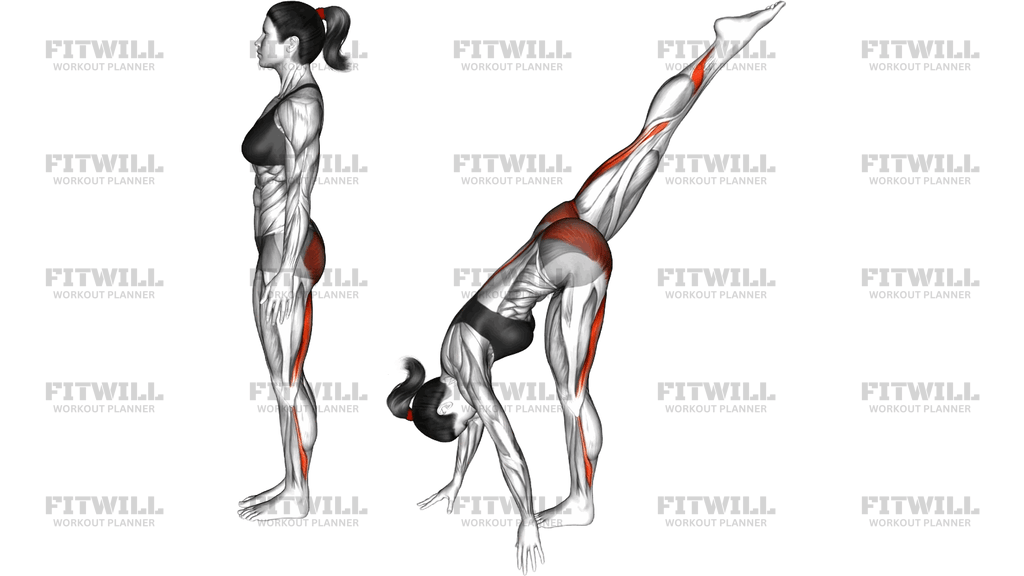
Instructions
- Stand tall at the top of your mat with feet hip-width apart and weight evenly distributed through both feet.
- Hinge forward from the hips with a long spine and place your fingertips or palms on the floor, bending the knees as much as needed to reach.
- Shift your body weight fully into the right foot, pressing the big toe base and heel firmly into the floor while keeping a soft micro-bend in that knee.
- Inhale, engage the core, and slowly float the left leg straight back and up behind you, leading with the inner thigh so the toes stay pointing down.
- Continue lifting the left leg until you feel a strong but tolerable stretch in the right hamstring, letting the torso drape toward the standing leg.
- At the top position, aim for square or gently open hips, relaxed neck and head, and hands either flat on the floor or on blocks directly under the shoulders.
- Breathe slowly through the nose, taking five to ten steady breaths while pressing the floor away with the fingertips to avoid collapsing into the standing leg.
- Exhale and lower the left leg back to the floor with control, without swinging or dropping it.
- Rise slowly to standing, rolling up one vertebra at a time with the head coming up last, then pause and reset your stance.
- Repeat on the other side for the same number of breaths to keep the work even.
Tips & Tricks
- Place yoga blocks under your hands instead of rounding the back to touch the floor; a long spine over straight knees matters more than leg height in this pose.
- The most common mistake is cranking the lifted leg up and letting the standing hip shear sideways or the torso twist; keep both hip points facing the floor to protect the lower back and sacrum.
- If the standing knee locks back hard, the hamstring stretch turns into joint strain; keep a small bend in the knee and drive the stretch by lifting the back leg slightly higher instead.
- Do not grip the floor with white-knuckled fingers; press the fingertips down and forward to lighten the load on the standing leg and sharpen your balance.
- Weight should sit in the heel and big toe base of the standing foot; if you roll onto the outer edge, the ankle wobbles and the whole pose drifts off line.
- Keep the lifted foot actively flexed or pointed with the toes facing down; a floppy, rotated foot usually signals a twisting hip and reduces the hamstring benefit.
- Momentum kills the stretch here; lift the back leg over several breaths rather than kicking it up, and lower it just as slowly.
- If your hamstrings are very tight, bend the standing knee generously and shift your hands slightly ahead of the foot, similar to a runner's lunge fold, so the leg can still travel upward.
- Warm up first with a few rounds of forward fold and low lunges; entering this deep single-leg stretch cold is the fastest route to a pulled hamstring.
Frequently Asked Questions
Which muscles does the Standing Split Yoga Pose stretch and strengthen?
The standing leg's hamstrings and calves receive the deepest stretch, while the glutes and hamstrings of the lifted leg work to raise it. The ankles, foot stabilizers, and deep core stay active the entire time to keep you balanced.
Can beginners do the Standing Split Yoga Pose?
Yes, as long as the range is scaled back. Beginners should place hands on yoga blocks or a chair, keep a generous bend in the standing knee, and lift the back leg only to a height where the hips stay level and comfortable.
How high should my leg go in the Standing Split Yoga Pose?
There is no required height; the pose is complete when you feel a strong hamstring stretch in the standing leg. Forcing the leg to vertical usually causes the hips to rotate and the lower back to twist, which defeats the purpose.
Why do my hips want to open to the side in this pose?
The hip flexors and outer hips of the lifted leg pull the pelvis into rotation as the leg rises. Actively turn the lifted toes toward the floor and think about keeping both hip points level to control it.
My hands cannot reach the floor. What should I do?
Set a pair of yoga blocks under your shoulders or rest your hands on a sturdy chair seat. The height of the support does not reduce the stretch as long as your spine stays long.
Is the Standing Split Yoga Pose safe for the lower back?
It is generally safe when the fold comes from the hips rather than a rounded spine and when the hips stay square. Avoid this pose if you currently have an acute back injury, and come out slowly if you feel any sharp or radiating sensation.
What can I substitute if balancing is too difficult?
Practice the pose with your lifted toes lightly touching a wall behind you, or do a supported version with hands on a bench. Both keep the hamstring stretch while removing most of the balance demand.
How long should I hold the Standing Split Yoga Pose?
Five to ten slow breaths per side works well for most people, and two to three rounds can deepen the stretch gradually. If your standing leg starts shaking or your breath gets strained, come out and rest.
Should the standing knee be straight or bent?
A soft micro-bend is the better default because it protects the knee joint and often lets the hamstring stretch more cleanly. Straighten the leg only if you can do so while keeping the hips square and the spine long.