Medicine Ball Slam Burpee
The Medicine Ball Slam Burpee combines two of the most demanding full-body movements into one continuous rep: an explosive medicine ball slam followed immediately by a burpee. You start standing with the ball, raise it overhead, drive it into the floor with everything you have, ride the rebound or pick it up, drop into a plank, snap your feet back in, and finish by lifting the ball as you stand back up. One rep trains power, conditioning, and coordination all at once.
This is a favorite for conditioning circuits, CrossFit-style metcons, and finishers because it keeps the heart rate high while forcing you to produce force repeatedly under fatigue. The slam portion hammers the abs, hip flexors, and shoulders through a fast, aggressive range, while the burpee adds quads, chest, and triceps work along with a serious cardiovascular demand.
The setup matters more than people expect. Your stance should be about shoulder width so you can hinge and slam straight down between your feet without the ball bouncing off your shins or drifting sideways. A ball with some bounce, like a weighted slam ball or a durable rubber medicine ball, makes the transition into the burpee smoother; a completely dead ball forces you to deadlift it off the floor each rep, which changes the rhythm.
To execute well, think of the slam as a whole-body throw, not an arm exercise. Raise the ball overhead onto your tiptoes, then violently flex your hips and slam the ball down while your hands stay connected to the path. Avoid bending your knees first and turning it into a squat toss — the power comes from the hip hinge. From the slam, control the rebound or pick the ball up, place your hands on it, and kick your feet back into a plank with a braced trunk.
The most common breakdown points are rounding the lower back during the slam, letting the ball bounce up into your face, and sagging the hips in the plank. Choose a ball weight you can throw hard and catch safely — typically 8 to 20 pounds depending on your training history. If your slam accuracy falls apart when you are tired, slow the tempo or drop to a lighter ball rather than throwing sloppy reps.
[ Workout Log & Planner ]
Put your next workout in Fitwill
Keep your plan and training log ready when you are.


Instructions
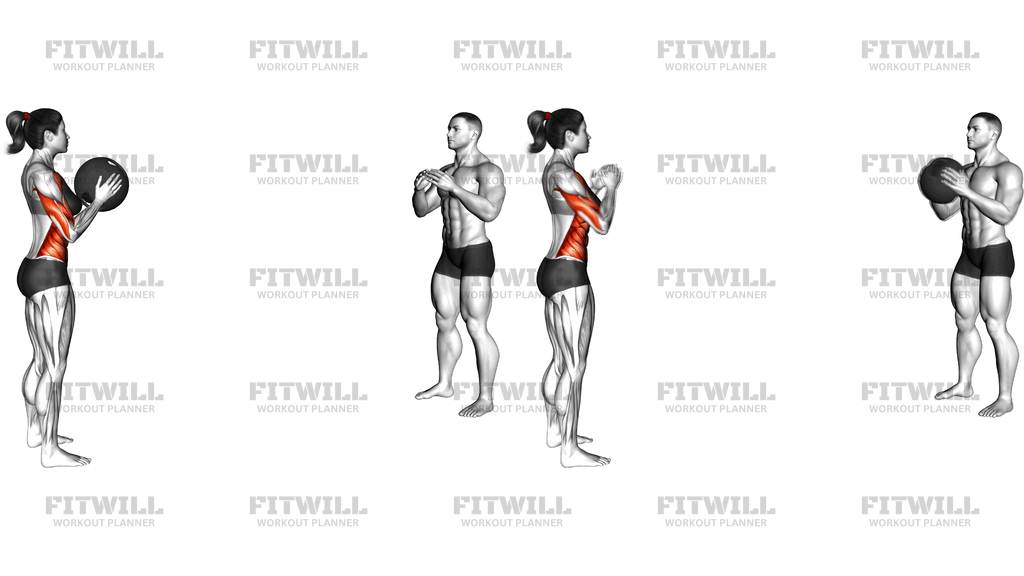
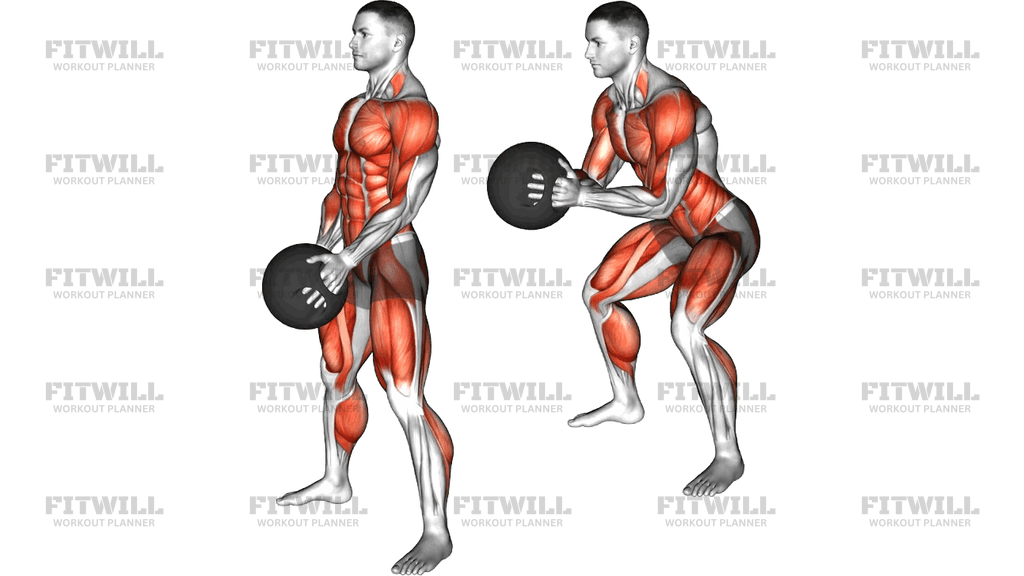
- Stand with your feet about shoulder-width apart and hold a medicine ball with both hands in front of your thighs, fingers spread around the sides of the ball.
- Check your stance so the ball can travel straight down between your feet, and clear the area in front of you in case the ball rolls or bounces forward.
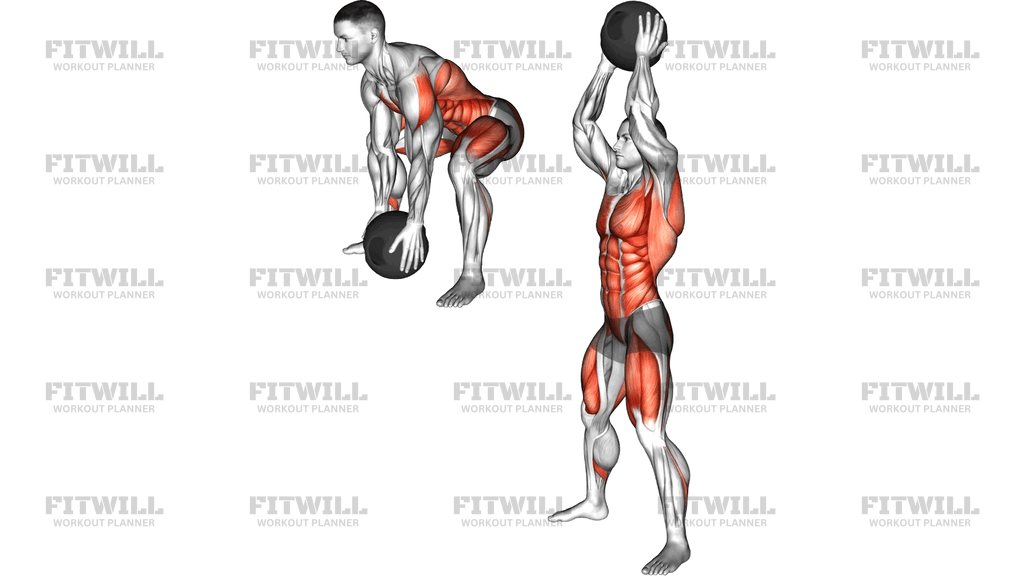
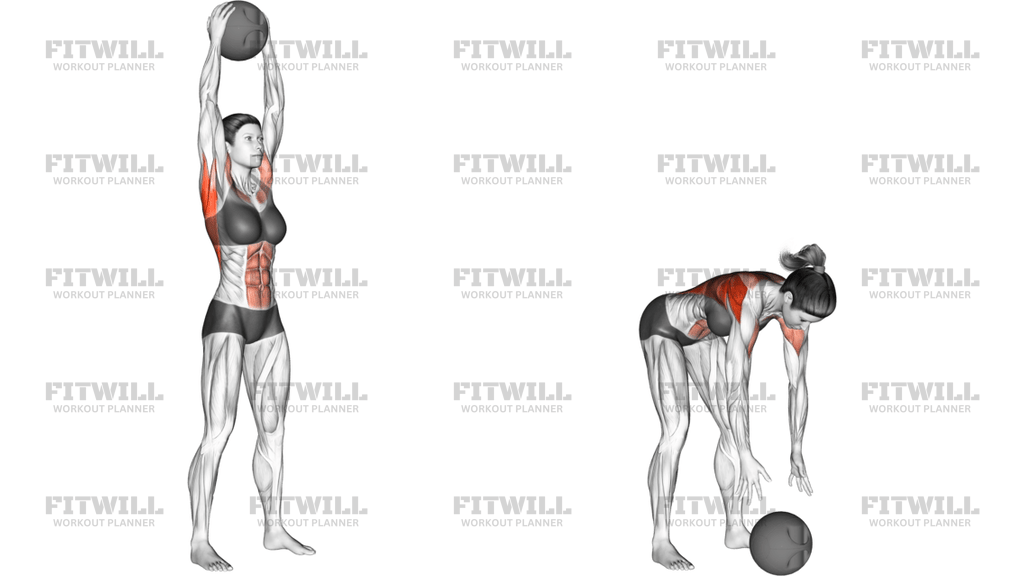
- Raise the ball overhead until your arms are extended and you are up on the balls of your feet, keeping your ribs stacked over your hips rather than arching your lower back.
- Brace your trunk, then hinge at the hips and slam the ball down into the floor as hard as you can, following through so your hands finish down by your hips.
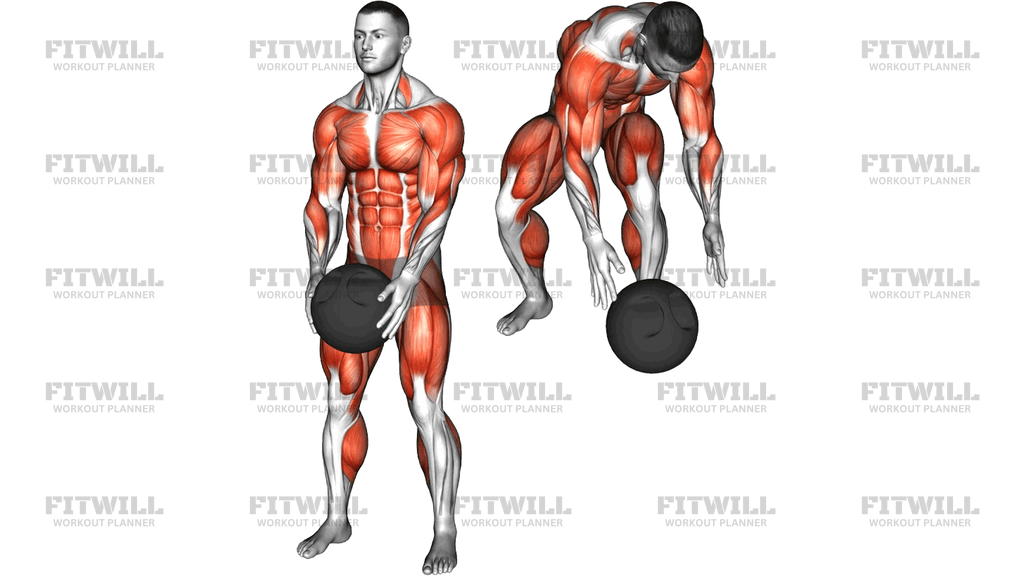
- As the ball rebounds or settles, keep your hands on it, place your palms flat on top, and kick your feet straight back into a high plank with your shoulders over your wrists.
- Lower your chest toward the ball or floor for a push-up if your variation includes one, keeping your body in a straight line from head to heels.
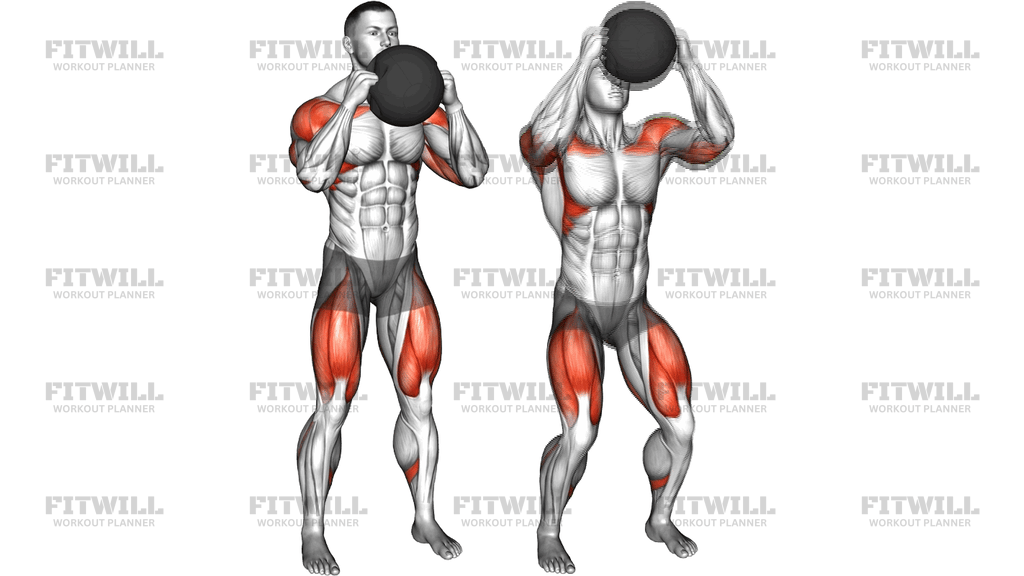
- Jump your feet back in so they land on either side of the ball, then exhale as you stand up, lifting the ball as you rise.
- Reset your grip and stance at the top, take a breath if you need it, and begin the next slam-burpee sequence.
Tips & Tricks
- Most people slam with their arms and knees. Cue yourself to start the throw from the hips — think of folding your torso down like a gymnast pike, with the arms just steering the ball.
- If the ball bounces unpredictably and comes back toward you, chase it down with your hands, but keep your chin tucked and face out of the flight path. Switching to a lower-bounce slam ball solves this for most people.
- Rounding your lower back at the bottom of the slam is the most common fault. Hinge only as far as your hamstrings allow while keeping a braced, neutral trunk.
- In the plank portion, hips that sag or pike up mean your trunk has quit before your lungs have. Squeeze your glutes and quads to hold a straight line, or step your feet back one at a time instead of jumping.
- Choose ball weight by throw quality, not ego. If you cannot slam explosively for all planned reps, the ball is too heavy and you will start muscling it down with your shoulders.
- For pacing, treat the stand-up with the ball as your recovery breath. Rushing every transition is what turns this into sloppy, shuffling reps by round three.
- Keep your hands on the ball through the slam-to-plank transition when possible. Reaching for a ball that rolled away breaks rhythm and adds needless lower back rounding under fatigue.
- If the floor is thin, elevated, or shared, a slam may not be appropriate — the burpee can be done with the ball held at the chest instead of thrown, keeping the training effect without the impact noise.
Frequently Asked Questions
What muscles does the Medicine Ball Slam Burpee work?
The slam drives the abs, hip flexors, lats, and shoulders, while the burpee adds quads, glutes, chest, and triceps. It is genuinely a full-body movement with a heavy conditioning component.
Is the Medicine Ball Slam Burpee suitable for beginners?
Yes, if you scale it. Learn the slam and the burpee separately first, then use a light ball, step back instead of jumping into the plank, and skip the push-up until the pattern feels automatic.
How heavy should the medicine ball be for slam burpees?
Pick a weight you can throw down explosively for every rep of your set — commonly 8 to 15 pounds for most lifters. If your slam height or accuracy drops as you fatigue, the ball is too heavy.
Should I catch the rebound after the slam or let the ball rest?
Either works. Catching a controlled rebound keeps the rhythm fast and adds a little extra bracing demand, while letting the ball settle and picking it up is safer and better when you are learning or very fatigued.
Why does my lower back ache after doing Medicine Ball Slam Burpees?
It usually means you are rounding through the bottom of the slam or letting your hips sag in the plank. Hinge from the hips with a braced trunk, and make sure you are standing tall between reps instead of staying folded over.
Can I do this exercise without a medicine ball?
You can substitute a slam with a dumbbell held in both hands by the head (never thrown) or do a burpee with a ball held at your chest, but the explosive throw is what makes the slam version unique, so a ball is worth using if you have one.
How is a Medicine Ball Slam Burpee different from a regular burpee?
The slam adds an explosive overhead-to-floor throw that trains trunk power and shoulder speed, and the ball gives you a fixed hand position for the plank and stand-up. The overall demand on your conditioning is higher because you are moving an external load through the whole rep.
How many reps and sets should I use?
For conditioning, work in intervals like 20 seconds on and 40 seconds off, or sets of 6 to 10 reps for 3 to 5 rounds. Keep the quality of the slam high — stop the set when your throws get slow or inaccurate.
What kind of floor do I need for medicine ball slams?
A firm, flat surface that can handle impact, such as rubber gym flooring or concrete, works best. Avoid glass, tile, or shared floors where a heavy ball slamming down will damage the surface or disturb people below.