Medicine Ball Twist Turn Slam
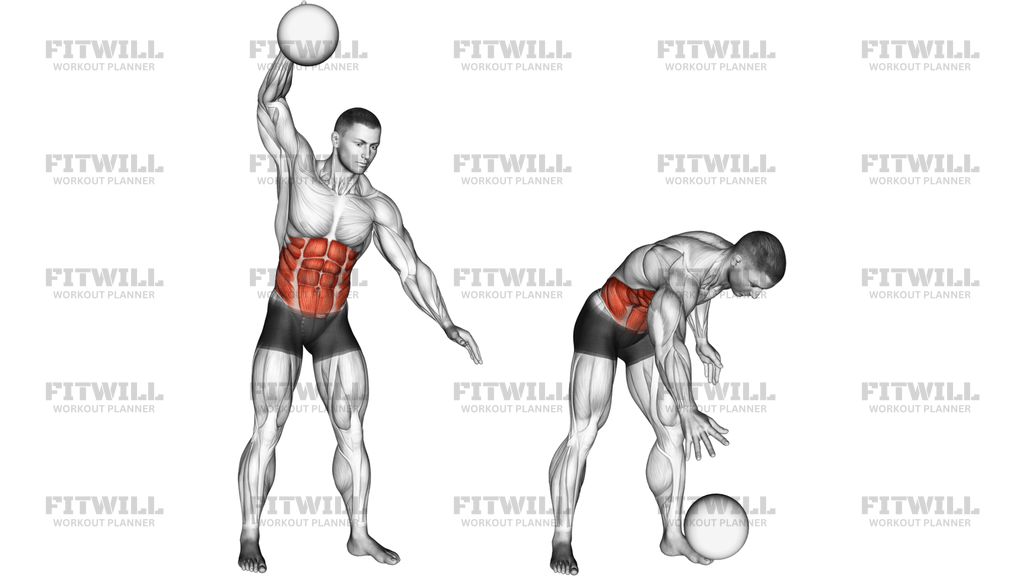
The Medicine Ball Twist Turn Slam is an explosive rotational movement that combines a twisting wind-up with an overhead ball slam. You start with a medicine ball held overhead with both hands, turn your torso to load one side, then whip the ball down diagonally across your body and slam it into the floor with as much force as you can produce. It is one of the few exercises that lets you train trunk rotation at full speed, which is difficult to do safely with weights.
This movement suits athletes in rotational sports such as baseball, tennis, golf, and combat sports, as well as anyone who wants a powerful midsection rather than just a static one. The twisting action heavily challenges the obliques and deep core, while the overhead reach and slam recruit the shoulders, lats, and arms. Because the legs are planted in a wide, bent-knee stance, the glutes and quads work continuously to stabilize your base and transfer force from the ground up.
Setup matters more than people expect. A shoulder-width to slightly wider stance with soft knees gives you a stable platform, and holding the ball with both hands at its sides keeps your wrists neutral overhead. The turn should come from your hips and ribcage rotating together, not from your arms swinging independently. If your feet slide or your lower back arches while the ball is overhead, reduce the ball weight before going further.
To execute well, think of the movement as one connected chain: turn, coil, then unleash. Rotate to one side with the ball extended overhead, brace your core, then rotate forcefully in the opposite direction and throw the ball down beside your front foot or hip. Follow through with your arms and let your back heel pivot naturally. Pick the ball up, switch sides, and repeat with the same intent on each rep.
The Medicine Ball Twist Turn Slam works well as a conditioning finisher, a warm-up power drill, or a main explosive core exercise in an athletic program. Keep the reps crisp and stop when the slam loses its snap. Slowing down just to squeeze out more reps usually means the core is fatigued and the lower back is about to start compensating, so end the set with quality intact.
[ Workout Log & Planner ]
Put your next workout in Fitwill
Keep your plan and training log ready when you are.


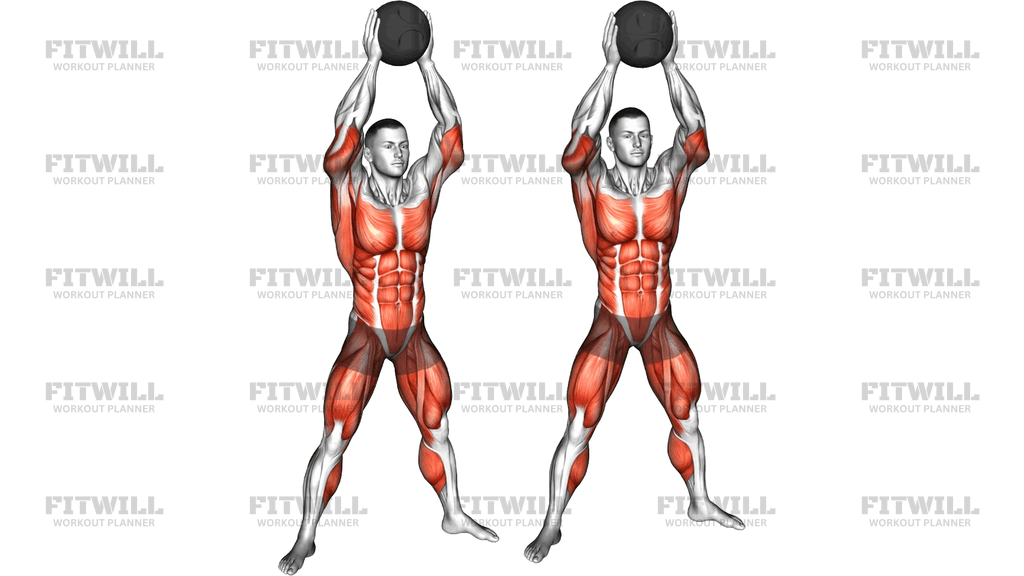
Instructions
- Stand with your feet slightly wider than shoulder-width apart and your knees softly bent, holding a medicine ball with both hands cupped at its sides.
- Raise the ball straight overhead until your arms are nearly locked out, keeping your ribs stacked over your pelvis and your shoulders down away from your ears.
- Rotate your torso to the right so the ball travels diagonally overhead toward that side, letting your left heel lift slightly as you coil.
- Brace your abs and hold a short pause at the top of the turn to set your trunk before the throw.
- Forcefully rotate your torso to the left, whipping the ball down in a diagonal arc across the front of your body.
- Slam the ball into the floor just outside your left foot, finishing with your arms extended and your weight shifted over the left leg.
- Exhale sharply as you throw and slam; breathe in as you lift the ball back up and reset.
- Squat down to pick up the ball, raise it back overhead, and coil to the opposite side to repeat the turn and slam in the other direction.
- Continue alternating sides for equal reps, resetting your stance and brace before every throw.
Tips & Tricks
- Choose a ball that bounces predictably and does not ricochet back into your face; a slam ball or moderately soft medicine ball is safer for this movement than a hard rubber ball.
- If your lower back arches when the ball is overhead, cut the overhead range slightly and focus on keeping your ribs pulled down before adding speed.
- Most of the power should come from hip and trunk rotation, not from your arms; if your shoulders are doing all the work, exaggerate the coil at the top of the turn.
- Pivot the back foot as you turn instead of twisting a planted foot against the floor, which strains the knee.
- Aim the slam to a specific spot on the floor beside your foot rather than throwing downward randomly, so the diagonal path stays consistent.
- Keep your knees bent throughout; standing tall and straight-legged removes the glute and quad drive and dumps stress onto the lumbar spine.
- Do not chase reps once the slam sounds flat and quiet — a dull landing means the explosiveness is gone and the set should end.
- On a slick floor, widen your stance slightly and grip the floor with your toes, because the rotational force tends to slide the feet inward.
Frequently Asked Questions
What muscles does the Medicine Ball Twist Turn Slam work?
The abs and obliques drive the twisting slam, with strong support from the shoulders and arms during the overhead hold and throw. The glutes, quads, and lower back stabilize your stance and transfer force from the ground through your trunk.
Is the Medicine Ball Twist Turn Slam suitable for beginners?
Yes, but start with a light ball and slow turns before adding slam speed. A beginner who can hold the ball overhead without arching the lower back and can rotate without the feet sliding is ready to progress to full-speed slams.
How heavy should the medicine ball be for this exercise?
Most people do best with a ball between 4 and 10 pounds. If you cannot maintain a fast, accurate slam by the last rep, the ball is too heavy for power work.
Why does the ball travel diagonally instead of straight down?
The diagonal path mirrors how the body actually rotates, loading the obliques across their natural fiber direction and matching the force patterns used in throwing, swinging, and striking sports.
What is the most common mistake in the Medicine Ball Twist Turn Slam?
Arm-dominant throwing, where the trunk barely rotates and the shoulders do everything. Fix it by exaggerating the coil at the top and thinking of the arms as the last link in the chain, not the engine.
Can I do this exercise without a slam, just turning with the ball?
Yes, the twist and turn portion alone makes a good warm-up or lower-impact option. You lose some power output, but the rotational core demand remains.
How many reps and sets should I use?
For power and athleticism, work in sets of 4 to 8 slams per side with full recovery between sets. For conditioning, use longer timed rounds but stop as soon as the slam quality drops.
Is the Medicine Ball Twist Turn Slam safe for the lower back?
It is generally safe when the knees stay bent, the feet pivot rather than twist, and the ball weight allows controlled rotation. People with a sensitive lower back should keep the slam lighter and prioritize smooth rotation over force.
What can I substitute if I do not have a medicine ball?
A weighted ball of any kind, a slam ball, or even a single dumbbell held by one head works, though you may need to set it down rather than slam it. Resistance bands anchored overhead can also simulate the diagonal pull.