Jack Burpee
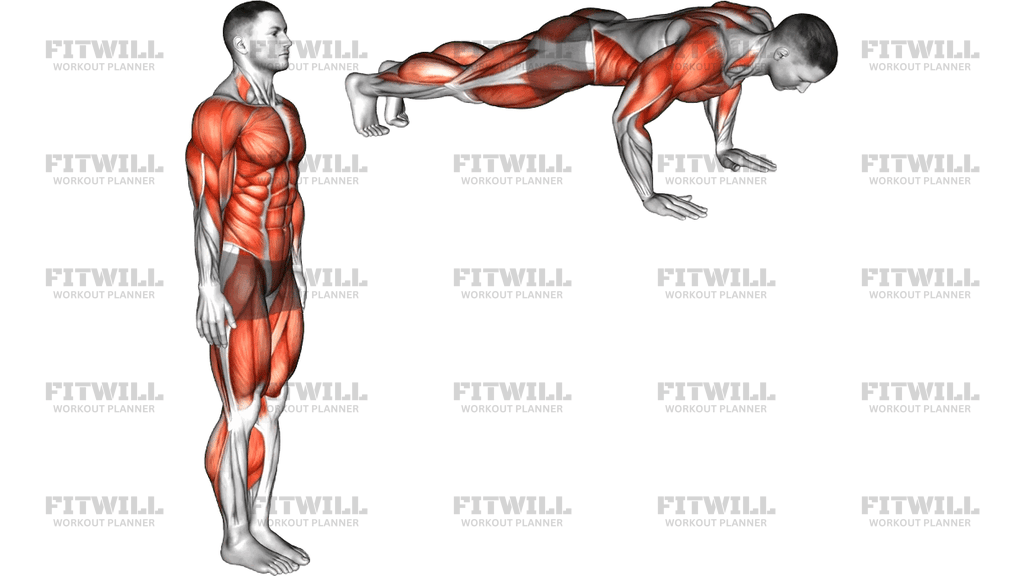
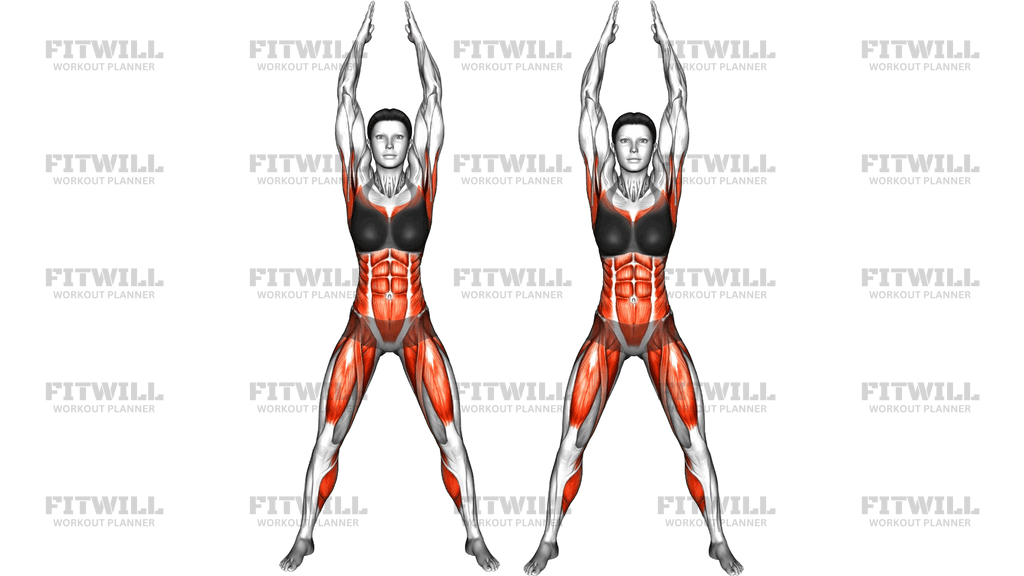
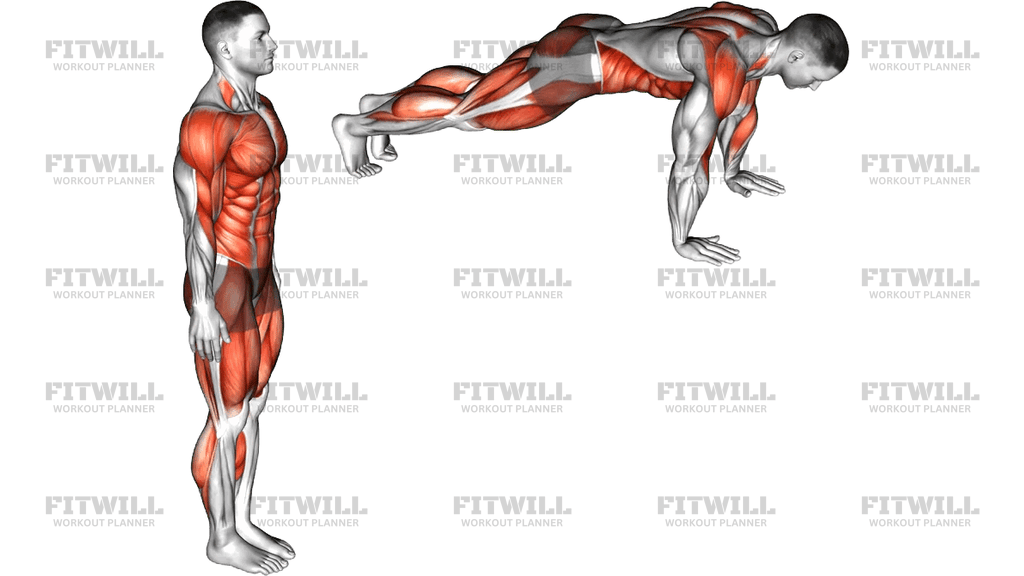
The Jack Burpee is a full-body conditioning movement that combines the classic burpee with a jumping-jack-style leg action. You start standing, drop into a squat, kick both feet back into a high plank with the hands set on the floor, then jump the feet forward again and finish back on your feet. What separates it from a standard burpee is the width of the landing: the feet drive out wide as they travel back and snap back in together, adding a lateral hip and inner-thigh component that most burpee variations never touch.
This exercise earns its place in almost any conditioning program because it trains the entire body while driving the heart rate up fast. The squat and kick-back load the quads, glutes, and hamstrings, the plank position demands work from the chest, shoulders, and triceps just to hold a stable line, and the repeated jumps recruit the calves and hip flexors with every rep. Because there is no equipment needed and only a small patch of floor required, it fits easily into home workouts, warm-up circuits, HITP intervals, and finishers at the end of a strength session.
Setup matters more than people expect. Your hands should land flat with fingers spread, and your body should form one straight line from shoulders to heels when you reach the plank — not a sagging hip or a piked waist. A sloppy plank position turns every rep into a lower-back stress test, while a tight, braced position lets the chest, shoulders, and core share the load properly. Take the time to plant the hands and set the plank before rushing into the next jump.
Execution should be rhythmic but not reckless. The power comes from the hips and legs: sit back into the squat, shoot the feet out wide, land softly on the balls of the feet, then reverse the motion by jumping them back in under the hips and standing tall. If the full jump-back and jump-in version beats up your wrists or knees, you can step the feet back and in one at a time while keeping the same wide-leg pattern and still get most of the conditioning benefit.
Practically, the Jack Burpee works best in timed intervals — 20 to 40 seconds of work with equal or shorter rest — or in rep ladders of 8 to 15 reps. Beginners should prioritize the quality of the plank and the softness of the landings before increasing speed, and anyone with wrist, knee, or lower-back irritation should keep the volume modest and the movement pattern crisp rather than chasing fatigue.
[ Workout Log & Planner ]
Put your next workout in Fitwill
Keep your plan and training log ready when you are.


Instructions
- Stand tall with the feet about hip-width apart, arms relaxed at your sides, and a clear stretch of floor in front of you.
- Drop into a quarter squat by pushing the hips back and bending the knees, then place both palms flat on the floor under the shoulders with fingers spread wide.
- From the squat, drive both feet back and out wide in one motion, landing on the balls of the feet so your body forms a straight line from head to heels in a high plank.
- Squeeze the glutes, brace the abs, and keep the neck neutral so the hips stay level and the chest hovers above the floor without sagging.
- Optional but standard for this variation: perform a push-up by bending the elbows until the chest nears the floor, then press back to the plank before continuing.
- Jump both feet forward and back in under the hands, returning to a low squat with the weight on the mid-foot.
- Explode up to a full stand, reaching the hips through and letting the arms swing naturally for momentum.
- Exhale as you jump the feet out to the plank and inhale as you jump them back in to the squat, keeping the breath steady rather than holding it.
- Reset the hand position and plank line before each rep if your hands drift, then continue at a pace you can hold without the hips collapsing.
Tips & Tricks
- If your lower back aches during the plank phase, the hips are usually sagging — shorten the distance between feet and hands slightly and squeeze the glutes to level the pelvis.
- Land the feet softly on the balls of the feet both going out and coming in; heavy heel slams are the fastest way to irritate the knees and ankles.
- Keep the elbows stacked roughly over the wrists in the plank rather than letting the hands slide forward, which strains the shoulders.
- If your wrists complain about the jump-back, step the feet out one at a time or place your hands on a low step or bench to reduce the angle.
- Do not pike the hips toward the ceiling when kicking out — the plank is the position, not a downward dog.
- Speed comes last. Learn the four positions (stand, squat, wide plank, squat) slowly, then increase tempo once each transition feels automatic.
- On a hard floor, a thin exercise mat under the hands noticeably reduces wrist pressure without making the standing and jumping unstable.
- Avoid holding your breath through the jump-back; a hissed exhale as the feet kick out keeps the core braced and the rhythm intact.
Frequently Asked Questions
What muscles does the Jack Burpee work?
It is a genuine full-body movement: the quads, glutes, and hamstrings power the squat and jumps, the chest, shoulders, and triceps stabilize and press in the plank, and the core ties everything together. The wide-leg kick also adds extra demand on the hip flexors and inner thighs compared to a standard burpee.
What makes the Jack Burpee different from a regular Burpee?
In the Jack Burpee the feet jump out wide as you kick back and snap back in together, mimicking the leg pattern of a jumping jack. This adds a lateral component that recruits the outer hips and inner thighs more than the straight up-and-down line of a standard burpee.
Is the push-up mandatory in the Jack Burpee?
No. Many people perform it as a squat-thrust with the wide-leg jump and skip the push-up, especially in high-rep conditioning sets. Add the push-up when you want extra upper-body volume or keep it out when the goal is pure leg and heart-rate work.
Can beginners do the Jack Burpee safely?
Yes, with modifications. Step the feet back and in instead of jumping, skip the push-up, and slow the pace until the plank position feels solid. Once the transitions are clean, reintroduce the jumps one at a time.
How do I protect my wrists during the jump-back?
Spread the fingers wide, press the floor away so the weight sits across the palm rather than jammed at the base of the wrist, and keep the shoulders over the hands. If that is not enough, step instead of jumping or elevate the hands on a low bench.
Why do my hips sag in the plank phase, and how do I fix it?
Sagging usually means the core has stopped bracing or the feet are planted too far back relative to the hands. Jump the feet out to a slightly narrower width and consciously squeeze the glutes and abs so the body forms one straight line from shoulders to heels.
How many Jack Burpees should I do in a workout?
A practical starting point is 3 to 5 rounds of 8 to 12 reps, or 20 to 30 seconds of work with equal rest. Build volume gradually — burpees punish sloppy fatigue faster than almost any other body-weight exercise.
What can I substitute if jumping is not an option for me?
A step-back Jack Burpee works the same pattern: step the feet out wide one at a time to the plank, then step them back in and stand. You lose some power output and heart-rate spike but keep the full-body and hip pattern intact.
Should I do the Jack Burpee before or after strength training?
Use it as a finisher after lifting or inside a dedicated conditioning block. Doing high-rep burpees before heavy squats, deadlifts, or presses fatigues the legs and core and makes it harder to hold good technique under load.
How do I land properly at the top of each rep?
Come up onto the balls of the feet, let the knees bend slightly to absorb the landing, and finish standing fully tall with the hips extended. Landing stiff-legged with locked knees sends the impact straight into the joints instead of the muscles.