Prayer Push (Version 2)
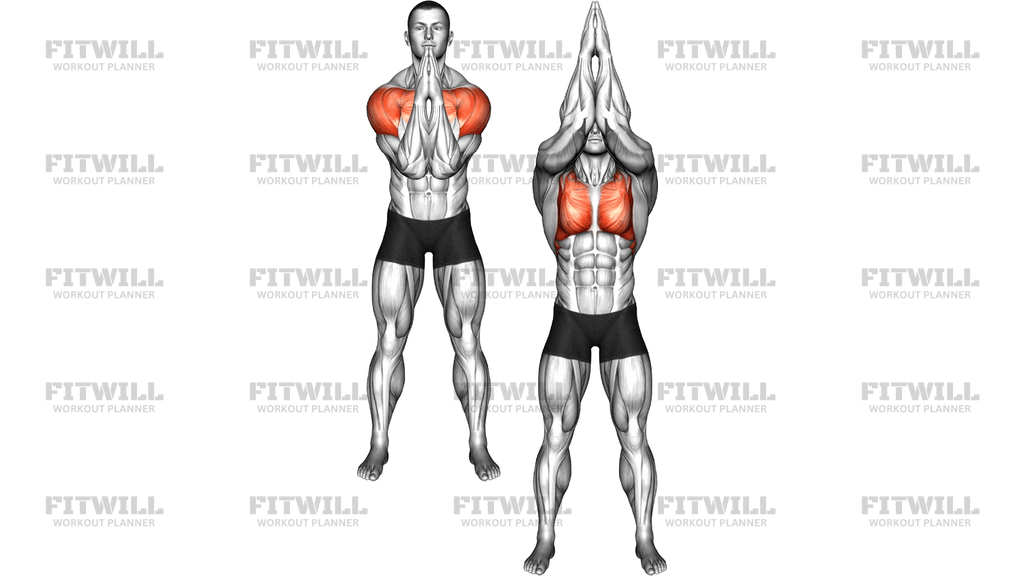
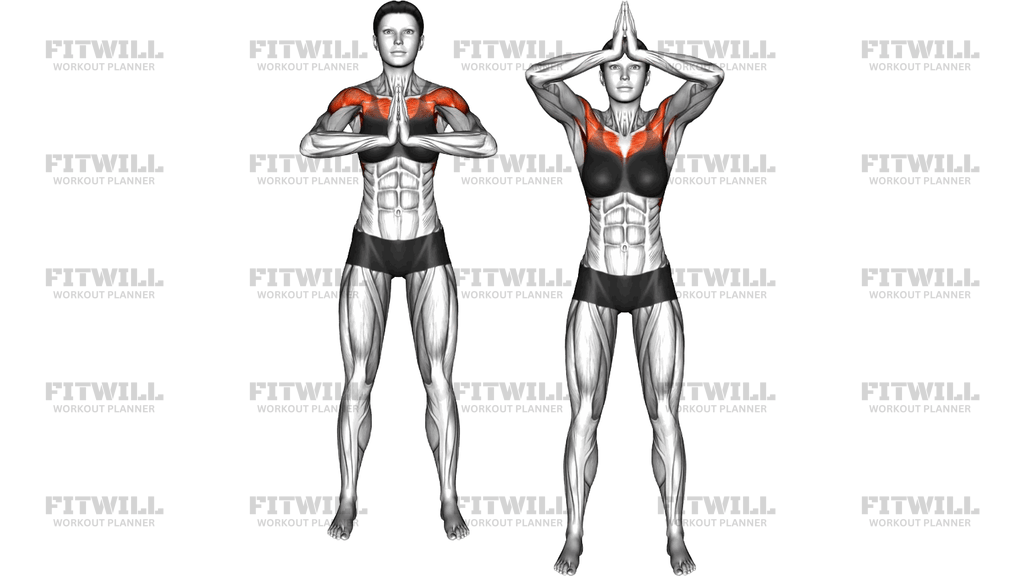
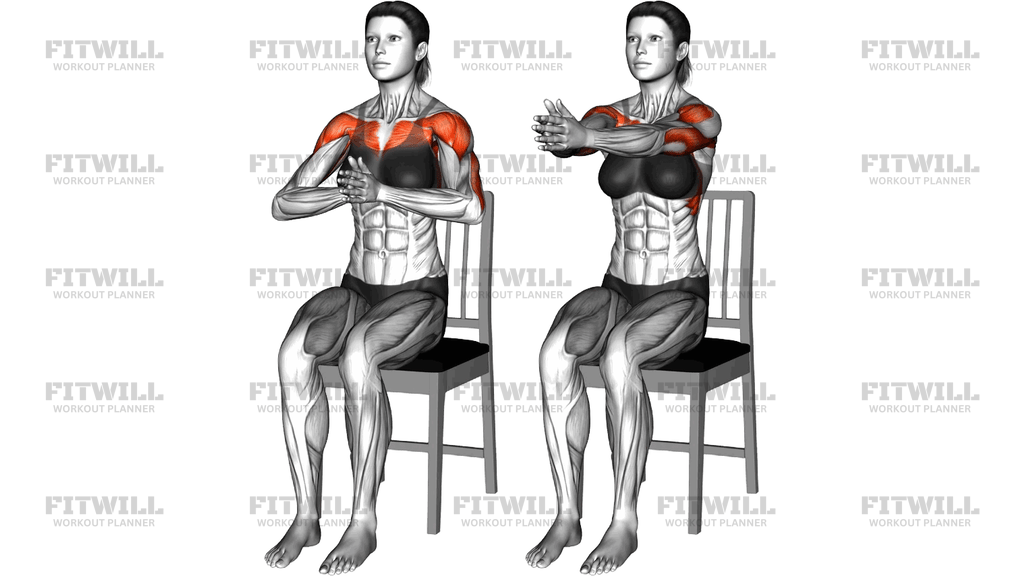
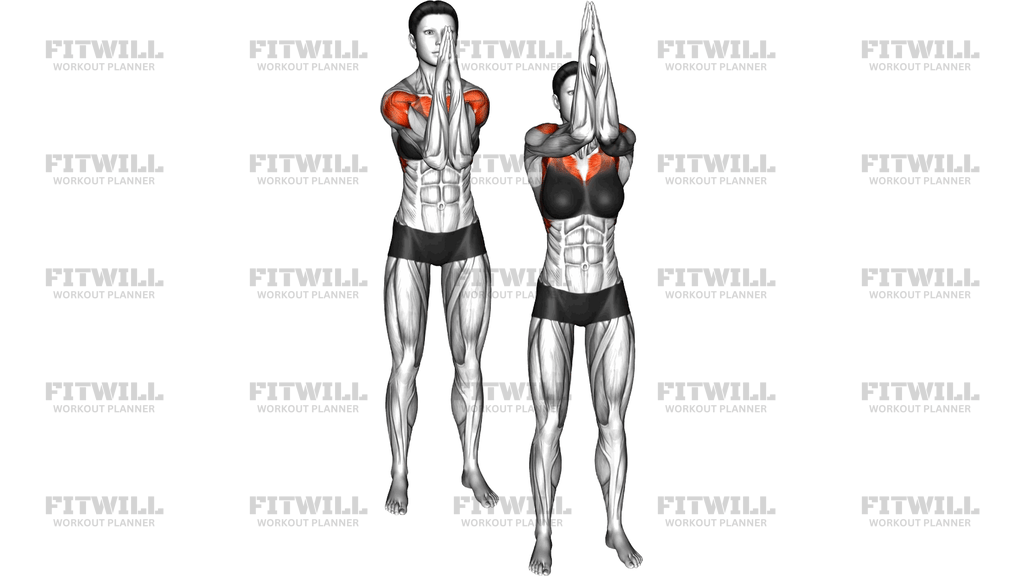
The Prayer Push is a bodyweight pressing exercise where you press your palms firmly together in a prayer position and keep that squeeze while raising your hands from chest height to full extension overhead. Because your hands never move relative to each other, the resistance comes entirely from your own muscles working against one another, which makes this a self-resisted, isometric-style movement rather than a lift against an external load.
The main work happens in the chest, particularly the pectoralis major, which contracts hard to press the palms together. The front shoulders assist throughout, and the triceps stay engaged to keep the elbows straight as the arms rise overhead. Your upper back and core also contribute more than you might expect, since they must hold your ribcage and shoulders steady while the arms travel up and down.
This movement is a good fit for people who train without equipment, for beginners learning what a chest contraction is supposed to feel like, and for anyone who wants a low-joint-stress way to work the pressing muscles. It is also a useful activation drill before bench pressing or push-up work, because the sustained palm squeeze drives blood into the chest and front delts and sharpens your awareness of that squeezing action. Travelers, office workers, and people rehabbing around busy gyms appreciate it because it needs no setup and only a small amount of space.
The setup matters because the quality of the exercise lives or dies with the palm pressure. If your hands are only lightly touching, there is no resistance and nothing is being trained. Pressing the palms together with genuine effort, fingers pointing up and elbows flared out to the sides, creates the internal tension that the upward arm path then has to overcome. Keeping the pressure constant as the arms travel overhead is what separates a productive repetition from an empty one.
To perform it well, stand tall with your feet about hip-width apart and your ribs stacked over your pelvis. Bring your palms together in front of your chest, press them hard against each other, and then sweep your hands upward in one smooth arc until your arms are straight overhead. Pause briefly at the top, then lower with the same deliberate control while maintaining the squeeze. Avoid letting your shoulders shrug toward your ears or your lower back arch as the hands rise.
A practical safety note: the effort should feel like muscular work across the chest, shoulders, and arms, not strain in the neck, wrists, or lower back. If you feel pinching at the shoulder as the arms pass face height, reduce the palm pressure slightly or shorten the range until you can move through that zone comfortably.
Fitwill
Log Workouts, Track Progress & Build Strength.
Achieve more with Fitwill: explore over 9600 exercises with images and videos, access built-in and custom workouts, perfect for both gym and home sessions, and see real results.
Start your journey. Download today!




Instructions
- Stand upright with your feet hip-width apart, knees soft but not bent, and your weight balanced evenly across both feet.
- Bring your palms together in front of your chest in a prayer position, fingers pointing up, with your elbows flared out to the sides at roughly chest height.
- Press your palms firmly against each other and hold that pressure for the entire repetition; the squeeze is the resistance.
- Brace your core lightly and draw your shoulders down away from your ears so your neck stays long.
- Keeping the palms pressed together, sweep your hands upward in a smooth arc in front of your face until your arms are fully extended overhead.
- Pause for one to two seconds at the top with elbows straight and the squeeze still active.
- Lower your hands back to chest height along the same path, taking two to three seconds and resisting the urge to let the pressure fade.
- Exhale as you press upward and inhale as you lower; keep breathing steadily rather than holding your breath.
- Complete your repetitions as one continuous flow, resetting your posture and palm pressure at chest height before the next rep.
Tips & Tricks
- The most common failure is letting the palm pressure drop as the hands travel overhead, which quietly turns the rep into a plain arm raise. Cue yourself to squeeze harder at the top, not less.
- If your shoulders shrug up as your arms rise, the upper traps take over and the chest gets less work. Lower your hands only as high as you can go without the shoulders creeping toward your ears.
- Keep the fingers pointing up and the wrists stacked; collapsing the wrists sideways as you press is a frequent cause of wrist discomfort in this drill.
- Aim for moderate-to-hard palm pressure you can sustain for the whole set, not a momentary crushing squeeze that fades after two reps.
- If you feel a pinch at the front of the shoulder as the hands pass face height, reduce the intensity of the squeeze by about half and see whether the arc feels smoother.
- Think of pushing your elbows up and out rather than just lifting your hands; this keeps the chest and front delts driving the movement.
- Avoid leaning back or arching the lower back as the arms go overhead; keep the ribs stacked over the pelvis and let the core do its job.
- Use slower lowering than lifting. A two- to three-second descent keeps tension on the chest and makes ten reps feel like twenty.
- This drill pairs well as a warm-up before push-ups or presses; two light sets of ten will wake up the chest without fatiguing it.
Frequently Asked Questions
What muscles does the Prayer Push work?
The chest is the primary muscle, since the pectorals contract to press the palms together. The front shoulders and triceps assist, especially as the arms extend overhead, and the core stabilizes your torso throughout.
How does the Prayer Push create resistance without equipment?
The resistance is self-generated: your chest, shoulder, and arm muscles press the palms together against each other, so the working muscles fight their own force. The harder you squeeze, the more demanding the exercise becomes.
Is the Prayer Push a good exercise for beginners?
Yes. It is gentle on the joints, requires no equipment, and teaches you to feel a chest contraction, which carries over well to push-ups and presses. Beginners should start with moderate palm pressure and ten to fifteen reps.
Why should my palms stay pressed together during the whole repetition?
The sustained squeeze is the entire training stimulus. If the pressure fades as your hands rise overhead, you are simply moving your arms through the air and the chest and front delts stop working.
My shoulders shrug up when my hands go overhead. How do I fix that?
Actively pull your shoulder blades down before starting and keep your neck long as your arms rise. If the shrug persists, shorten the range so your hands only go as high as you can control without the shoulders lifting.
Can I use the Prayer Push as a warm-up before bench pressing or push-ups?
It works well for that. One or two sets of ten with light-to-moderate palm pressure activates the chest and front delts and reinforces the squeezing sensation that helps on pressing movements.
How many reps and sets of the Prayer Push should I do?
For activation or warm-up, two sets of ten to twelve reps is plenty. If you are using it as a standalone chest exercise, three to four sets of fifteen to twenty reps with a firm squeeze and a slow lowering phase will challenge you.
What can I substitute if pressing my palms overhead feels uncomfortable?
You can keep the same palm squeeze but shorten the arc so your hands only travel from chest to eye level, or perform the classic static version where you simply press the palms together at chest height and hold for ten to twenty seconds.
Is it normal to feel the Prayer Push in the neck or lower back?
No. Neck tension usually comes from shrugged shoulders, and lower back strain comes from arching as the arms go overhead. Reset your posture, draw the shoulders down, and keep your ribs stacked over your pelvis before continuing.