Sitting Alternate Knee Tuck On A Chair
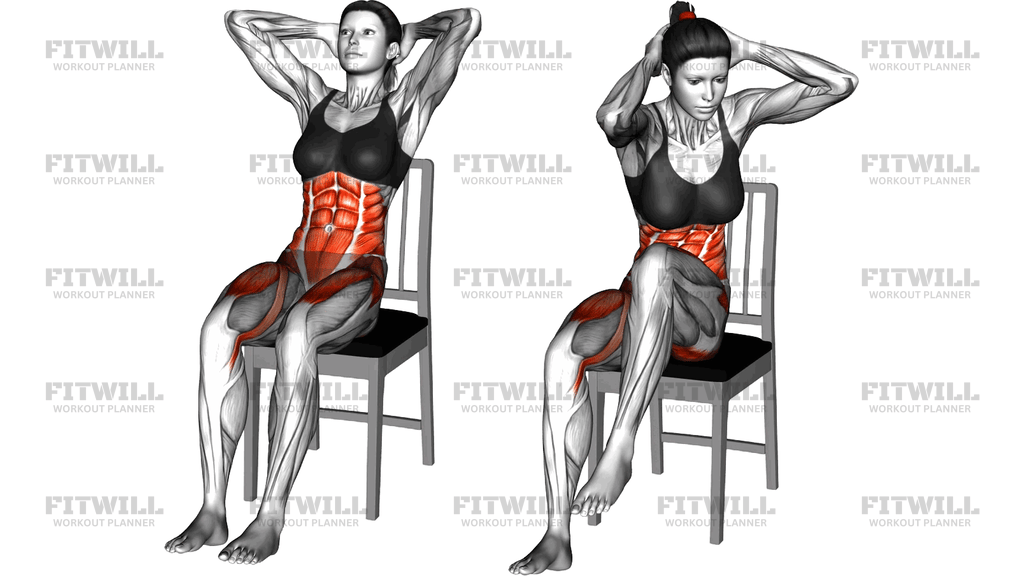
The Sitting Alternate Knee Tuck On A Chair is a seated core exercise performed on a sturdy chair. You sit upright near the front edge of the seat with your hands clasped in front of your chest, then lift one knee up toward your torso, lower it, and repeat with the other leg, alternating sides. Because the chair supports your upper body, all the work happens in your trunk and hips, making this a low-barrier way to train the midsection without getting on the floor.
The main muscles at work are the abdominals, which brace and shorten to bring the ribcage and pelvis closer together, and the hip flexors, which drive the thigh upward. The obliques contribute by keeping your torso from rotating as each knee travels up its own side of the body. Your lower back muscles and the stabilizers around the shoulder girdle work isometrically to hold a tall, neutral posture throughout the set.
This movement suits beginners building their first core routine, older adults or office workers who want a floor-free option, and anyone doing desk-break training. It also works well as a warm-up drill before standing ab work or as a low-impact finisher. Because it requires nothing more than a stable chair, it fits easily into home, hotel, or workplace workouts.
Setup matters more than it looks. Sitting too far back on the seat rounds your lower back and hides the crunching action; sitting at the front edge with feet flat on the floor lets you hinge slightly and actually curl the trunk. Sliding forward until only a small amount of thigh is supported, and keeping the spine tall with the chest lifted, turns a casual leg lift into a genuine abdominal contraction.
To execute it well, brace your midsection before the first rep, then pull one knee up while your torso leans forward and curls a few degrees to meet it. Think of bringing the knee and the chest toward each other rather than only raising the leg. Pause briefly at the top, feel the abdominal squeeze, and lower the foot back to the floor under control before switching sides.
The most common errors are relying purely on the hip flexors with a stiff, arched spine, letting the torso twist toward the moving knee, and dropping the foot down quickly instead of controlling the return. Keep the reps slow enough to feel the trunk working, and stop the set if you feel strain in your lower back rather than your abs.
[ Workout Log & Planner ]
Put your next workout in Fitwill
Keep your plan and training log ready when you are.


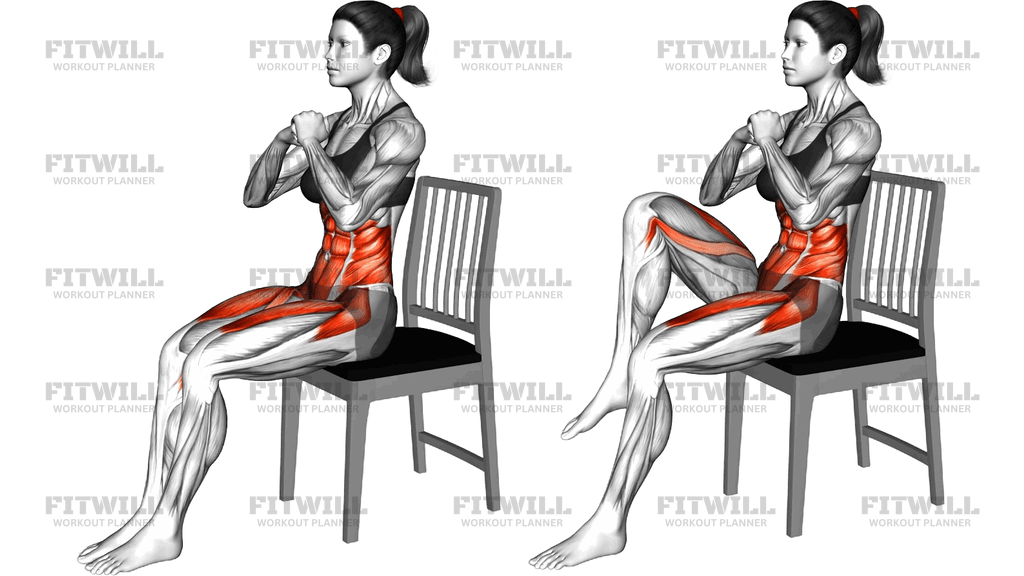
Instructions
- Sit on a sturdy, non-swiveling chair and slide forward so only a small portion of your thighs rests on the seat, with both feet flat on the floor.
- Clasp your hands together in front of your chest with elbows bent, and sit up tall so your ears, shoulders, and hips are roughly aligned.
- Take a breath and brace your abdominal wall as if preparing for a light nudge to the stomach.
- Exhale and pull one knee up toward your chest, letting your torso curl forward a few degrees so the knee and ribcage move toward each other.
- Pause for a beat at the top with the foot off the floor and feel the contraction across your midsection.
- Lower the foot back to the starting position slowly, keeping the torso tall as you return.
- Immediately lift the opposite knee in the same manner, alternating sides for the desired number of reps.
- Breathe out on the lift and in on the lower, keeping the rhythm smooth and even.
- Keep your knees traveling up in line with your own shoulder rather than crossing toward the middle of your body.
- After the final rep, set both feet flat on the floor and sit tall for a moment before standing up.
Tips & Tricks
- If your lower back arches as the knee rises, exaggerate the forward curl of your chest toward the thigh; the crunch, not just the leg lift, is what trains the abs.
- Keep your clasped hands still at chest height. Swinging the arms toward the knee turns the drill into a rotation and shifts work away from the front of the trunk.
- Use a chair without wheels or padding that sinks too much; a fixed dining-style chair keeps your base stable so you can focus on the tuck.
- Do not let the torso fall back into the chair back at the bottom of each rep. Staying on the front edge of the seat keeps tension on the core between sides.
- Lower the foot gently instead of letting it drop. The controlled return is where many people lose most of the benefit of this exercise.
- If hip flexors take over completely, shorten the range slightly and emphasize squeezing the lower abs to tilt the pelvis as the knee comes up.
- Slow the tempo down to about two seconds up and two seconds down; fast alternating kicks turn this into a hip-flexor speed drill with little abdominal work.
- Keep your neck relaxed and your gaze level. Pushing the chin forward as you curl adds neck strain without adding core activation.
Frequently Asked Questions
Which muscles does the Sitting Alternate Knee Tuck On A Chair work?
The abdominals are the primary movers, with the hip flexors lifting the thigh and the obliques stabilizing against rotation. Your lower back and shoulder stabilizers hold the seated posture throughout.
Is the Sitting Alternate Knee Tuck On A Chair good for beginners?
Yes. The chair supports your upper body and removes the need to get down on the floor, so it is one of the more accessible ways to learn abdominal bracing and controlled knee lifts.
Why should I sit at the front edge of the chair instead of leaning back?
Leaning into the chair back flattens the natural curve of your lower spine and limits how far your knee can travel, which reduces the crunching action. The front edge gives your thigh room to lift and lets your torso curl toward the knee.
Should my back stay completely upright during the tuck?
No. A small forward curl as the knee comes up is what engages the abs. Keeping the spine perfectly rigid turns the movement into a pure hip-flexor exercise.
My legs feel this more than my abs. What am I doing wrong?
You are most likely lifting with the hip flexors alone. Slow the tempo, brace your midsection before each rep, and consciously curl your chest toward the rising knee so the abdominals share the work.
How many reps should I do of the Sitting Alternate Knee Tuck On A Chair?
Start with 10 to 20 total alternating reps per set, or about 30 to 45 seconds of continuous work. Prioritize a smooth, controlled tempo over a high rep count.
Can I do this exercise at my desk?
Yes, as long as your chair is stable and does not roll or swivel. Slide forward on the seat, keep your hands at chest height, and perform the reps slowly so the movement stays deliberate.
What can I use instead of a chair?
Any stable seat such as a bench or the edge of a sturdy couch works. Avoid exercise balls or soft, sinking surfaces, because they make the seated posture unstable and reduce control of the knee path.
Is the Sitting Alternate Knee Tuck On A Chair safe for people with lower back issues?
It is generally gentle because the seat supports your weight, but keep the range modest and avoid any forward curl that causes discomfort. If you have a diagnosed back condition, check with a qualified professional before adding it to your routine.