Bodyweight Invisible Equipment Swing
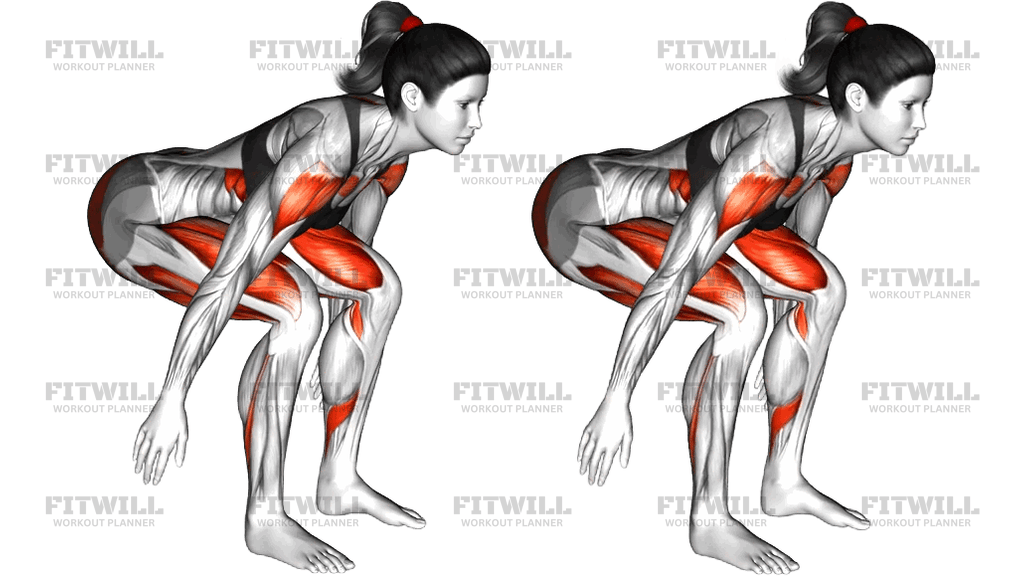
The Bodyweight Invisible Equipment Swing is exactly what it sounds like: you perform the full pattern of a kettlebell swing without holding anything. Your arms mimic the path a bell would travel, rising toward chest height as your hips snap forward and falling back between your knees as you hinge. Because there is no load, all of your attention goes into the hinge, the hip drive, and the timing that make the loaded version work.
This movement is one of the best teaching tools for anyone who wants to swing a kettlebell safely but has never been coached through the pattern. It also stands on its own as a warm-up drill before lower-body training and as a conditioning exercise you can perform anywhere, since it raises your heart rate quickly without needing any equipment or floor space beyond a body length.
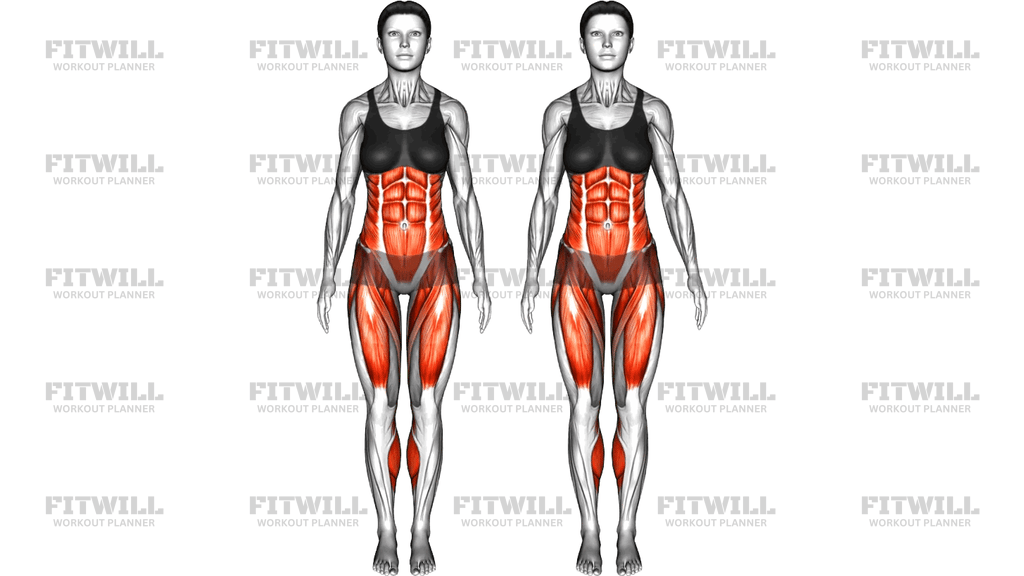
The main work comes from the glutes and hamstrings, which load during the hinge and explode to drive you upright. Your lower back works isometrically to hold a flat torso position, your core braces to transfer force, and your shoulders and upper back lightly control the free-swinging arms. The quads assist slightly as the knees extend, but this is a hip-dominant movement, not a squat.
Setup matters more than it might seem for an unweighted drill. Without a bell pulling your arms down, it is easy to cheat by squatting, standing too upright, or letting the arms float up on their own instead of being driven by the hips. Set your feet about shoulder-width apart with toes turned out slightly, and reach your hands toward a spot on the floor between and slightly behind your feet, as if a heavy weight were hanging there.
To execute it well, think of the arms as dead weight attached to your shoulders. Hinge back with a flat back and soft knees, let your hands travel back between your thighs, then drive your hips forward hard and let that momentum fling your arms up to roughly chest height. Snap back down into the hinge and repeat in a rhythmic loop, breathing out forcefully on every hip drive.
Keep the movement honest by never lifting your arms with your shoulders and never turning the hinge into a squat. If your lower back rounds or aches, shorten the range and reduce speed until you can hold a neutral spine. Done right, this drill builds the hip snap and posterior-chain strength that carry over directly to kettlebell swings, broad jumps, and any explosive hip extension.
[ Workout Log & Planner ]
Put your next workout in Fitwill
Keep your plan and training log ready when you are.


Instructions
- Stand with your feet about shoulder-width apart, toes turned out slightly, and your weight spread across the whole foot.
- Reach both arms straight down toward the floor between and slightly behind your feet, palms facing back, as if gripping an imaginary kettlebell handle.
- Push your hips back and hinge forward, letting your hands travel back between your thighs, with knees soft and your back flat rather than rounded.
- Brace your core and pull your shoulders down away from your ears so your arms hang heavy instead of tensing up.
- Drive your hips forward explosively by squeezing your glutes until your body is tall and standing fully upright.
- Let the momentum swing your relaxed arms up to about chest height, then guide them back down as you immediately hinge again.
- Exhale sharply as your hips snap forward, and inhale as you fold back into the hinge.
- Keep the rhythm continuous, aiming for 10 to 20 crisp swings per set, with each rep powered by the hips and not the arms.
- On the final rep, decelerate your arms, stand tall, and reset your stance before starting another set.
Tips & Tricks
- If your arms float up on their own, consciously relax your shoulders and grip; the arms should be passengers, with the hips as the engine.
- A common mistake is squatting instead of hinging. Your shins should stay close to vertical and your hips travel backward, not straight down.
- Avoid hyperextending your lower back at the top. Stand tall and squeeze your glutes and abs rather than leaning back past vertical.
- If your back rounds at the bottom, reduce how deep you hinge and practice reaching your chest forward while keeping a neutral spine.
- Keep your heels glued to the floor. Rising onto the toes means the hips are drifting forward too early in the drive.
- Move faster than you think for a swing, but never so fast that the hinge position falls apart; crisp beats sloppy.
- Use this drill as a warm-up before kettlebell swings, deadlifts, or jumps to groove the hip hinge pattern under no load.
- If your knees cave inward as you drive up, think about spreading the floor with your feet to keep them tracking over your toes.
Frequently Asked Questions
What muscles does the Bodyweight Invisible Equipment Swing work?
The glutes and hamstrings do the main work during the hip drive, while the lower back and core stabilize your torso. Your shoulders and upper back only guide the arms; they should not be doing the lifting.
Is the Bodyweight Invisible Equipment Swing good for beginners?
Yes, it is one of the safest ways to learn the kettlebell swing pattern because there is no load to mishandle. Master the hinge and hip snap here before picking up a bell.
Why are my arms swinging up if I am holding nothing?
The invisible equipment is the point: pretending your hands hold a heavy bell forces you to keep your arms relaxed and lets your hip drive create the swing. If you lift with your shoulders, the drill loses its purpose.
Should this feel like a squat?
No. It is a hip hinge, so your hips travel backward, your shins stay nearly vertical, and your torso leans forward. If your knees bend deeply and your hips drop, you are squatting the movement.
How far should my arms swing at the top?
Chest height is the target, roughly where a kettlebell would float at the top of a swing. Higher than that usually means you are pulling with your shoulders or leaning back.
Can I use the Bodyweight Invisible Equipment Swing for conditioning?
Absolutely. Performed at a brisk, continuous pace for 30 to 60 seconds, it elevates your heart rate and works the whole posterior chain without equipment.
What can I substitute if I want more resistance later?
Progress to a real kettlebell swing, a dumbbell swing held by the head, or a resistance band swing anchored behind you. Only add load once your hinge pattern is consistent and pain-free.
How many reps should I do?
For technique practice, do sets of 10 to 15 crisp swings and stop when the hinge starts to look like a squat. For conditioning, work in timed intervals with short rests.
Is it safe for my lower back?
When performed with a flat, neutral spine and power coming from the hips, it is generally well tolerated. If you feel rounding or strain in your back, shorten the range, slow down, and rebuild the hinge position before continuing.