Jog And Drop
Jog And Drop is a bodyweight conditioning drill that alternates between a light jog and an explosive drop into a deep tuck crouch with your hands planted on the floor. The movement combines rhythmic footwork with a fast, powerful descent, forcing your legs, hips, and trunk to absorb and re-produce force over and over. It is a compact drill that trains athletic footwork, deceleration control, and repeatability under fatigue.
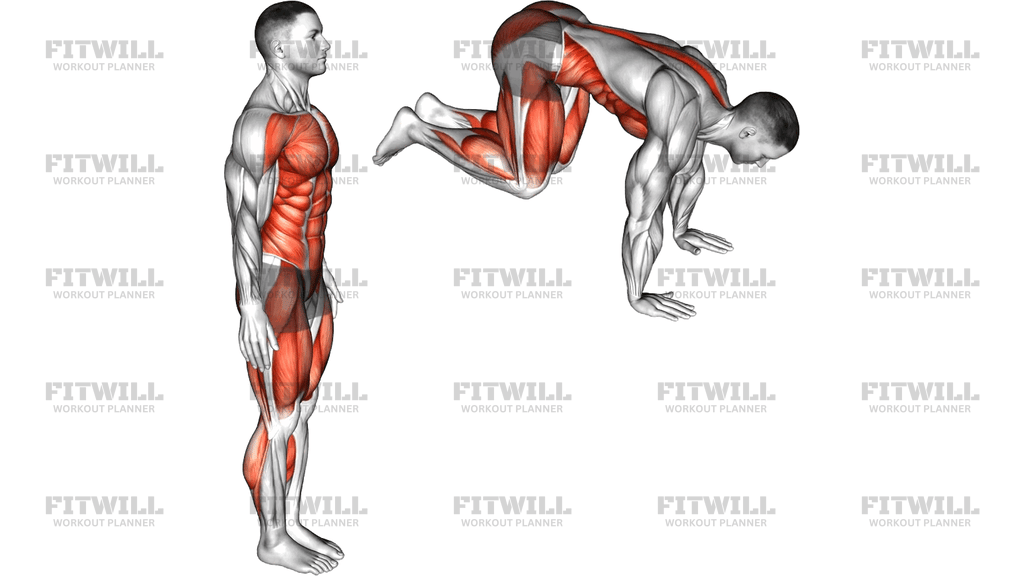
The pattern is simple but demanding: you jog lightly in place, then on a cue or count you drop your hips down, plant both palms on the floor, and snap your knees up and out toward the outside of your elbows into a compact tuck position before landing back on your feet and returning to the jog. This start-stop rhythm is what makes the drill valuable. Unlike a steady jog, the repeated drops teach your body to decelerate quickly, keep the trunk braced through a rapid change of position, and re-accelerate without losing posture.
This drill fits well into warm-ups, circuit training, and conditioning finishers. It is especially useful for field and court athletes who need to change levels quickly, and for anyone who wants a low-equipment way to raise the heart rate while reinforcing squat mechanics and hip mobility. Because the drop position requires the knees to travel toward the armpits, it also serves as a dynamic mobility drill for the hips, ankles, and groin when performed with control.
To execute it well, think of the drop as an active landing rather than a collapse. Hinge the hips back slightly, bend the knees over the toes, and place your hands flat with the fingers spread for support. The tuck hop should be quick and tight: knees drive up and out, the hips stay light, and the toes stay pulled back so you land on the balls of your feet. Chest stays tall enough that you can see a few feet of floor ahead of you rather than staring straight down.
The most common errors are rounding the back as the hands reach the floor, letting the knees cave inward during the tuck, and making so much noise on the landing that the joints clearly aren't absorbing the force. Slow the tempo down before speeding it up. Two to four rounds of twenty to thirty seconds, with equal rest, is a practical starting dose. If the deep crouch aggravates your knees or hips, reduce the depth of the drop or step back to a simpler squat-and-stand version before adding the hop.
Fitwill
Log Workouts, Track Progress & Build Strength.
Achieve more with Fitwill: explore over 9600 exercises with images and videos, access built-in and custom workouts, perfect for both gym and home sessions, and see real results.
Start your journey. Download today!




Instructions
- Stand tall with your feet hip-width apart, arms relaxed at your sides, and enough clear floor space around you for both the jog and the drop.
- Begin jogging lightly in place, staying on the balls of your feet with a relaxed, quick cadence.
- After several strides, drop quickly: push your hips back, bend your knees deeply, and plant both palms flat on the floor inside your knees with fingers spread.
- Keep your back flat and your chest lifted as your hands touch down, rather than hunching over your arms.
- Drive your knees up and out toward the outside of your elbows into a tight tuck, letting your feet leave the floor briefly.
- Land back on the balls of your feet with soft knees, absorbing the landing quietly through your hips and ankles.
- Push the floor away and return immediately to the light jog to begin the next repetition.
- Exhale sharply as you drop and tuck, then breathe steadily through the jog segments.
- Continue alternating jog and drop intervals for your target time or repetitions, then step out and walk it off to reset your breathing.
Tips & Tricks
- If your heels slam down after the tuck, you are landing flat-footed; cue yourself to stay on the balls of your feet and let the calves and hips absorb the landing.
- Knees drifting inward during the tuck usually means the hips are too tight to open wide — deliberately spread the knees toward the armpits and shorten the jump height until the path is clean.
- A rounded back when the hands hit the floor points to limited hip or ankle mobility; bend the knees more and sit the hips lower so the hands can reach without hunching.
- Do not rush the transition out of the crouch; a fast, quiet landing followed by a controlled return to the jog beats a sloppy, loud scramble.
- Keep your weight distributed across the whole palm when planted — collapsing onto the wrists strains them on every drop.
- If you lose your jog rhythm after each drop, count your jog strides out loud to re-establish the cadence before the next drop.
- On a hard floor, place an exercise mat down to reduce impact on the balls of the feet and the heels during repeated landings.
- Scale intensity by adjusting the tuck, not the jog: bring the knees only as high as you can control before progressing toward the elbows.
- Stop the set when your posture changes — once the back rounds and the knees cave, you are training the wrong pattern under fatigue.
Frequently Asked Questions
What muscles does Jog And Drop work?
The main drivers are the quads and glutes, which power the drop and the tuck hop, while the calves handle the repeated landings. The abs and hip flexors work hard to hold the trunk together and pull the knees up and out toward the elbows.
Is Jog And Drop suitable for beginners?
Yes, with scaling. Beginners can reduce the depth of the drop, skip the tuck hop and simply tap the knees toward the chest from the crouch, or jog for longer intervals between drops to manage fatigue.
Why do the knees move toward the outside of the elbows in this drill?
That wide tuck path opens the hips and keeps the knees tracking in line with the feet while training the hip flexors explosively. It also creates the compact shape that makes the hop quick and the landing controllable.
How is Jog And Drop different from a burpee?
A burpee drops to a plank and usually includes a push-up and an overhead jump. Jog And Drop stays low and compact — you drop straight into a deep crouch with hands planted and tuck the knees, then flow right back into the jog without going to the floor.
How long should I perform Jog And Drop in a workout?
Twenty to thirty seconds of work with equal or slightly longer rest is a solid starting interval. As conditioning improves, you can extend toward forty-five seconds or add rounds rather than sprinting the drill harder.
What is the most common mistake in this drill?
Rounding the lower back as the hands reach the floor and letting the knees cave inward during the tuck. Both are usually mobility or pacing issues, so sit lower into the crouch and slow the tempo until the positions look clean.
Can I substitute Jog And Drop if my knees bother me during the drop?
Try a shallower crouch with hands on a low step or bench to reduce the knee angle, or replace the tuck hop with a controlled knee lift from the crouch. If knee discomfort persists, consult a qualified professional before continuing.
Should I wear shoes or go barefoot for this exercise?
Shoes with a modest cushion are fine and kinder to the balls of the feet on hard floors. Barefoot can work on a mat if you land softly, but the repeated landings favor some footwear for most people.
Where does Jog And Drop fit best in a training session?
It works well as a dynamic warm-up finisher to wake up the hips and raise the heart rate, or as a station in a circuit and a short conditioning finisher. Avoid placing it right before heavy lower-body strength work when your legs need to be fresh.