Sitting Pelvis Imbalance Twist On A Chair Hold
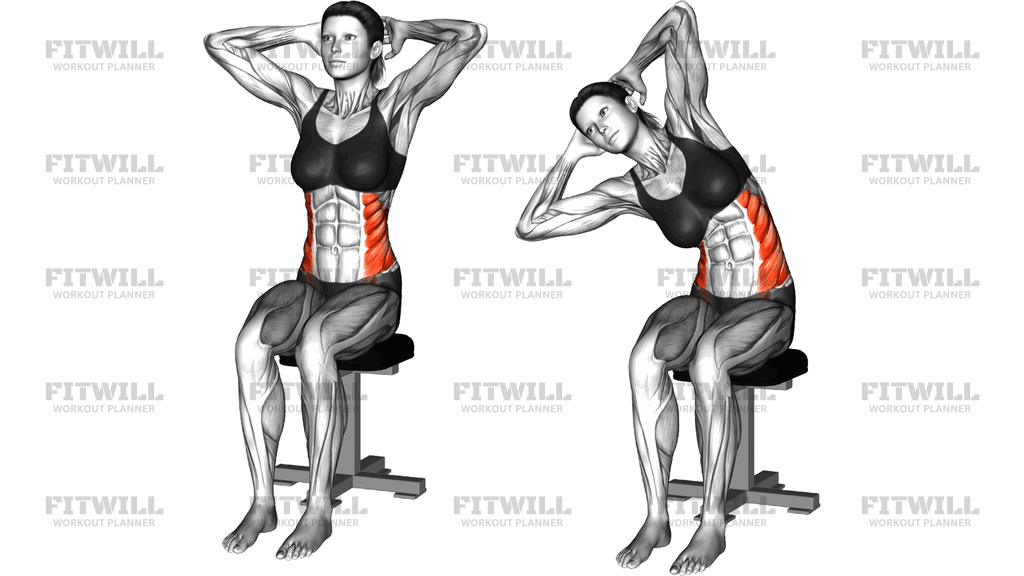
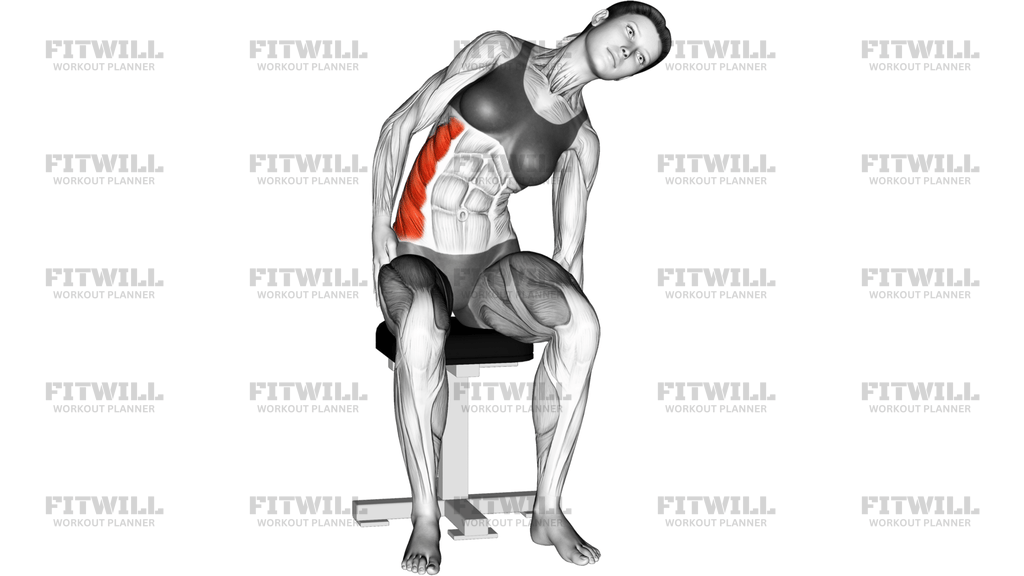
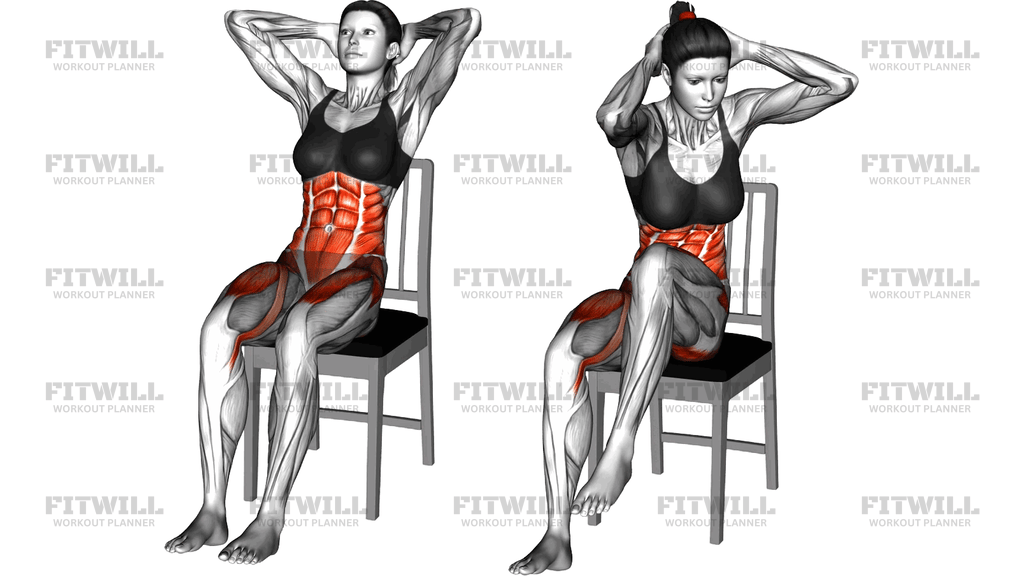
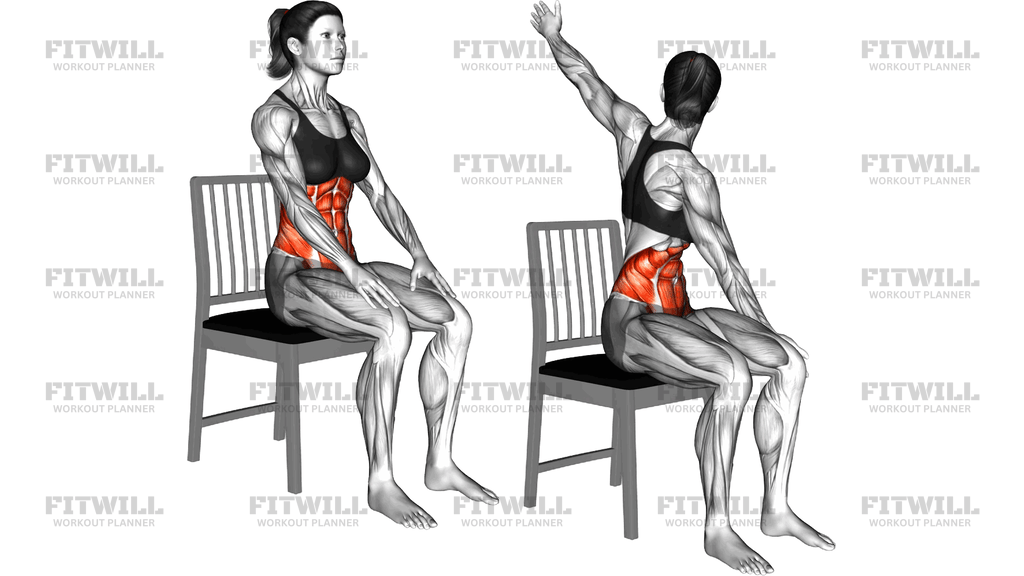
The Sitting Pelvis Imbalance Twist On A Chair Hold is an isometric core exercise performed on a standard chair. You sit with your pelvis deliberately uneven on the seat — one sit bone on the chair, the opposite hip lifted off it — then rotate your trunk away from the tilted side, reach the top arm up and across, and hold that twisted position. The highlighted work in this movement happens through the side of the trunk, where the obliques and deep core have to contract continuously to keep you twisted while the off-center pelvis pulls you back toward level.
Because the pelvis starts out of balance, the trunk muscles on the low side work from a shortened position and the muscles on the high side work from a lengthened position. That asymmetry is the whole point. It challenges the obliques, quadratus lumborum, and deep stabilizers in a way a symmetrical seated twist cannot, which makes it useful for people who feel one-sided in their rotation, for desk workers rebuilding awareness of how their pelvis sits, and for anyone who wants core work without getting on the floor.
Setup matters more than effort here. A firm chair without wheels lets you control exactly how much of your pelvis is supported. Your feet stay flat on the floor and your knees stay roughly over your ankles, so the rotation comes from the waist and ribcage rather than from your hips sliding or your lower back rounding. Sit tall before you twist — a collapsed chest turns this into a neck and shoulder exercise very quickly.
To execute it well, place one glute fully on the seat and let the opposite hip hover just off the edge. Press down lightly through the supported sit bone, lengthen through the spine, then rotate the ribcage away from the lifted hip, raising that side's arm diagonally overhead. Hold, breathe steadily, and resist the urge to let the pelvis settle flat onto the chair. Your eyes follow your raised hand, which keeps the neck in line with the twist.
The hold format makes this a low-fatigue exercise you can slot into warm-ups, desk-break routines, or rehabilitation-style core work. Start with 10 to 20 seconds per side and only progress the duration once you can hold without your torso slumping. If you feel pinching in the lower back or sharp strain anywhere, reduce the rotation angle or sit with more of your pelvis on the seat until control improves.
[ Workout Log & Planner ]
Put your next workout in Fitwill
Keep your plan and training log ready when you are.


Instructions
- Sit sideways on a sturdy armless chair so that only one glute rests fully on the seat and the opposite hip is positioned just past the edge of the chair.
- Place both feet flat on the floor with knees bent to about 90 degrees and knees stacked over the ankles.
- Rest your hands lightly on your thighs and sit up tall, drawing the crown of your head toward the ceiling to set a long spine.
- Brace your midsection gently, as if preparing for a light push to the side, without holding your breath.
- Rotate your ribcage away from the hip that is lifted off the chair, keeping the pelvis exactly where it is — do not let the lifted hip drop onto the seat.
- Raise the arm on the lifted-hip side diagonally overhead, fingers reaching up and across, and turn your head to follow your hand.
- Hold this twisted, uneven-pelvis position for 10 to 20 seconds, breathing steadily and keeping pressure through the supported sit bone.
- Exhale as you slowly rotate back to center, letting the raised arm lower back to your thigh.
- Recheck your pelvic position, then either repeat on the same side or switch which glute sits on the chair and repeat the twist to the opposite direction.
Tips & Tricks
- The most common mistake is letting the hovering hip sink onto the chair as the hold progresses — the moment you feel that, lift it back up or end the set.
- If your low back pinches during the twist, you are likely rotating from the lumbar spine instead of the ribcage; reduce the rotation angle and think of turning your chest, not your waist band.
- Keep weight anchored through the sit bone that is on the chair. If your weight drifts toward the edge, you will lose the pelvic imbalance that makes this exercise different from a regular seated twist.
- Do not crane the neck to look up at the raised hand; the head should rotate with the trunk, eyes tracking the fingers.
- If the chair slides or wobbles, place it against a wall. A rolling office chair is not appropriate for this movement.
- Shorter holds with a truly level-checked pelvis beat long sloppy holds — quality of the tilt matters more than duration.
- Breathe the whole time. If you catch yourself holding your breath during the hold, your brace is too aggressive.
- Expect one side to feel much harder. Spend an extra set on the weaker side before matching volume on the stronger one.
Frequently Asked Questions
Which muscles does the Sitting Pelvis Imbalance Twist On A Chair Hold work?
The obliques on both sides of the waist do the main work, with the deep core and the quadratus lumborum stabilizing the tilted pelvis. The glute on the supported side also works quietly to keep you anchored to the seat.
Why does only one glute sit on the chair in this exercise?
The uneven pelvic position is the defining feature — it forces the trunk muscles to control rotation from a tilted base rather than a symmetrical one. With both sit bones on the seat, this would just be an ordinary seated twist.
Is the Sitting Pelvis Imbalance Twist On A Chair Hold suitable for beginners?
Yes, it is low load and easy to scale. Beginners should shorten the hold to 10 seconds and sit with slightly more of the pelvis on the chair until the twisted position feels stable.
How long should I hold each repetition?
Start with 10 to 20 seconds per side and build toward 30 to 40 seconds only when you can keep the lifted hip off the seat for the entire hold without slumping.
What kind of chair works best for this exercise?
A firm, armless chair without wheels, placed against a wall if needed. You need a stable edge to perch one glute on, so soft couches and rolling office chairs are poor choices.
My lower back aches during the twist — what am I doing wrong?
You are probably rotating too far from the lumbar spine or letting the pelvis collapse. Twist a little less far, focus on turning the ribcage, and recheck that the lifted hip is still hovering off the chair.
Can I substitute the Sitting Pelvis Imbalance Twist On A Chair Hold with a regular seated twist?
A standard seated twist is a reasonable fallback, but it removes the pelvic imbalance, so the obliques work under less challenge. Sitting on the very edge with one hip off the seat is what preserves the training effect.
Should I feel one side more than the other?
Most people do, especially if they habitually sit shifted to one side. Train both sides, but give the harder side one additional set rather than avoiding it.
Is this exercise safe if I have a history of back problems?
It is low impact, but the twisted hold still loads the spine in rotation. Keep the range modest, avoid any position that produces sharp or radiating symptoms, and check with a qualified professional before adding it to your routine if you have ongoing issues.
Where should I put this exercise in my workout?
It works well early in a session as core activation before heavier lifts, or as a standalone desk-break hold. Because it is isometric and low fatigue, it will not interfere with most training that follows.