Standing Front Leg Lift Cross Toe Touches (Version)
Standing Front Leg Lift Cross Toe Touches is a body weight core exercise that combines a standing leg raise with a cross-body reach, so you lift one leg straight out in front while the opposite hand travels across to touch the toes of that lifted leg. You perform it standing tall with your arms extended out to your sides, which means your torso has to stay controlled through a rotational, single-leg balance challenge rather than lying on the floor like a traditional toe touch.
The movement mainly trains the abdominal wall, with strong involvement from the hip flexors as they drive the leg up, and the obliques as they rotate and stabilize the trunk during the cross-body reach. Because you are standing on one leg at the top of each rep, the glutes, quads, and small stabilizing muscles around the ankle and hip of the support leg work continuously to keep you from wobbling or tipping.
This is a useful exercise for anyone who wants core work without getting down on the floor, and it fits well into warm-ups, circuit training, or balance-focused sessions. It also carries over to real-world movement patterns: bringing the knee and opposite shoulder toward each other is the same contralateral coordination used in walking, running, and climbing, so practicing it under control has practical value beyond just feeling your abs work.
Setup matters more than it looks. With both arms out to the sides and one leg leaving the ground, your base of support shrinks dramatically, so your foot placement, posture, and bracing determine whether you get a crisp core contraction or an uncontrolled lunge toward your toes. Stand with feet about hip-width apart, weight spread across the whole foot, and ribs stacked over the pelvis before you start.
To execute it well, lift one leg straight forward to roughly hip height, keep the knee extended but not locked, and simultaneously reach the opposite hand across your body toward the toes of the raised leg. Think of folding at the hip and rotating slightly through the trunk rather than just curling the shoulder down. Exhale as you lift and reach, then lower the leg and arm back to the T position under control before switching sides.
Common mistakes include rounding the lower back into a slouch as you reach, yanking the leg up with momentum, and letting the support foot roll to the outside edge. Keep the reach honest: if you cannot touch your toes without collapsing your posture, reach toward the shin or knee instead. Quality reps with a tall spine and steady balance beat a higher, sloppier touch every time, and anyone with balance limitations can place a hand on a wall or sturdy chair for light support.
[ Workout Log & Planner ]
Put your next workout in Fitwill
Keep your plan and training log ready when you are.


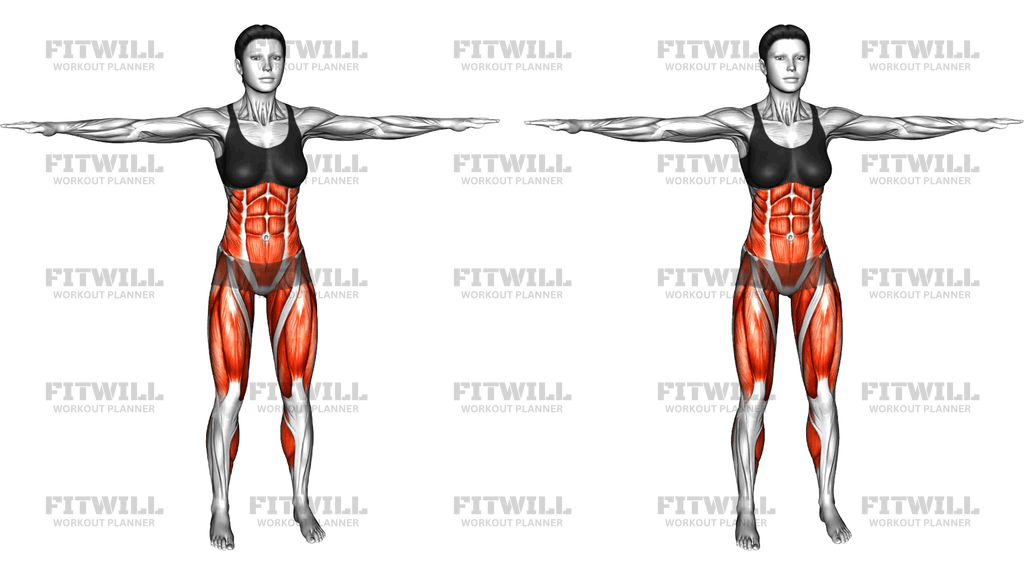
Instructions
- Stand upright with your feet about hip-width apart and your arms extended straight out to the sides at shoulder height, forming a T shape.
- Shift your weight onto one leg and spread it evenly across the foot, keeping a soft bend in the support knee.
- Brace your abdominal wall and keep your ribs stacked over your pelvis so your lower back stays neutral before any movement begins.
- Lift your free leg straight forward in front of you toward hip height, keeping the knee extended and the toes pulled up.
- As the leg rises, reach the opposite hand across your body toward the toes of the lifted leg, rotating slightly through the trunk and hinging forward at the hip.
- Pause briefly at the top where your hand is closest to your toes and your torso and leg form a controlled fold, without rounding your lower back into a slump.
- Exhale as you lift and reach; inhale as you return.
- Lower the leg and bring the arm back out to the T position slowly, resisting the urge to drop both limbs with gravity.
- Reset your balance and brace, then repeat on the other side, lifting the opposite leg and reaching with the other hand.
- Continue alternating sides for the desired number of repetitions, keeping the movement tempo even from rep to rep.
Tips & Tricks
- If you keep missing the touch, the problem is usually a collapsed torso, not short hamstrings; hinge slightly at the hip while keeping your back long instead of curling your spine down.
- Do not swing the leg up with momentum, as this removes tension from the hip flexors and lower abs; if you need to swing, the height is too high for now.
- Watch your support foot: rolling to the outer edge or letting the arch collapse is the most common balance failure in this exercise, so grip the floor with your toes and keep the whole foot loaded.
- Keep the lifted knee straight rather than bending it toward your chest, since bending the knee turns the movement into a standing knee raise and changes which muscles do the work.
- Reach with the whole arm, not just a hand flick; the cross-body rotation of the trunk is what engages the obliques.
- If you wobble badly at the top, shorten the range by lifting the leg to knee height and progress upward as your single-leg control improves.
- Placing a fingertip on a wall is a legitimate regression, not a cheat; use it until you can balance for full sets without it.
- Avoid holding your breath through the reach, as the exhale on the lift naturally helps the abdominal muscles do their job.
- Keep both shoulders level at the top; dropping the reaching shoulder toward the floor rounds the upper back and reduces the cross-body rotation.
Frequently Asked Questions
What muscles do Standing Front Leg Lift Cross Toe Touches work?
The primary work comes from the abdominal wall, especially the lower abs, with the hip flexors lifting the leg and the obliques controlling the cross-body rotation. The glutes, quads, and ankle stabilizers of the standing leg work to keep you balanced.
Is Standing Front Leg Lift Cross Toe Touches suitable for beginners?
Yes, because it requires no equipment and can be scaled easily. Beginners can lift the leg to knee height, reach toward the shin instead of the toes, or keep a fingertip on a wall for balance until the coordination feels natural.
Why do I have to reach with the opposite hand instead of the same-side hand?
The opposite-hand reach creates a cross-body rotation that engages the obliques and mirrors the contralateral coordination used in walking and running. Reaching with the same-side hand changes the trunk mechanics and reduces the rotational demand.
Should my lifted leg stay straight during the exercise?
Yes, keeping the knee extended makes the hip flexors and lower abs lift the leg as a unit and gives your hand a consistent target. Bending the knee turns it into a standing knee raise and lightens the load on the abdominal muscles.
My lower back rounds when I reach for my toes. How do I fix it?
Hinge slightly forward from the hips while keeping your spine long, and stop the reach at your shin or knee if the toes are out of range. Forcing the touch by curling the spine shifts the work away from the abs and strains the lower back.
Can I do Standing Front Leg Lift Cross Toe Touches as a warm-up?
Absolutely, and it works well in that role because it raises the heart rate slightly, mobilizes the hips and hamstrings, and primes cross-body coordination. Use slow, controlled reps without going to fatigue before harder training.
What can I substitute if I struggle to balance on one leg?
Standing toe touches with the heel of the lifting leg kept close to the floor, or a supported version with one hand on a wall or chair, both train the same pattern with less balance demand. Floor-based cross-body toe touches are another option if standing is too difficult.
How many reps should I do of Standing Front Leg Lift Cross Toe Touches?
Aim for 8 to 12 controlled reps per side, counting a full lift-and-touch cycle as one rep. Since the value comes from balance and control, stop the set when your form or stability breaks down rather than pushing to exhaustion.
Is it safe to do this exercise every day?
For most people, yes, as it is a low-load body weight movement, though daily balance work can still create fatigue. If you feel persistent strain in the standing ankle or lower back, take a rest day and check that you are not forcing the toe touch with a rounded spine.