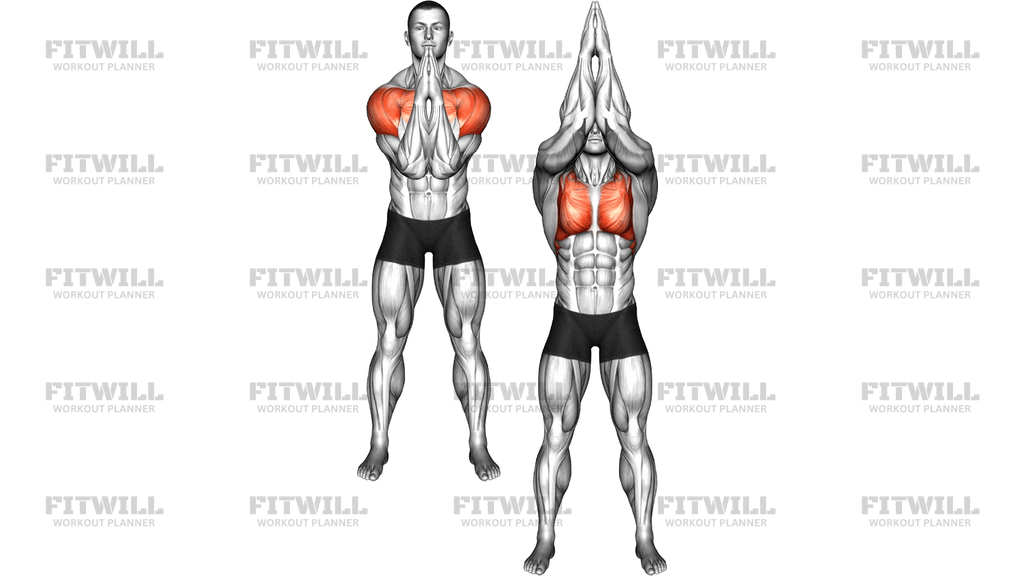
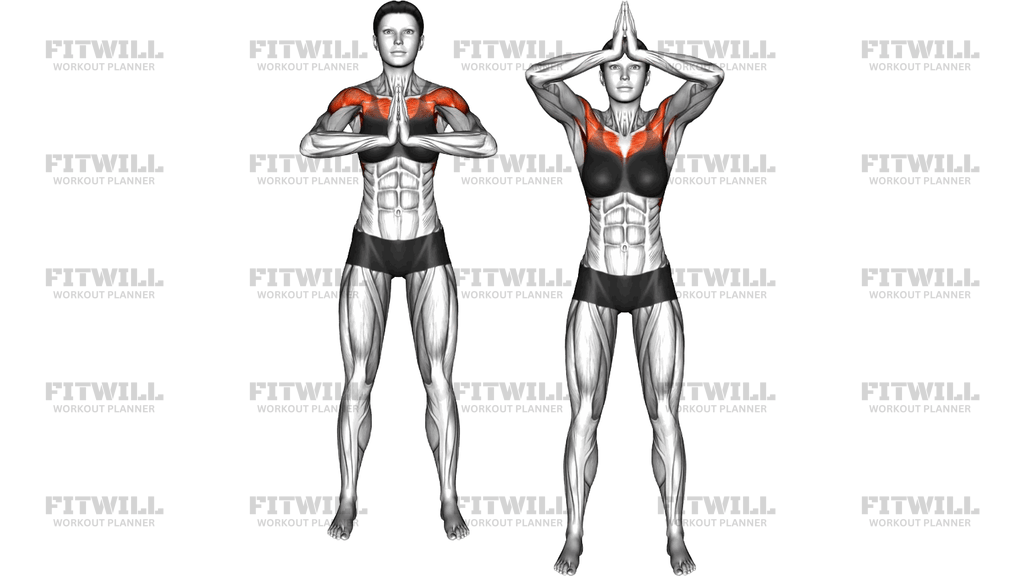
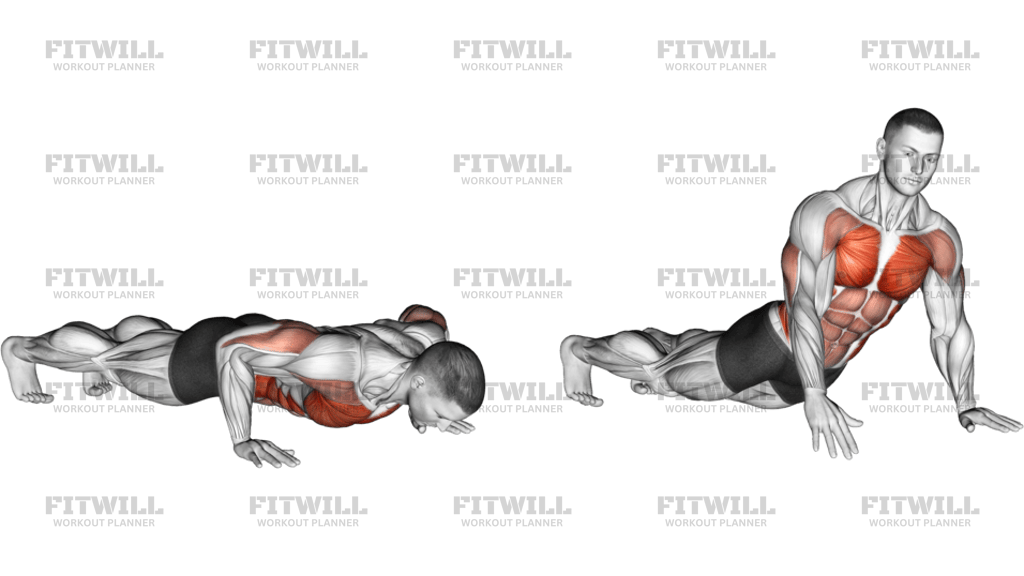
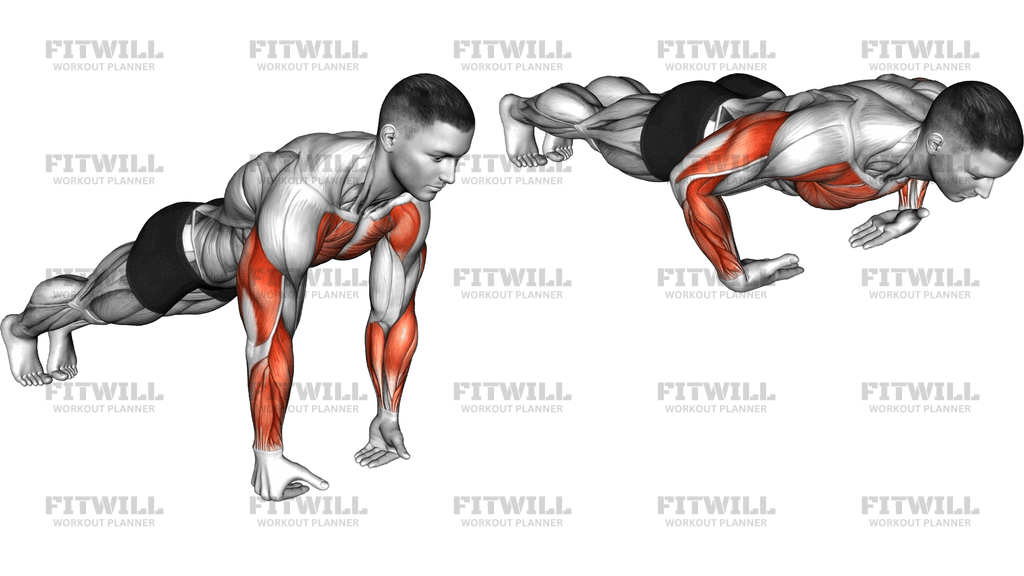
Bodyweight Standing Straight Arm Chest Low Fly
The Bodyweight Standing Straight Arm Chest Low Fly is a standing movement where you start with both arms extended straight out to your sides at shoulder height and sweep them down and forward so your hands cross in front of your lower chest or upper abdomen. Because you provide all of the resistance yourself, the exercise works through deliberate muscular tension rather than external load, making it a pure bodyweight movement that requires no equipment and very little space.
The main muscles working are the pectorals, with the fibers of the chest driving the adduction as the arms travel from a wide T position toward the midline of the body. The front delts assist throughout the arc, and because the arms stay straight the whole way, the shoulders, upper back, and core musculature work isometrically to hold your posture and keep the arms from bending. This straight-arm requirement is what separates it from a push-up or press: the chest is challenged in its role of pulling the arms across the body, not pushing away.
This exercise is useful for people who train at home without equipment, as a warm-up activation before pressing or flye work, as a finishing movement to fatigue the chest with high reps, or as a teaching tool for learning what a chest fly contraction should feel like before adding bands, cables, or dumbbells. It is also gentle on the elbow and shoulder joints compared with loaded fly variations, since you can instantly adjust effort by changing how hard you squeeze.
Setup matters more than it looks. Stand tall with feet about hip-width apart, a soft bend in the knees, ribs stacked over the pelvis, and shoulders pulled gently down away from the ears. If you shrug or arch your lower back, the chest loses tension and the shoulders and traps take over. Keeping the arms locked at a straight but not hyperextended elbow is the other key detail — any bend turns it into a partial press and reduces the fly effect.
To execute it well, imagine your hands are pushing inward against heavy resistance the entire way. Sweep the arms down and across in a wide arc until your hands cross in front of your body at lower chest height, pause for a beat while squeezing the chest, then open back out to the wide starting position under control. Do not let gravity or momentum snap the arms back; the opening half of the rep is where a lot of the muscle work happens.
A practical safety note: because the arms stay straight, keep the effort at a level where you never feel pinching at the front of the shoulder. If the range irritates your shoulders, reduce how far you cross your hands or work with the arms slightly lower. Stop if you feel sharp pain rather than muscular effort.
[ Workout Log & Planner ]
Put your next workout in Fitwill
Keep your plan and training log ready when you are.


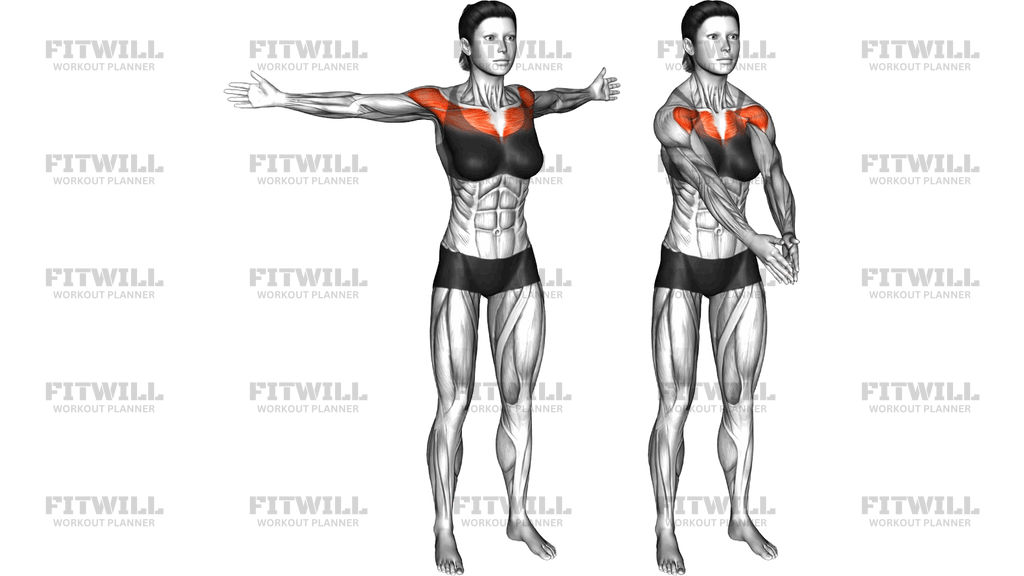
Instructions
- Stand upright with your feet hip-width apart, knees soft, and your weight balanced evenly across both feet.
- Raise both arms straight out to your sides until they form a T with your torso at shoulder height, palms facing forward, elbows fully straight but not locked hard.
- Draw your shoulder blades down and slightly together, lift your chest, and brace your core so your torso stays upright and still.
- Inhale at the wide starting position before beginning the rep.
- Exhale as you sweep both straight arms down and forward in a wide arc, as if wrapping them around a large barrel in front of you.
- Continue the arc until your hands meet and cross over in front of your lower chest, one hand overlapping the other.
- Squeeze your chest hard in this crossed position for one to two seconds, keeping the elbows straight and shoulders down.
- Inhale as you slowly open the arms back out along the same wide arc to the starting T position, resisting the urge to let them fall back.
- Reset your posture — shoulders down, chest lifted, core braced — and begin the next rep without swinging or leaning.
Tips & Tricks
- Think about pressing your palms inward against an invisible wall the whole way through the arc — passive arm swinging does almost nothing for the chest.
- If you feel the work in your neck or traps instead of your chest, your shoulders have crept up toward your ears; drop them back down before continuing.
- Do not bend the elbows to make the crossing easier — once the arms bend, the movement becomes a partial press and the chest fly effect is lost.
- Alternate which hand crosses on top each rep so both sides of the chest get an identical squeeze at the finish.
- Lean back slightly or swing the torso to generate momentum is a common cheat; if your upper body moves, slow the tempo down instead of using body English.
- A slight forward lean of the torso, only a few degrees, can increase chest tension, but anything more turns it into a shoulder-dominant movement.
- Keep the arc wide and round rather than straight down — sweeping the hands toward your hips shifts work away from the chest toward the lats.
- For more resistance, contract harder and squeeze a medicine ball or small towel between your hands in the crossed position; for less resistance, shorten the range so your hands stop just short of touching.
Frequently Asked Questions
Which muscles does the Bodyweight Standing Straight Arm Chest Low Fly work?
The pectorals are the primary movers, pulling the straight arms down and across the body. The front delts assist, while the upper back, shoulders, and core hold your posture isometrically.
Why do the arms have to stay straight during the Bodyweight Standing Straight Arm Chest Low Fly?
Straight arms force the chest to perform pure horizontal adduction, which is the fly pattern. Bending the elbows lets the pressing muscles take over and turns the movement into something closer to a push-up.
Is this exercise good for beginners?
Yes, it is one of the safest ways to learn the chest fly contraction because there is no external load and you control the resistance with your own effort. Beginners should focus on slow tempo and feeling the chest squeeze rather than doing fast reps.
How many reps should I do of the Bodyweight Standing Straight Arm Chest Low Fly?
Because the resistance is limited, it works best with higher reps, typically 15 to 30 per set, with a strong muscular squeeze at the crossed position. Use it as an activation drill before pressing or as a finisher after heavier chest work.
Can I make the Bodyweight Standing Straight Arm Chest Low Fly harder without equipment?
Squeeze maximally throughout the arc, pause three to five seconds with the hands crossed, and slow the opening phase to a four-second count. If you have a small ball or towel, pressing it between your palms during the crossing adds meaningful resistance.
Why do I feel this more in my shoulders than my chest?
This usually means your shoulders are shrugging or the arc is traveling too far down toward your hips. Keep the shoulder blades pulled down, sweep the hands to lower chest height rather than to your thighs, and reduce effort so the chest squeeze stays dominant.
What can I use instead of the Bodyweight Standing Straight Arm Chest Low Fly?
Cable or band standing chest flyes with straight arms follow the same path and add adjustable resistance. Floor flyes with dumbbells or a resistance band fly also train the same chest adduction pattern.
Is it safe to cross the hands past each other at the bottom of the movement?
Yes, as long as you keep the elbows straight but relaxed and avoid forcing extra range. If you feel any pinching at the front of the shoulder, stop the hands from crossing as far and build the range gradually over time.