Resistance Band Seated Row
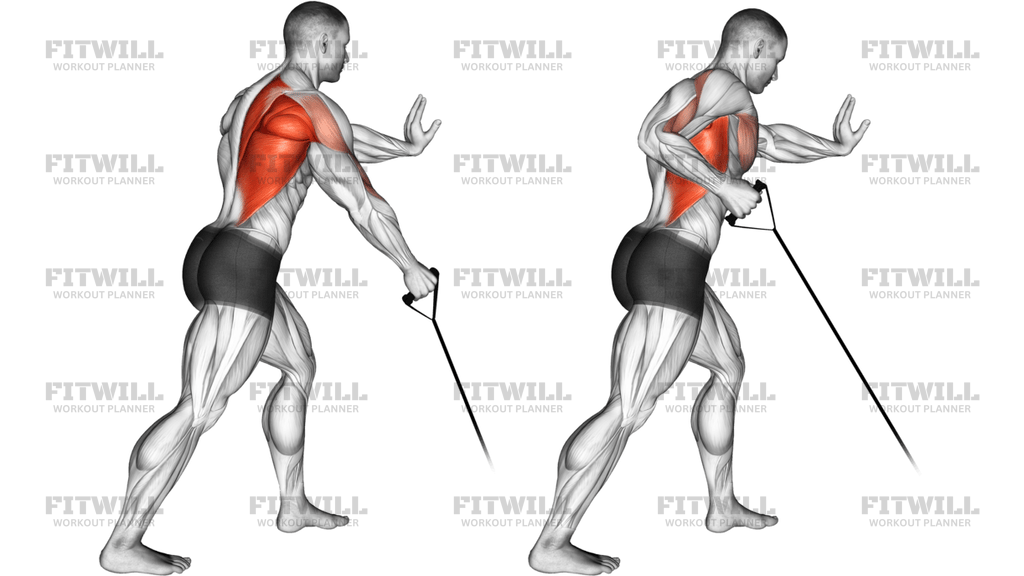
The Resistance Band Seated Row is a floor-based rowing exercise that targets the muscles of the mid and upper back. You sit with your legs extended in front of you, loop a resistance band around both feet, and pull the band toward your torso, driving your elbows back past your ribs. It is essentially the bodyweight-friendly cousin of the cable seated row, using the band's stretch rather than a weight stack for resistance.
This movement is useful for nearly anyone. Beginners can learn proper rowing mechanics without loading the spine, home gym owners get a full back workout from a single band, and office workers can use it to counteract rounded shoulders and hunched posture by strengthening the muscles that pull the shoulder blades back and down. It also works well as a warm-up or burnout finisher on lifting days.
The primary work comes from the lats and the muscles between the shoulder blades, mainly the rhomboids and mid traps, with the rear shoulders and biceps assisting on each pull. Because you are seated on the floor, your hamstrings and lower back also have to hold your torso upright, which quietly builds postural endurance while you row.
Setup matters more than it looks. The band needs to be anchored securely around the arches of both feet with your knees softly bent, because a slipped band can snap back toward your face or shins. Your sitting posture sets the quality of every rep: tall spine, chest open, and a slight forward lean at the hips so the pull travels along the right path toward your lower ribs rather than up toward your chin.
To execute it well, pull the band by driving your elbows behind you rather than yanking with your hands or shrugging your shoulders. Think about pinching your shoulder blades together at the back of the movement, pause briefly, then let the band draw your hands forward under control. Keep tension in the band even at the stretch position instead of letting it go slack.
A common use case is programming two to four sets of 12 to 20 reps, since bands accommodate high-rep, joint-friendly volume. If the band is too easy, shorten it by wrapping it once more around your feet or stepping up to a thicker band; if you cannot sit upright through a set, the band is likely too strong for you right now.
[ Workout Log & Planner ]
Put your next workout in Fitwill
Keep your plan and training log ready when you are.


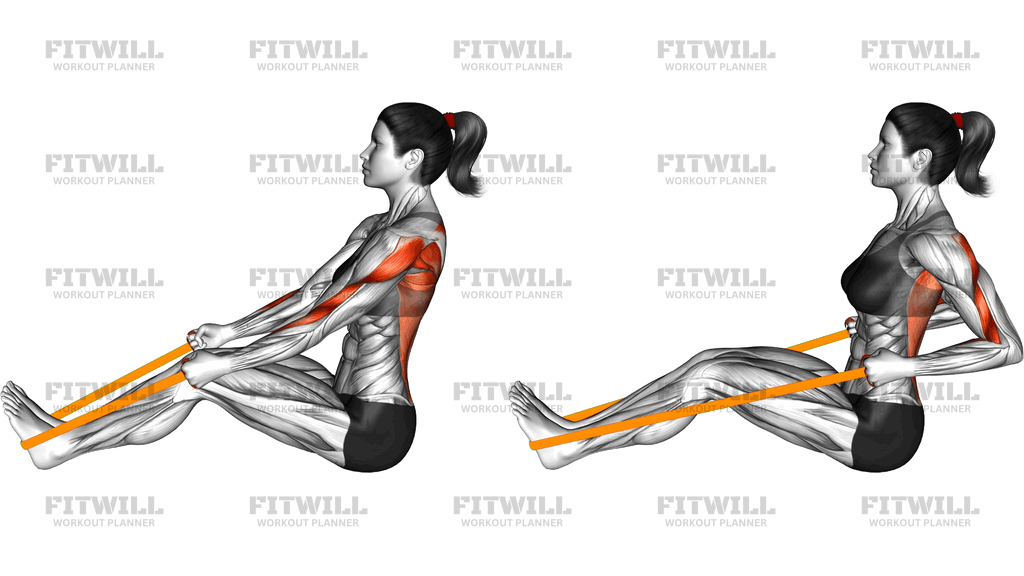
Instructions
- Sit on the floor with your legs extended in front of you and your knees slightly bent, feet flexed and about hip-width apart.
- Loop the middle of the resistance band around the arches of both feet and hold one end of the band in each hand, crossing the band under your feet if you need extra security.
- Sit tall with your chest lifted, hinge slightly forward from the hips, and extend your arms so there is light tension on the band before the first rep.
- Brace your abdominal muscles and draw your shoulder blades down away from your ears to set your posture.
- Pull the band toward your lower ribs by driving your elbows straight back, keeping them close to your sides.
- Squeeze your shoulder blades together at the end of the pull and hold for a beat.
- Slowly let your arms extend forward, resisting the band's pull until your arms are straight and the band is stretched but not slack.
- Exhale as you pull the band back, and inhale as your arms return forward.
- Complete your reps, then release the band from your hands before unhooking it from your feet so it cannot snap back at you.
Tips & Tricks
- If your torso keeps collapsing backward as you pull, the band is too strong; switch to a lighter band or wrap it around your feet fewer times.
- Avoid shrugging at the top of each rep — if your shoulders creep toward your ears, consciously press them down before initiating the pull.
- Do not let the band go fully slack at the stretch position; keeping slight tension protects the shoulder joint and makes each rep consistent.
- If your hamstrings are so tight that you cannot sit upright, soften your knees more or prop your hips up on a folded mat or low step to improve your angle.
- Pull toward your lower ribs, not your chest or chin — a high pull shifts the work away from the lats and toward the upper traps.
- Grip the band with relaxed fingers rather than squeezing hard; over-gripping fatigues your forearms before your back gets worked.
- Round-shouldered pullers should add a deliberate one-second pause with the shoulder blades pinched together to reinforce the mid-back contraction.
- Check the band for small tears or worn spots before every session, since a band that snaps under tension around the feet is a real injury risk.
- Keep your lower back neutral; arching excessively to gain range means the band tension is too high or your hip hinge has drifted.
Frequently Asked Questions
What muscles does the Resistance Band Seated Row work?
The lats and rhomboids do most of the pulling, supported by the rear shoulders, mid traps, and biceps. Your hamstrings and lower back also work isometrically to keep you sitting upright.
Is the Resistance Band Seated Row good for beginners?
Yes, it is one of the most beginner-friendly rowing variations because the resistance is light, adjustable, and easy on the joints. It also teaches the shoulder-blade retraction pattern needed for harder rows later.
How do I anchor the band correctly for the Resistance Band Seated Row?
Place the band around the arches of both feet with your knees slightly bent and hold the ends in each hand. If it slips, wrap it an extra time around each foot or cross it underneath before gripping.
Why do I feel the Resistance Band Seated Row more in my biceps than my back?
That usually means your elbows are drifting away from your body or your hands are doing the pulling. Focus on driving your elbows back toward your hips and let your hands travel as a follow-through.
How do I make the Resistance Band Seated Row harder?
Use a thicker band, shorten the band by wrapping it around your feet an extra time, or slow down the return phase to three or four seconds. You can also switch to a single-arm version to double the tension on one side.
Can I do the Resistance Band Seated Row every day?
Yes, in moderation. Since the load is modest, doing a few sets most days is reasonable, especially for posture, but give the muscles a genuine rest day if you train with heavier bands or high volumes.
What can I use instead of the Resistance Band Seated Row if I have no band?
A cable machine seated row with a handle is the closest substitute. A bent-over dumbbell row also trains the same muscles, though it changes your body position from seated to hinged standing.
Is it safe to do the Resistance Band Seated Row with straight legs?
Straight legs are fine if you can keep a neutral spine, but most people sit taller and pull better with slightly bent knees. If your back rounds when your legs are locked out, bend the knees more or elevate your hips on a cushion.
How many reps and sets should I do of the Resistance Band Seated Row?
Two to four sets of 12 to 20 reps works well for most people, finishing each set about two reps short of losing form. If your last reps involve shrugging or leaning back hard, stop the set there.