Resistance Band 45 Degree Hip Extension Glute Focu
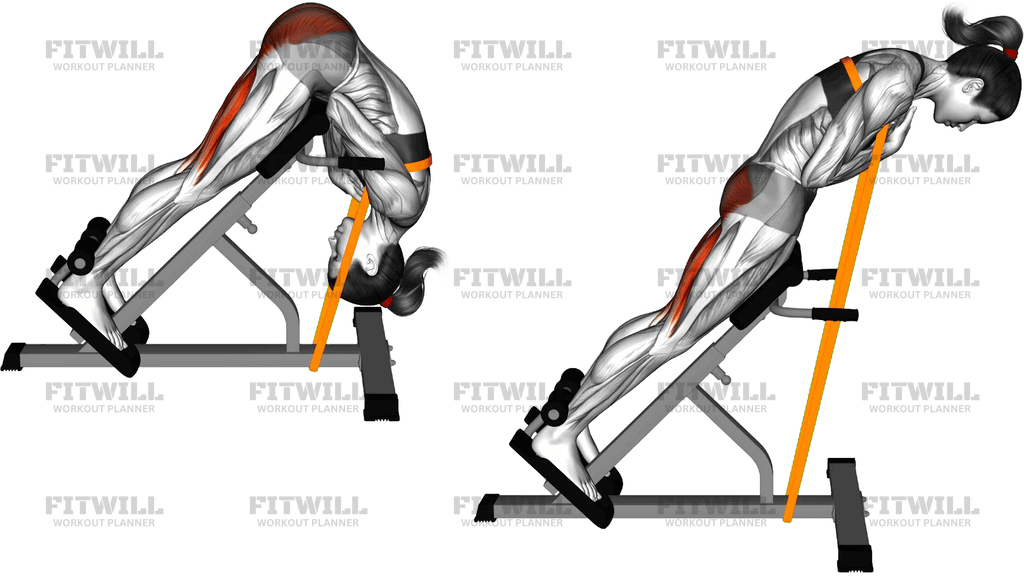
The Resistance Band 45 Degree Hip Extension Glute Focus is a back extension variation performed on a 45-degree hyperextension bench, with a resistance band looped around your upper back and anchored to the base of the bench. The band adds downward tension that peaks as you rise toward the top, which is exactly where the glutes need the most challenge. Because the movement is coached as a hip extension rather than a back extension, the emphasis shifts away from the spinal erectors and onto the gluteus maximus and hamstrings.
This version suits lifters who want direct glute and hamstring work without loading the spine with a barbell or plate. It is commonly used as an accessory after squats or deadlifts, as a primer before heavier hip hinges, or as a main glute movement for people who train at home or in a gym without a glute-focused machine. The band makes the exercise scalable: a thicker band or a folded band increases the difficulty, while a light band lets beginners learn the hip hinge pattern with feedback.
Setup matters more here than in a standard back extension. The pad should sit just below the hip crease so your pelvis can tilt freely, your feet are secured under the ankle pads, and the band must sit flat across your upper back, not your neck. If the pad sits too high, your range gets cut short and your lower back takes over; too low and you lose stability at the bottom.
To execute well, lower your torso under control until you feel a stretch across the back of your hips, then drive your hips into the pad and squeeze the glutes to bring your torso back in line with your legs. Stop at a neutral torso position rather than arching past it, since the glute focus comes from the hip squeeze, not from hyperextending the spine. Keep the band pressed against your chest with crossed arms so it cannot slip up toward your neck.
The main safety point is controlling the eccentric. Letting the band yank you down into the bottom position rounds the lower back under tension and is the most common way this exercise goes wrong. Move deliberately, breathe out as you rise, and stop the set as soon as your glutes can no longer finish the rep without your lower back arching past neutral.
[ Workout Log & Planner ]
Put your next workout in Fitwill
Keep your plan and training log ready when you are.


Instructions
- Anchor a resistance band around the base post of a 45-degree hyperextension bench and loop the other end behind your upper back, holding it in place by crossing your arms over your chest.
- Place your feet on the platform and secure your ankles under the rear pads, then set your hips on the pad so the top edge sits just below your hip crease and your torso can fold forward freely.
- Straighten your legs softly with a slight knee bend, brace your core, and let your torso hang down toward the floor to reach the starting position.
- Inhale at the bottom and feel a mild stretch across your hamstrings and glutes before initiating the lift.
- Push your hips down into the pad and drive them forward, squeezing the glutes to lift your torso up along the 45-degree line of the bench.
- Stop when your shoulders, hips, and ankles form one straight line; do not arch your lower back past neutral.
- Exhale as you reach the top and hold the glute squeeze for a beat while the band pulls down hardest.
- Lower your torso back down slowly over two to three seconds, letting the band tension stretch you back into the starting position under control.
- Complete your reps, then carefully uncross your arms and lift the band off your upper back before stepping off the bench.
Tips & Tricks
- If the band rides up toward your neck, cross your arms lower over your chest and pull it down against your upper back before each rep.
- Rounding your lower back at the bottom is the most common fault with the band pulling you down; limit your depth to the point where your back stays long and neutral.
- Arching past a straight line at the top removes tension from the glutes and loads the spine, so end every rep with the hips locked out and the ribs down instead.
- Pushing off with your calves or bouncing out of the ankle pads steals work from the glutes; keep your feet passive and let the hips do the lifting.
- If you feel only your lower back working, your pad may be set too high; drop the hip position slightly so the pelvis can hinge fully.
- Pause for one to two seconds at the top of each rep, since the band tension is highest exactly where glute contraction should peak.
- Switch to a lighter band if your torso speed drops sharply mid-set; band exercises punish rushed, sloppy reps more than plate-loaded ones.
- Keep a slight bend in the knees rather than locking them straight, which keeps the hamstrings engaged and reduces pull behind the knees.
- Point your toes down slightly and turn them out a few degrees to bias the glutes over the hamstrings, similar to a hip thrust foot position.
Frequently Asked Questions
Which muscles does the Resistance Band 45 Degree Hip Extension Glute Focus work?
The gluteus maximus is the primary mover, with the hamstrings assisting through the hip drive. The lower back muscles work mainly to hold your torso stable rather than to lift the weight.
Why is there a resistance band behind my back instead of holding a plate?
With the band anchored to the base of the bench, tension increases as you rise toward the top, which matches the point where your glutes are strongest. Holding a plate loads the bottom position more, where you are weakest.
Is the Resistance Band 45 Degree Hip Extension Glute Focus suitable for beginners?
Yes, provided you start with a light band or no band at all and first learn the hip hinge on a plain back extension. Once you can control the descent and stop at neutral, add band tension gradually.
How is the glute focus version different from a regular back extension?
In the glute focus version you deliberately push your hips into the pad and finish with a glute squeeze at a neutral torso, while a regular back extension often allows more spinal arch and relies more on the erectors.
How far down should I lower my torso?
Lower until you feel a stretch in the hamstrings and glutes while your back stays long and neutral. The band will pull you deeper than usual, so err on the side of a shallower range rather than letting your spine round.
Where exactly should the band sit?
Flat across your upper back, held in place by crossed arms over your chest. If it sits on your neck, it creates uncomfortable cervical pressure and can slip during the rep.
What should I do if my lower back feels strained during this exercise?
Check that the pad sits below your hip crease, reduce the band thickness, and cut your range of motion at the bottom. Also make sure you are not arching past a straight line at the top of each rep.
What can I use if I do not have a 45-degree hyperextension bench?
A stability ball against a wall with your feet anchored, glute bridges or hip thrusts with a band, or banded Romanian deadlifts all train similar hip extension patterns with the glutes emphasized.
How many reps and sets work best for this movement?
Two to four sets of 10 to 15 controlled reps with a brief top pause works well for most lifters. Because the band makes the top harder, stop the set when the glute squeeze fades rather than when total failure hits.
Should my knees be straight or bent during the Resistance Band 45 Degree Hip Extension Glute Focus?
Keep a slight bend in the knees. Fully locked knees shift tension behind the knee joint and can let the hamstrings dominate, while a soft bend keeps the emphasis on hip extension.