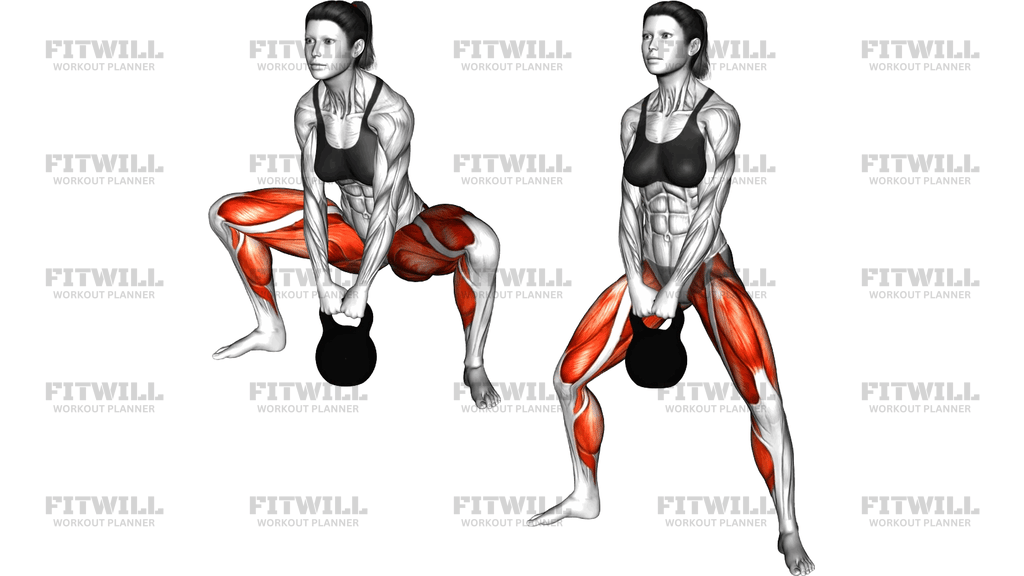
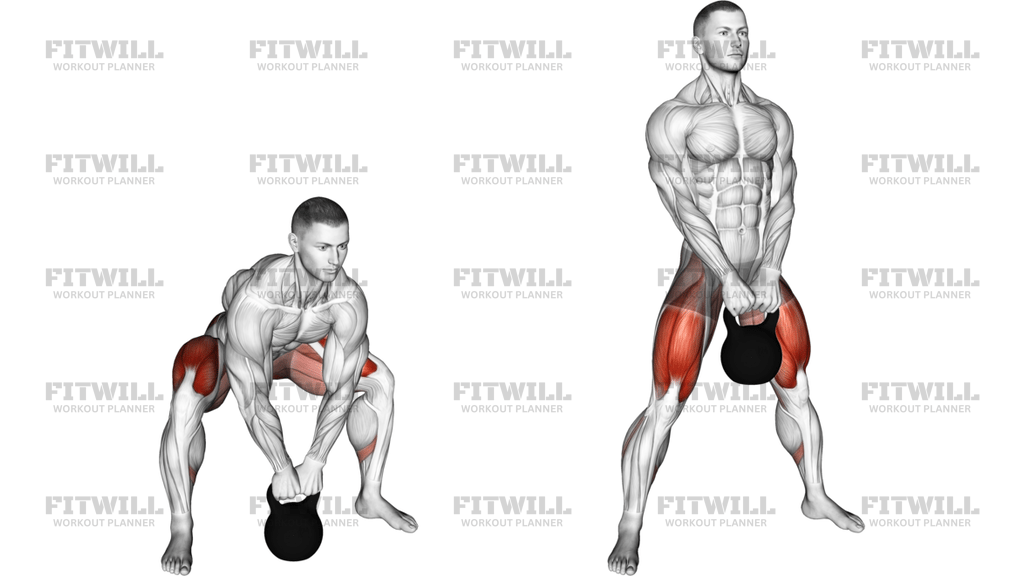
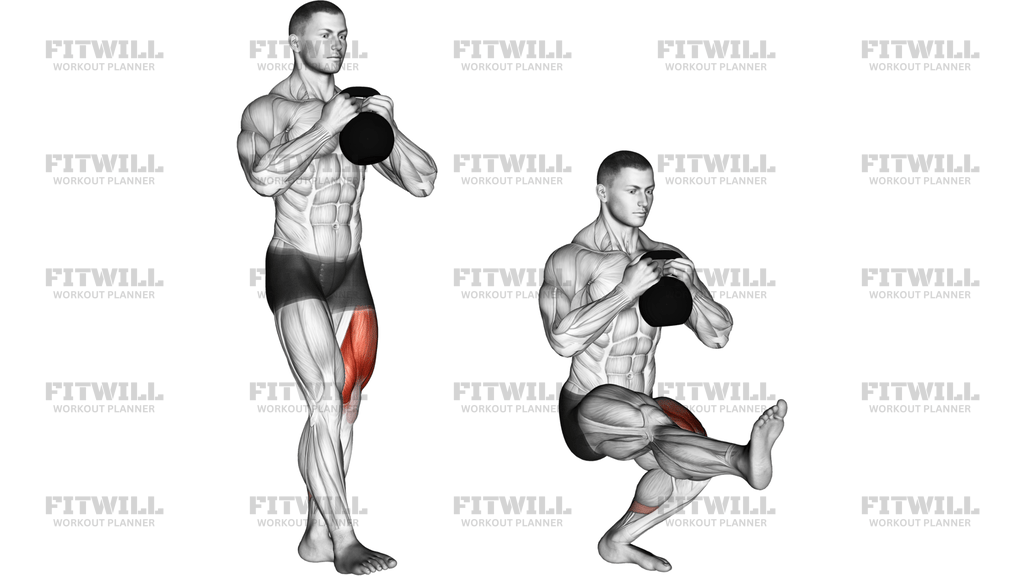
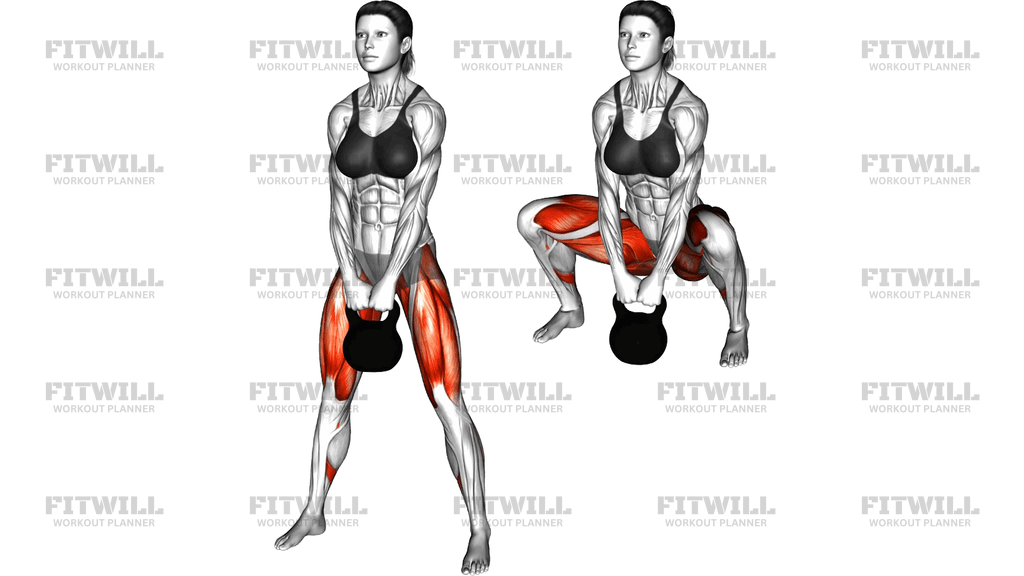
Kettlebell Lateral Step Up
The Kettlebell Lateral Step Up is a single-leg strength exercise performed from the side of a flat bench, with one or two kettlebells held in the front rack position at chest height. Instead of facing the bench head-on as in a standard step up, you approach it sideways, place your inside foot on top, and drive through that leg to stand fully upright on the bench. The front rack hold changes the character of the movement considerably: the load sits high on your torso, your core has to work to keep your ribs stacked over your hips, and your upper back and shoulders stay engaged for the entire set.
This exercise is especially useful for people who want to fix left-to-right strength differences. Because each rep is driven by one working leg, the stronger side cannot quietly take over the way it can in a barbell squat or leg press. It also fits well into programs for runners, cyclists, and field-sport athletes, since stepping up sideways in a racked position trains the quads and glutes through the exact kind of single-leg, hip-stabilizing demand those sports produce. The highlighted work in the front of the thigh shows the primary emphasis, with the glutes and hamstrings contributing heavily as you finish each rep to a full stand.
Setup matters more here than in most lower-body moves. The bench should be stable and at a height that lets your stepping thigh reach roughly parallel or slightly above without you having to hop or swing the load. Holding the kettlebells in the rack, with elbows tucked down and wrists stacked over them, keeps the weight close to your midline. If the bells drift forward, your torso pitches forward too, and the exercise turns into a lower-back test instead of a leg exercise. Stand tall next to the bench, not leaned onto it, and keep your whole body organized before the first step.
Execution should be slow and deliberate. Shift your weight fully onto the foot on the bench, push the floor away through your whole foot, and rise until your standing leg is straight and your trailing foot can touch down lightly on top. Pause briefly, then lower under control, letting the trailing leg reach down and absorb only a small amount of your bodyweight. The descending half is where most people rush, and it is also where the glutes and quads get much of their training effect. Breathe in on the way up or before the push, and exhale as you rise.
In practice, this movement works well as a secondary strength exercise after squats or deadlifts, or as a main single-leg lift on its own day. Start with one kettlebell racked on the side of the working leg, master the balance, and only then progress to two bells. If you find yourself pushing off the floor with the bottom leg, the bench is too high or the load is too heavy, and reducing either will get the emphasis back where it belongs.
Fitwill
Log Workouts, Track Progress & Build Strength.
Achieve more with Fitwill: explore over 9600 exercises with images and videos, access built-in and custom workouts, perfect for both gym and home sessions, and see real results.
Start your journey. Download today!




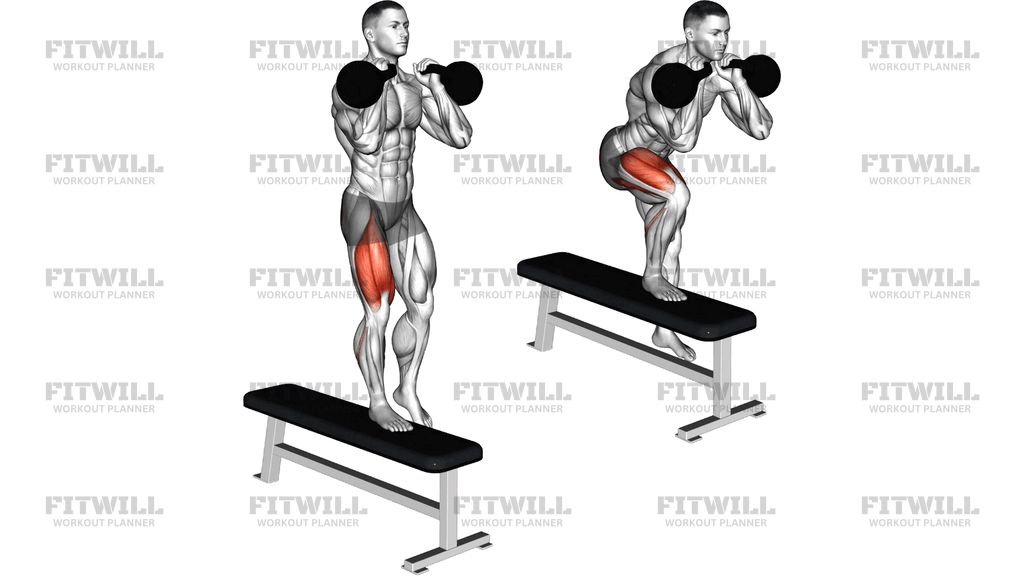
Instructions
- Set a flat bench parallel to your body so that you are standing beside it, facing forward, with your feet hip-width apart on the floor.
- Clean one or two kettlebells into the front rack position, resting them against your forearms and shoulders with elbows tucked close to your ribs and wrists straight.
- Place your inside foot flat on the center of the bench so your whole foot is supported, and shift your weight over that leg while keeping your torso tall.
- Brace your core and pull your ribs down so the kettlebells stay stacked over your midfoot and your lower back stays neutral.
- Push through the entire foot on the bench and drive up until your working leg is fully straight, bringing your trailing foot up to stand on the bench next to it.
- Pause for a moment at the top with both feet on the bench, hips and knees locked out and torso upright.
- Shift your weight onto the working leg again and lower the trailing foot slowly toward the floor, controlling the descent rather than dropping into it.
- Touch the floor lightly with the trailing foot, keeping most of your bodyweight on the bench leg, then immediately begin the next rep or reset fully between reps.
- Exhale as you step up, inhale at the top and as you lower, and complete all reps on one side before switching to stand on the other side of the bench.
Tips & Tricks
- If you have to bounce or push hard off the bottom leg to get up, the bench is too tall for your current strength. Lower it until your stepping thigh reaches parallel without assistance.
- Keep the kettlebell handles resting on the heel of your hand and your elbows pointed down, not flared out to the sides, or your shoulders will fatigue before your legs do.
- Watch for the common mistake of letting the trailing leg do half the work. Aim to keep only a light touch with the bottom foot on the descent so the working leg controls the load.
- Do not let your knee collapse inward as you drive up. Think about spreading the floor with your stepping foot so the knee tracks over the middle of the foot.
- If the bells pull you forward and you feel it in your lower back, squeeze your glutes and brace harder before each rep rather than leaning back to compensate.
- Alternate which leg is closest to the bench between sets, or the movement will gradually become one-sided without you noticing.
- Hold a brief pause at the top of each rep instead of bouncing straight down. It exposes whether you are actually finishing the step with a straight hip.
- Start with one kettlebell on the side of the working leg before trying two. The two-bell version demands significantly more torso stability than the extra weight alone suggests.
Frequently Asked Questions
Which muscles does the Kettlebell Lateral Step Up work the most?
The quadriceps on the front of the working thigh do most of the pushing, with the glutes and hamstrings extending the hip as you stand up. Holding the kettlebells in the front rack also keeps your core and upper back working throughout the set.
Why step up from the side of the bench instead of facing it?
The lateral approach changes the angle of the hip and knee and challenges the outer hip and stance stability more than a front-facing step up. It also closely matches the sideways, single-leg demands of running, hiking, and field sports.
How high should the bench be for the Kettlebell Lateral Step Up?
Choose a height where your stepping thigh reaches roughly parallel to the floor at the bottom and you can rise without pushing off the trailing leg. For most people that means the bench sits at or just below knee height.
Should I use one kettlebell or two?
Start with one kettlebell racked on the side of the working leg so you can focus on balance and leg drive. Progress to two bells in the front rack once you can complete all reps without losing your tall torso position.
Is the Kettlebell Lateral Step Up suitable for beginners?
Yes, provided the bench is low and the weight is light. Beginners often benefit from doing the same step pattern with bodyweight or a single light bell first to learn the balance before adding a real load.
Why do I feel this in my lower back instead of my legs?
That usually means the kettlebells are drifting away from your midline and your torso is leaning forward or collapsing at the ribs. Retract the bells over your midfoot, tuck your elbows, and brace your core before each step.
Can I push off the floor with my bottom foot?
Only lightly. If the bottom leg is contributing real force, the working leg is no longer doing the exercise. Lower the bench height or reduce the kettlebell weight until the top leg can complete the rep on its own.
What can I substitute if I do not have a kettlebell?
A dumbbell or pair of dumbbells held at chest height works well, or you can perform the lateral step up with bodyweight and add load later. The key details, side approach, tall torso, and full single-leg drive, stay the same.
How many reps and sets should I do?
Two to four sets of six to ten controlled reps per leg works well for strength. Because balance degrades quickly under fatigue, keep the reps at a level where your form on the last rep still matches your first.
Is it safe to do this exercise if my knees are sensitive?
Many people tolerate step ups well because the foot stays planted and the range is easy to adjust, but you should reduce bench height and load if you feel knee discomfort. Stop and reassess your knee tracking or consult a professional if discomfort persists.