Kettlebell Goblet Lateral Step Up
The Kettlebell Goblet Lateral Step Up is a single-leg strength exercise performed by standing sideways to a flat bench and driving yourself up onto it with one leg while holding a kettlebell in the goblet position at chest height. Unlike a standard front-facing step up, approaching the bench from the side changes the angle of the hip and knee, which shifts more emphasis onto the quads and outer hip muscles and challenges your balance in a way straight-ahead stepping does not. The highlighted quadriceps in the movement pattern reflect just how much work the lead leg does here — the trailing leg should only assist minimally.
This exercise suits a wide range of lifters. Beginners can use a light kettlebell or just body weight to learn single-leg control, while more advanced trainees can load it substantially because the goblet position keeps the weight close to the center of mass and spine-friendly. It is especially useful for runners, hikers, and field sport athletes who need to generate force from a single leg at a time, and for anyone whose left and right sides have drifted apart in strength or coordination.
The setup matters more than it first appears. The bench height should allow your foot to rest on it with your thigh roughly parallel to the floor or slightly above — too high and your calf and hip have to compensate, too low and the movement loses its value. Holding the kettlebell by the horns at your sternum keeps your torso tall and upright, which loads the working leg instead of letting you lean into the step. Because you approach from the side, the bench edge also gives you a clear depth reference: your hip crease should lower to about bench level each rep.
To execute it well, place your inside foot flat and centered on the bench, keep your weight stacked over that foot, and push the floor away through your whole foot — heel and midfoot together — until your leg is straight. Bring your trailing foot up to meet the other one, stand fully tall at the top, then lower yourself back down on the same side with a slow, controlled eccentric. The descent is where most of the strength benefit lives, so resist the urge to drop off the bench.
Practically, this movement slots in as a main lower body lift on moderate days or as an accessory after squats and deadlifts. Typical work sets fall between 6 and 12 reps per side. The main safety points are simple: keep the bench on a non-slip surface, start with a height you can step onto without pushing off the trailing leg, and switch sides before fatigue makes your balance sloppy.
Fitwill
Log Workouts, Track Progress & Build Strength.
Achieve more with Fitwill: explore over 9600 exercises with images and videos, access built-in and custom workouts, perfect for both gym and home sessions, and see real results.
Start your journey. Download today!




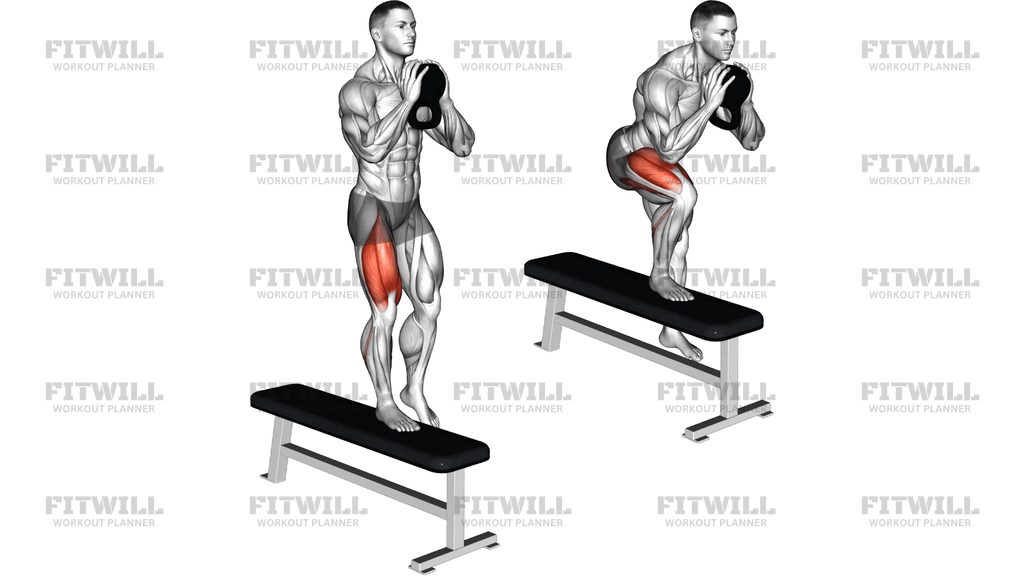
Instructions
- Place a flat bench on a stable, non-slip floor and stand sideways to it so the bench is at your right or left side, not in front of you.
- Grip a kettlebell by the horns with both hands and bring it up to your sternum, elbows pointing down and tucked close to your ribs in the goblet position.
- Place your inside foot flat on the center of the bench so your knee is bent roughly 90 degrees, and keep your outside foot planted on the floor.
- Brace your core, pull your shoulders down, and look straight ahead to keep your torso tall and upright.
- Exhale and drive through your whole working foot — heel and midfoot — to push yourself up until your leg is fully straight at the top of the bench.
- Bring your trailing foot up and set it next to the working foot so you are standing fully on the bench with both feet.
- Step the trailing leg back down to the floor on the same side, then lower your working leg slowly, controlling the descent for 2-3 seconds until your foot touches down.
- Inhale at the bottom, reset your grip on the kettlebell and your stance, and complete all reps on one side before switching to the other leg.
- Stop the set if you find yourself pushing off the floor leg or leaning your torso heavily toward the bench — that means the working leg is no longer doing the lifting.
Tips & Tricks
- A common fault is driving off the bottom leg instead of the top one. Keep the trailing foot's toes lightly touching for balance only — if you feel it pushing, lighten the load or lower the bench.
- Do not let your knee collapse inward as you step up. Think about spreading the floor and tracking your knee over your second toe, especially on the lateral approach where the hip is rotated differently than in a front-facing step up.
- Keep the kettlebell glued to your chest. If it drifts forward as you rise, your torso will follow and pull weight off the working leg.
- Choose bench height before you choose load. If your hip cannot reach bench-level depth with control, step down to a lower box or bench first.
- Control the lowering phase deliberately — dropping off the bench turns a strength exercise into a landing drill and multiplies the stress on your knee.
- If you wobble sideways at the top, squeeze the glute of the standing leg and hold the top position for a one-count before stepping down. Stability usually improves within a few sessions.
- Your front foot should sit fully on the bench, not hang half off the edge. A partial footprint makes your calf and ankle do work your thigh should be handling.
- Keep the work balanced: if your weaker side gets 8 reps, your stronger side gets 8 reps, even if it feels easy. Let the weaker side set the standard.
Frequently Asked Questions
What muscles does the Kettlebell Goblet Lateral Step Up work?
The quadriceps of the working leg do most of the lifting, with strong support from the glutes and hamstrings as you rise to full hip extension. The calves stabilize your ankle on the bench, and the core works isometrically to keep the kettlebell and torso upright.
Why step up from the side instead of facing the bench?
The lateral approach changes the hip and knee angles, placing extra demand on the outer hip muscles and emphasizing the quads differently than a front-facing step up. It also challenges side-to-side balance, which most stepping variations miss.
How high should the bench be for the Kettlebell Goblet Lateral Step Up?
Pick a height where your thigh is roughly parallel to the floor with your foot flat on the bench. If your heel lifts or you cannot control the descent, the bench is too high — start lower and progress up.
How do I hold the kettlebell during this exercise?
Grip the horns with both hands and hold the bell against your sternum with your elbows pointing down. This goblet position keeps the load close to your center of mass and helps you stay upright.
Is the Kettlebell Goblet Lateral Step Up good for beginners?
Yes, provided you start with a light kettlebell or body weight and a low bench. It is actually one of the better ways to learn single-leg strength because the bench limits your range and the goblet hold makes good posture intuitive.
What is the most common mistake in this movement?
Pushing off the bottom leg to help the working leg, usually because the load or bench height is too aggressive. The bottom foot should only balance you — if it is driving, reduce the weight or step height so the top leg does the work.
Can I substitute a dumbbell for the kettlebell?
You can hold a single dumbbell vertically against your chest in a similar goblet-style grip, though the kettlebell's horns are easier to control in this position. Two dumbbells at your sides are a poorer choice because they pull you out of the tall posture this step up needs.
How many reps and sets should I do per side?
For strength and control, 3 sets of 6-10 reps per leg works well, always starting with your weaker side. If you are using it as an accessory after squats or deadlifts, 2-3 sets of 10-12 at a lighter load is plenty.
Are Kettlebell Goblet Lateral Step Ups safe for the knees?
When performed with a controlled descent, a knee that tracks over the toes, and an appropriate bench height, it is generally a knee-friendly way to build leg strength. If you feel sharp pain rather than muscular effort, lower the step height and reduce the load, and check your foot placement on the bench.