Weighted Bar Standing Lateral Raise
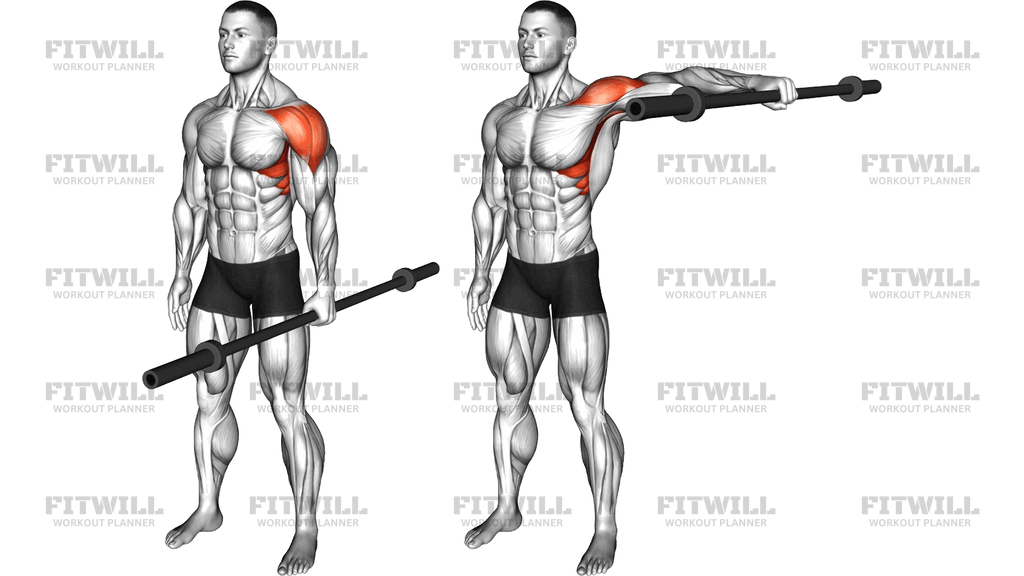
The Weighted Bar Standing Lateral Raise is a single-arm lateral raise performed with one end of a barbell in hand. Instead of a dumbbell, you grip the bar's sleeve so the plates on the opposite end sit behind you, creating a long lever with the weight offset from your hand. That offset changes the feel of the movement completely: the resistance builds gradually as the bar tilts upward, and the load pulls slightly backward as well as outward, demanding extra control from the shoulder at the top.
This setup suits lifters who want a fresh stimulus for the side delts without piling on heavy dumbbell weight. Because the bar acts as a lever, a modest plate load feels substantially harder than the same weight held close in the hand, making it useful for people with cranky shoulders who find heavy dumbbell laterals uncomfortable. It is also a practical choice in busy gyms or minimalist setups where a barbell and one plate are all that is available. Grip strength gets a genuine workout too, since holding the thick sleeve under an offset load is harder than holding a dumbbell handle.
The primary muscles worked are the lateral deltoids on the side of the shoulder, with the anterior delts and upper traps assisting, especially near the top of the lift. The rotator cuff and scapular stabilizers work throughout to keep the humerus tracking cleanly in the socket, and the forearm and grip stay engaged the entire time. Because you train one side at a time, you can spot and correct left-right strength differences that often hide in two-arm raises.
Setup matters more here than in a standard lateral raise. Stand tall with the bar held at your side, sleeve in your working hand and the loaded end behind your hip. The bar should hang vertically at the bottom, not rest against your leg or drift forward. Your stance stays about hip width, your free arm hangs relaxed, and your torso stays upright throughout. If you start with the bar leaning against your thigh, the first few degrees of the lift become a momentum-driven swing rather than delt work.
To execute well, raise the bar out to your side in a smooth arc, leading with the elbow and stopping when your arm reaches roughly shoulder height. The bar tilts from vertical toward horizontal as you lift, which is exactly where the resistance peaks. Pause briefly, then lower under control until the bar returns to vertical at your side. Avoid shrugging, leaning away, or swinging the bar upward; the moment the torso starts moving, the delts are being cheated out of work.
This movement fits best as a secondary or accessory exercise placed after your main pressing or overhead work, typically for moderate reps in the 10 to 15 range per side. Start light with a single small plate, master the arc, and only add load when you can raise and lower the bar without body english. Because each rep finishes near shoulder height with a long lever in front of your shoulder, err on the side of caution with weight and stop a set if your form tightens up.
[ Workout Log & Planner ]
Put your next workout in Fitwill
Keep your plan and training log ready when you are.


Instructions
- Load a small plate onto one end of a barbell and stand holding the opposite sleeve in your working hand, with the loaded end hanging behind your hip.
- Set your feet hip width apart, keep your torso upright, and let your free arm hang relaxed at your side.
- Position the bar so it hangs vertically at the bottom, just outside your thigh, without touching your leg.
- Brace your core and pull your shoulder blade down and back so you are not starting from a shrugged position.
- Raise the bar out to your side in a smooth arc, leading with the elbow and keeping the elbow slightly bent.
- Stop when your arm reaches about shoulder height, where the bar has tilted near horizontal and the resistance is greatest.
- Hold the top position for a beat, feeling the tension across the side of your shoulder.
- Lower the bar slowly along the same arc until it returns to vertical at your side, keeping tension instead of letting it drop.
- Breathe in as you lift and exhale steadily as you lower, keeping your ribcage stacked over your hips.
- Complete all reps on one side, reset your stance and grip, then switch hands and match the rep count.
Tips & Tricks
- The most common fault is turning this into a swing: because the loaded end sits far from your hand, a small hip drive produces a big arc. Pin your torso still and let only the shoulder joint move.
- If your traps take over and you feel it on top of the shoulder, lighten the load and focus on keeping the shoulder blade depressed as the arm rises.
- Do not raise the bar above shoulder height. With the long lever tilting past horizontal, extra height mostly shifts work to the traps and stresses the shoulder joint.
- Keep the bar hanging vertical at the bottom of each rep. If it rests against your thigh between reps, the start of every lift gets an illegal push.
- Grip the sleeve firmly but not white-knuckle tight; a choke grip fatigues your forearms before your delts get their stimulus.
- Chalk or a lifting strap can help if your grip gives out first. A strap is a legitimate fix here since the goal is delt training, not grip endurance.
- Start with a light plate only. The offset leverage makes the effective load grow quickly as the bar rises, so a weight that feels easy at your hip can be unmanageable at shoulder height.
- Perform the exercise facing a mirror from the side to check that the arc stays in line with your shoulder rather than drifting forward across your body.
- If your shoulder pinches at the top, reduce the range to just below shoulder height rather than forcing the full arc.
Frequently Asked Questions
Which muscles does the Weighted Bar Standing Lateral Raise target?
It primarily targets the lateral deltoids on the side of the shoulder, with the anterior delts and upper traps assisting as the bar approaches shoulder height. The forearms and grip work continuously because you are holding a thick bar sleeve under an offset load.
Why use a barbell instead of a dumbbell for a lateral raise?
Holding the bar's sleeve puts the plates well behind your hand, creating a long lever that gets heavier as the bar tilts upward. A small plate load therefore feels much harder than the same dumbbell weight, and the resistance curve differs from a standard dumbbell raise.
Is the Weighted Bar Standing Lateral Raise suitable for beginners?
Yes, as long as beginners start with a very light plate or an empty sleeve on the far end. The leverage amplifies load quickly, so learning the movement with minimal weight and a strict arc is more important than adding plates early.
How high should I raise the bar during the Weighted Bar Standing Lateral Raise?
Stop at roughly shoulder height, where your arm is parallel to the floor. Raising higher mainly recruits the traps and places the shoulder under more stress with no meaningful benefit for the side delts.
Why does the bar want to swing backward as I lift it?
Because the loaded end sits behind your body, the bar's weight pulls back as it tilts upward, especially near the top. This is expected; keep the arc in line with your shoulder and use a controlled tempo rather than fighting it with a heavier weight.
My grip fails before my shoulders on this exercise. What should I do?
Use chalk first, and if that is not enough, secure the bar with a lifting strap. The purpose of the exercise is delt training, so letting grip be the limiting factor defeats the point once the weight gets meaningful.
Can I substitute the Weighted Bar Standing Lateral Raise with dumbbell lateral raises?
Dumbbell lateral raises are a fine substitute and easier to load progressively. The barbell version is worth using when you want a different resistance curve, a grip challenge, or when only a barbell is available.
Should I do both arms at once with two barbells?
It is possible, but most lifters get better quality reps training one side at a time. Single-arm work lets you brace with the free hand if needed and makes it easier to keep the torso still.
How many sets and reps should I use for the Weighted Bar Standing Lateral Raise?
Treat it as an accessory movement: two to three sets of 10 to 15 controlled reps per side works well. Because the lever makes loads unforgiving at the top, prioritize smooth technique over adding weight.
Is this exercise hard on the shoulder joint?
Done with a light load, a controlled tempo, and an arc that stops at shoulder height, it is generally well tolerated. If you feel pinching at the top, shorten the range slightly, and avoid the movement entirely during any active shoulder pain.