Resistance Band Standing Balance Hip Abduction
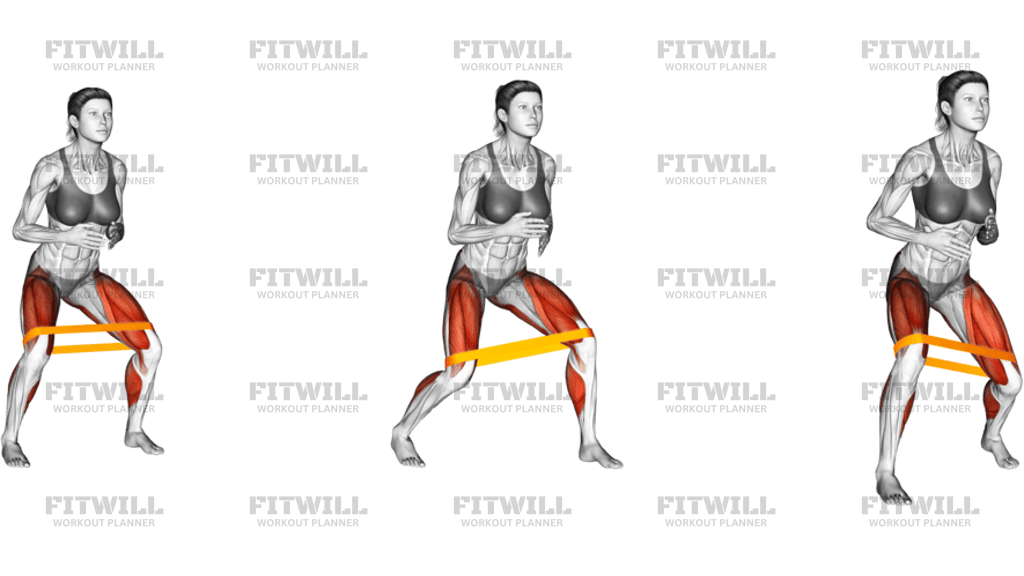
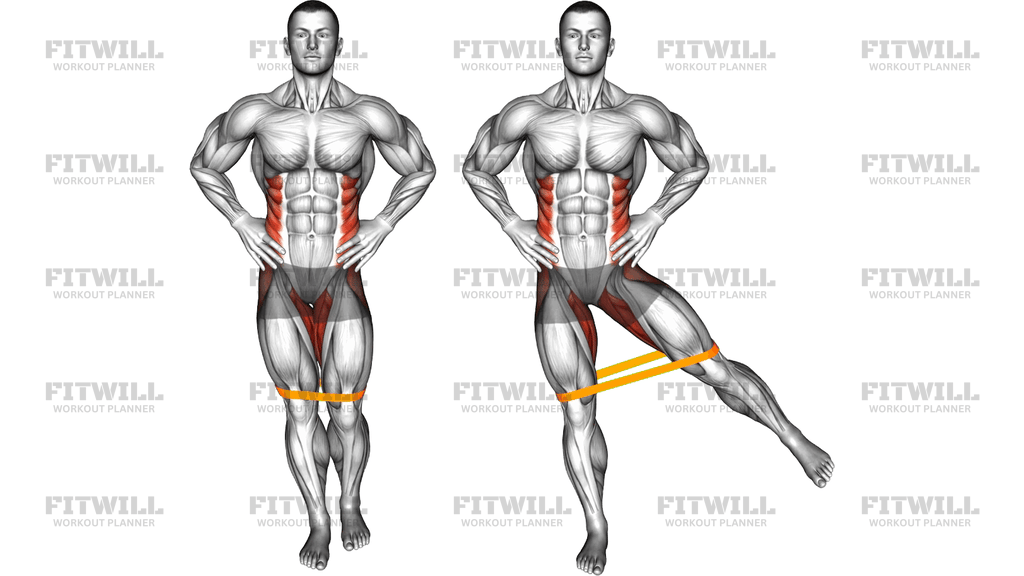
Resistance Band Standing Balance Hip Abduction is a single-leg exercise performed with a loop band placed around both legs just above the knees. You stand tall with your hands on your hips, shift your weight onto one leg, and lift the free leg out to the side against the band's pull, then control it back in. The band creates tension in both directions: it resists the leg as it lifts away and pulls it back toward the standing leg as you return.
This movement targets the gluteus medius and the muscles along the outer hip, which are responsible for moving the leg away from the midline and keeping the pelvis level when you stand, walk, or run. Because you're balancing on one leg, the standing hip, the deep core, and the small stabilizing muscles around the ankle and foot all have to work together to keep you upright. The highlighted areas in the demonstration reflect exactly that: the outer hip of the moving leg and the trunk musculature that holds the torso steady.
The setup matters more than it might seem. Placing the band just above the knees keeps the resistance close to the hip joint, which encourages you to drive the movement from the hip rather than swinging from the foot. Standing rather than lying down or kneeling also makes this a balance drill at the same time, which is why it shows up so often in warm-ups, rehabilitation-style programming, and lower-body activation work before squats, lunges, or running.
To execute it well, keep your torso upright and your hips square to the front. Lift the leg out to the side only as far as you can without leaning your torso over the standing leg or rotating the pelvis. A controlled lift of 20 to 30 degrees with steady tension beats a big sideways swing every time. Move slowly on the way back in so the band's pull doesn't snap the leg back to the start.
This exercise suits a wide range of trainees: runners and field-sport athletes who want more stable hips, lifters using it as a glute primer, older adults working on single-leg balance, and anyone spending long hours sitting who needs targeted work for the often-underused outer hip muscles. Because the load is a band rather than a weight, it's easy to adjust the difficulty simply by changing band thickness or where you place the loop.
[ Workout Log & Planner ]
Put your next workout in Fitwill
Keep your plan and training log ready when you are.


Instructions
- Stand with a loop resistance band placed around both legs just above the knees, feet about hip-width apart so the band is lightly taut.
- Place your hands on your hips, keep your chest up, and soften the knees slightly without bending forward.
- Shift your weight fully onto your left leg and lift the right foot slightly off the floor, finding your balance before moving.
- Brace your abdominal muscles and keep both hips facing forward throughout the set.
- Abduct the right leg straight out to the side, pressing against the band's tension while keeping the knee fairly extended and the toes pointing forward.
- Stop at the highest point you can reach without leaning your torso to the left or rotating your pelvis, usually around 20 to 30 degrees of hip abduction.
- Pause briefly at the top, feeling the contraction along the outer hip of the moving leg.
- Slowly bring the leg back toward the standing leg, resisting the band's pull rather than letting it snap your leg inward, and lightly tap or hover the foot near the floor.
- Exhale as you lift the leg out and inhale as you lower it back in.
- Complete your reps on one side, reset your stance, then switch legs and repeat on the other side.
Tips & Tricks
- If you wobble badly on the standing leg, the band is probably too heavy; drop to a lighter loop until you can stay steady for all reps.
- Leaning the torso away from the lifting leg is the most common compensation; it shortens the lift and shifts work off the outer hip, so check yourself in a mirror and stay vertical.
- Don't point the toes of the moving leg outward as you lift; rotating the leg lets other muscles take over and reduces gluteus medius involvement.
- Keep a small bend in the standing knee the whole time. A locked-out knee makes balancing harder and loads the joint instead of the hip muscles.
- If the band slides down your calves, it's positioned too low or too loose; move it back up to just above the knees before continuing.
- A slow three-second return is where a lot of the benefit lives. Rushing the lowering phase turns the exercise into a swinging motion with little tension.
- For extra balance challenge without adding band resistance, stand on a folded mat or remove a point of visual focus rather than immediately jumping to a thicker band.
- Hold onto a wall, rack, or sturdy chair with one hand at first if your balance is limited, then progress to hands-on-hips as stability improves.
- Stop the set when your standing-leg foot starts gripping or cramping excessively; that usually means the stabilizers are fatigued and form is about to break down.
Frequently Asked Questions
Which muscles does Resistance Band Standing Balance Hip Abduction work?
The primary muscles are the gluteus medius and other outer hip abductors of the moving leg. The standing leg's hip stabilizers, the deep core, and the ankle stabilizers also work hard to keep you balanced.
Where exactly should the resistance band be placed?
Place the loop around both legs just above the knees, as shown in the standard setup for this exercise. This position keeps tension close to the hips and discourages swinging the leg from the foot.
Is Resistance Band Standing Balance Hip Abduction suitable for beginners?
Yes, it's a low-load exercise that most beginners can learn quickly. Start with a light band and keep the lift small, and hold a wall or rack for support until your single-leg balance feels secure.
Why do I keep losing my balance during this exercise?
Balance usually breaks down when the lift goes too high, the band is too strong, or you move too fast. Reduce the range, use a lighter band, and add a brief pause at the top where you're stable before returning.
How far should I lift my leg out to the side?
Lift only to about 20 to 30 degrees, or wherever you can keep your torso upright and hips square. A higher leg almost always comes with leaning or pelvic rotation, which reduces the work on the outer hip.
Can I use this exercise as a warm-up?
Yes, it works very well as an activation drill before squats, lunges, deadlifts, or running. One or two sets of 10 to 15 controlled reps per side is enough to wake up the glute medius without fatiguing it.
How many reps and sets should I do?
For strength and stability, 2 to 3 sets of 10 to 15 slow reps per side works well. Use a band tension that leaves the last few reps challenging while you still stay balanced and controlled.
What can I use if I don't have a loop band?
You can perform the same standing abduction without a band for a balance-focused version, or use a cable machine with an ankle strap set low for similar resistance. The band version, however, is the most portable and practical option.
Is it normal to feel this in my standing leg rather than the lifting leg?
Some fatigue in the standing hip and foot is expected because they're stabilizing your whole body, but the strongest working feeling should be along the outer hip of the moving leg. If the standing side dominates entirely, shorten the range and slow the tempo.
Is Resistance Band Standing Balance Hip Abduction safe for the knees?
With the band above the knees and a soft bend in the standing leg, the load stays on the hip muscles rather than the knee joint. If you have a current knee issue, keep the movement small and stop if you feel joint discomfort rather than muscle effort.