Bodyweight Single Leg Deadlift
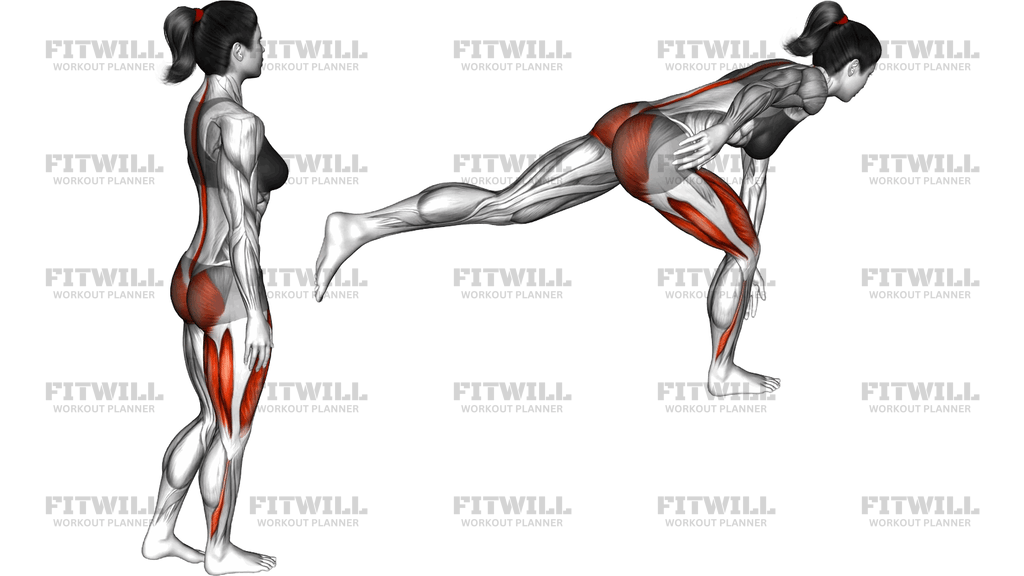
The Bodyweight Single Leg Deadlift is a hip hinge performed on one leg, where you balance on a standing foot while the other leg travels behind you as your torso lowers forward. Because there is no external load, the challenge comes entirely from controlling your own body through balance, hip mobility, and single-leg strength. It is one of the simplest ways to expose and fix left-to-right differences in hip strength and stability.
This movement primarily works the glutes and hamstrings of the standing leg, with the glute of the lifted leg assisting as it extends behind you. The lower back muscles work isometrically to keep your spine neutral as you hinge, while the deep core and the stabilizers around the standing hip and ankle handle the balance demand. Few bodyweight exercises tie these systems together as efficiently.
The setup matters more than it might seem. With one foot off the floor, your whole body becomes a seesaw pivoting around the standing hip, so where you place your weight, how you square your hips, and where your eyes focus all determine whether the hinge stays clean or turns into a twisting, rounded-back reach. Taking a moment to brace and set your balance before the first rep pays off in every rep after it.
To execute it well, shift your weight onto one foot, keep a soft knee, and push your hips back as your chest lowers and your free leg swings behind you. Aim for a straight line from the crown of your head to the heel of your lifted foot at the bottom, then drive through the standing heel to return upright. The movement should feel like you are closing a door with your backside, not like you are reaching for the floor with your hands.
It is useful for runners and field-sport athletes who need single-leg stability, for lifters as a warm-up or accessory before barbell deadlifts, and for anyone rehabilitating balance and hip control after time away from training. It also travels well: no equipment means you can do it at home, in a hotel room, or as part of a dynamic warm-up.
The main safety point is honesty about your range. Hinge only as far as you can keep your back flat and your hips square; a shallow, controlled hinge beats a deep, wobbly one every time. If your balance is the limiting factor at first, that is normal, and light fingertip support from a wall or rack is a reasonable way to learn the pattern before going fully unsupported.
[ Workout Log & Planner ]
Put your next workout in Fitwill
Keep your plan and training log ready when you are.


Instructions
- Stand tall with your feet hip-width apart and your arms relaxed at your sides or hands resting lightly near your hips.
- Shift your weight fully onto your right foot, press it into the floor, and lift your left heel slightly so your left foot is ready to travel back.
- Brace your core, pull your shoulders back, and pick a fixed spot on the floor a few feet in front of you to anchor your gaze.
- Softly bend the standing knee to about 15-20 degrees, then hinge at the hips by pushing your glutes backward, letting your torso lower forward.
- As your chest descends, extend your left leg straight behind you so it moves in the same plane as your torso, keeping both hips square to the floor.
- Lower until your torso and back leg form one long line, roughly parallel to the floor, or as far as your hamstrings allow without your back rounding.
- Pause briefly at the bottom, then drive your hips forward by pushing through the standing heel and squeezing the glute of the standing leg to return to standing.
- Exhale as you hinge down, inhale at the bottom, and exhale again as you drive back up.
- Bring the left foot back down under you, reset your balance and brace completely, then complete all reps on the right side before switching to the left leg.
Tips & Tricks
- If your hips open and your lifted foot rotates outward, think about pointing the toes of the back leg straight down and keeping both hip bones facing the floor.
- Rounding the lower back to reach lower is the most common fault; stop the descent at the point where your spine starts to curve, even if that means stopping well above parallel.
- If you keep losing balance, slow the movement down by half. Speed hides instability, and a slow hinge gives your ankle and hip stabilizers time to make corrections.
- Lightly tapping the floor with the back toes between reps is a fine regression while you build control; aim to reduce the taps over time rather than eliminating them on day one.
- Do not lock the standing knee hard. A soft knee keeps the hamstrings loaded and stops the hinge from collapsing into a stiff-legged toe touch.
- Keep your arms hanging straight down or hands near your hips rather than reaching forward with them, since reaching shifts weight forward and pulls your lower back out of position.
- If your standing foot arch collapses inward, consciously grip the floor with your toes; the ankle is often the hidden failure point in this exercise, not the hip.
- Start with your weaker or less coordinated leg first, and match the rep count on the stronger side so the gap between legs does not grow.
Frequently Asked Questions
What muscles does the Bodyweight Single Leg Deadlift work?
The glutes and hamstrings of the standing leg do most of the work, with the lifted leg's glute assisting as the hip extends. The lower back and deep core stabilize the torso, and the calf and ankle stabilizers of the standing leg manage balance.
Is the Bodyweight Single Leg Deadlift good for beginners?
Yes, as long as the range is adjusted. Beginners can hinge only partway down or rest fingertips lightly on a wall or rack for balance until the pattern feels stable.
How far down should I hinge in the Bodyweight Single Leg Deadlift?
Lower until your torso and back leg form a straight line near parallel with the floor, or earlier if your hamstrings or lower back limit you. Depth is secondary to keeping a flat back and square hips.
Why do I keep losing my balance during this exercise?
Balance usually fails because of moving too fast, letting the hips rotate, or letting weight drift toward the toes. Slow the descent, focus your eyes on a fixed spot, and keep your weight over the middle of the standing foot.
Should my back leg stay straight during the Bodyweight Single Leg Deadlift?
Keep it essentially straight with the knee soft, so it moves as a counterweight in line with your torso. A sharply bent back knee turns the movement into a balance reach and reduces the hamstring stretch.
How many reps and sets should I do?
Two to three sets of 6-10 controlled reps per leg is a solid range. Because balance is a skill, higher-frequency practice with moderate reps tends to work better than occasional all-out sets.
Can I replace weighted deadlifts with the Bodyweight Single Leg Deadlift?
It is not a direct replacement for heavy loading, but it builds the single-leg hinge pattern, balance, and hip stability that support deadlift performance. It works well as an accessory or warm-up alongside weighted hip hinges.
What can I use instead if I cannot balance at all?
Hold a wall, squat rack, or sturdy chair with one fingertip, or perform the same hinge with your back foot resting lightly on the floor for support. Progress by using a lighter touch rather than removing support all at once.
Is it normal to feel this in my lower back?
Some engagement in the lower back is normal because those muscles hold your spine position during the hinge. Sharp or dominant lower-back discomfort usually means the back is rounding or the hips are twisting, so reduce the range and re-brace.
Should I do this exercise barefoot or in shoes?
Either works. Barefoot or thin-soled shoes give you more feedback from the standing foot, which can help if balance is your limiting factor.