Seated Scapular Rotation
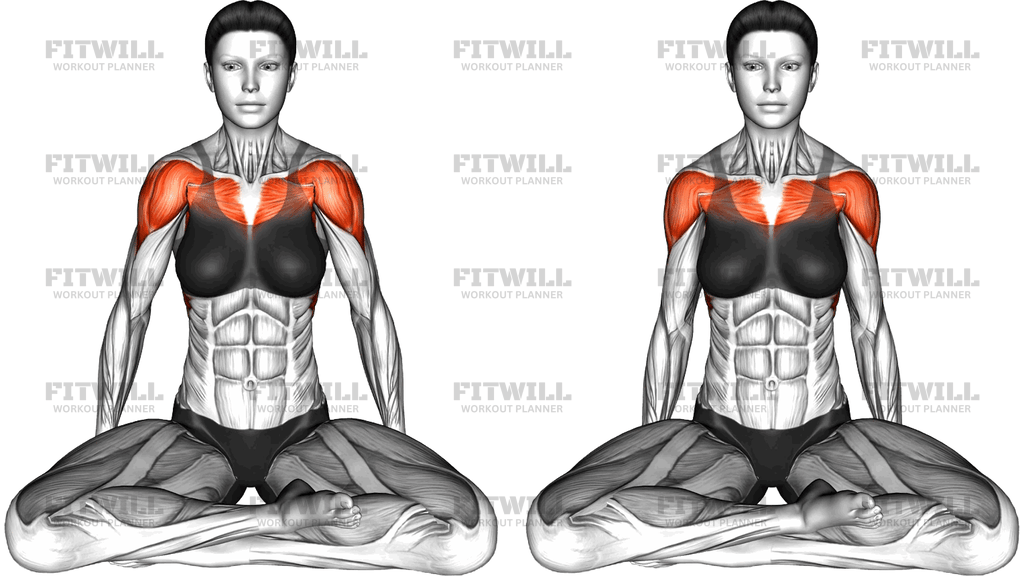
Seated Scapular Rotation is a body-weight mobility and control drill performed sitting cross-legged on the floor with the hands resting lightly beside the hips. From this position you slowly roll the shoulder blades through their full range — lifting them up toward the ears, drawing them back and together, pressing them down, and rounding them forward — tracing a smooth circle with each shoulder blade. The image shows the two halves of that cycle: one side with the shoulders shrugged and rotated forward, the other with the collarbone area open and the shoulder blades settled down and back.
This drill is useful for anyone whose shoulders feel stiff or heavy after long hours at a desk, as well as lifters who want better shoulder blade control before pressing or pulling sessions. Because the arms stay relaxed and unloaded, the focus stays entirely on moving the shoulder blades themselves rather than the arms, which is exactly the skill most people are missing. The trapezius, rhomboids, and serratus anterior do the steering, while the rotator cuff and the muscles around the chest and shoulder work to keep the arm hanging quiet at your side.
The cross-legged seated position matters more than it looks. Sitting on the floor removes the backrest that would otherwise let you lean and cheat, and it anchors the lower body so the movement has to come from the upper back and shoulders. A tall, quiet torso gives the shoulder blades a stable base to glide against; slouching or swaying turns the drill into noise.
Execution is deliberately slow. Think of drawing a circle with the tip of each shoulder blade rather than simply shrugging. Keep the arms heavy, the hands resting on the floor, and the neck long. Most people discover one quarter of the circle — usually the forward roll — feels unfamiliar or sticky, which is normal and improves with practice.
Use Seated Scapular Rotation as a warm-up before upper-body training, as a reset between long blocks of sitting, or as part of a shoulder health routine alongside band work. It asks very little of the joints, needs no equipment, and rewards consistency over intensity. Move within a comfortable range, keep the face and jaw relaxed, and let the quality of the circle — not its size — be the goal.
Fitwill
Log Workouts, Track Progress & Build Strength.
Achieve more with Fitwill: explore over 9600 exercises with images and videos, access built-in and custom workouts, perfect for both gym and home sessions, and see real results.
Start your journey. Download today!




Instructions
- Sit on the floor in a comfortable cross-legged position, sitting bones grounded and spine tall, with the crown of your head stacked over your pelvis.
- Let both arms hang relaxed at your sides and place the backs of your hands lightly on the floor beside your hips, with no weight through them.
- Roll the shoulders back once to find a neutral position, then relax the neck and jaw and take a slow breath in.
- Begin the circle by shrugging both shoulder blades straight up toward your ears.
- From the top, roll the shoulder blades backward and squeeze them gently toward each other, letting the chest open without arching the lower back.
- Continue the circle by pressing the shoulder blades down toward the back pockets, feeling the shoulders drop away from the ears.
- Complete the loop by rounding the upper back slightly and letting the shoulder blades glide forward and apart around the ribcage.
- Keep the arms completely passive throughout — the hands should not press, lift, or drag along the floor.
- Breathe steadily, exhaling as the blades travel down and forward, inhaling as they rise; aim for 5-8 controlled circles in each direction.
- After the final rep, settle into neutral, take one full breath, and gently shake out the shoulders before the next set or your next exercise.
Tips & Tricks
- The most common mistake is turning this into a plain shrug. If your shoulders only travel up and down, slow down at the top and consciously push the circle backward before letting the blades descend.
- If your head juts forward as the blades roll back, picture lengthening the back of your neck; the chin should stay level the whole time.
- Keep your weight even on both sitting bones. Leaning to one side usually means one shoulder is doing a bigger circle than the other — check in a mirror and match the sides.
- Hands that press into the floor are a sign the arms are trying to help. Lift them an inch off the floor for a few reps to confirm the shoulder blades are doing the work.
- A tight upper back often limits the forward half of the circle. Reduce the range rather than rounding hard from the lower back — the rounding should come from the thoracic spine only.
- Breathe out during the down-and-forward phase; holding your breath tends to create neck tension and shrugging through the upper traps.
- Smaller, smoother circles beat big, jerky ones. If the movement snaps or skips in one spot, work quietly around that zone rather than forcing through it.
- Do this drill before pressing or pulling days rather than after — waking up the shoulder blade movers first makes heavier work feel more stable.
Frequently Asked Questions
Which muscles does Seated Scapular Rotation work?
The trapezius, rhomboids, and serratus anterior control the shoulder blade circle, while the rotator cuff and the muscles around the chest and shoulders stabilize the arm as it hangs. It is a control and mobility drill, not a strength exercise, so the demand is moderate.
Why is the Seated Scapular Rotation done cross-legged on the floor?
The cross-legged seat removes any backrest, so you cannot lean or slouch against support, and it anchors the hips so the movement has to come from the shoulder blades. You can sit on a low cushion or block if your hips feel tight.
Should my arms move during Seated Scapular Rotation?
No — the arms stay heavy and passive with the hands resting lightly beside the hips. If your hands press into the floor or your elbows bend, the arms are taking over from the shoulder blades.
Is Seated Scapular Rotation good for beginners?
Yes, it is one of the gentlest ways to learn shoulder blade control because there is no load and no equipment. Beginners should start with small, slow circles and focus on feeling all four directions of the movement.
How many reps and directions should I do?
Five to eight smooth circles in each direction is plenty, ideally as part of a warm-up. Reverse direction halfway through so both rotational paths feel equally familiar.
What is the most common mistake with Seated Scapular Rotation?
Reducing the circle to a simple up-and-down shrug. Pause at the top of each rep and steer the shoulder blades backward before they descend, then let them glide forward around the ribs at the bottom.
My neck gets tight during Seated Scapular Rotation — what should I change?
Neck tension usually means you are shrugging with the upper traps and lifting through the shoulders near the ears. Make the circles smaller, soften the jaw, and emphasize the downward phase with a slow exhale.
Can I do Seated Scapular Rotation if I cannot sit cross-legged comfortably?
Yes — sit on a firm chair with your feet flat and your torso tall, keeping the arms hanging at your sides. The shoulder blade action is identical; only the seat changes.
When is the best time to use Seated Scapular Rotation in a workout?
It works best as the first movement of an upper-body warm-up, before presses, pull-ups, or rows. It is also a convenient mid-day reset if your shoulders feel stiff from sitting.
Should I feel any clicking in my shoulders during this drill?
Occasional pain-free clicking during shoulder blade movement is common and not a concern by itself. If a movement reproduces pain, shrink the range, slow the tempo, and stop if discomfort persists.