Seated Shoulder Shrug
The Seated Shoulder Shrug is a simple body weight movement where you sit cross-legged on the floor, rest your hands on your hips or upper ribs, and lift your shoulders straight up toward your ears before lowering them back down with control. Because there is no external load, the exercise isolates theshrugging action itself, making it easy to feel exactly which muscles are doing the work.
The main muscles involved are the upper trapezius, the diamond-shaped muscle that runs from the base of the skull and along the top of the spine out to each shoulder. The levator scapulae assists in lifting the shoulder blades, and the mid-back stabilizers work to keep your torso upright as the shoulders rise. Done seated, the movement removes any help from the legs or hips, so the traps have to do the job on their own.
This version is especially useful for people who are learning what a proper shrug feels like before adding dumbbells or a barbell, and for anyone who wants to wake up the upper traps and shoulder area without equipment. It fits well into warm-ups, desk-break routines, and rehab-style or mobility-focused sessions where light, controlled activation is the goal. Office workers and drivers who carry tension high in the shoulders often find the slow, deliberate tempo helps them reconnect with this area.
Setup matters more than it looks. Sitting cross-legged with a tall spine and hands resting lightly on your hips gives you a stable base and a reference point: you should feel your ribs stay quiet while only the shoulders move. If the torso rocks or the head juts forward, the shrug loses its focus and the neck starts compensating.
To execute it well, think of pushing your hands gently down into your hips as your shoulders rise straight up, keeping your chin level and your neck long. Pause briefly at the top, then lower the shoulders all the way back to a relaxed hanging position rather than letting them drop. The controlled descent is where much of the benefit lives.
A practical safety note: because the upper traps and neck are easy to overwork, keep the range comfortable and avoid forcing the shoulders toward the ears or rolling the head during the movement. If you feel pinching, sharp pain, or tingling down the arm, stop and reduce the range or speed before trying again.
Fitwill
Log Workouts, Track Progress & Build Strength.
Achieve more with Fitwill: explore over 9600 exercises with images and videos, access built-in and custom workouts, perfect for both gym and home sessions, and see real results.
Start your journey. Download today!




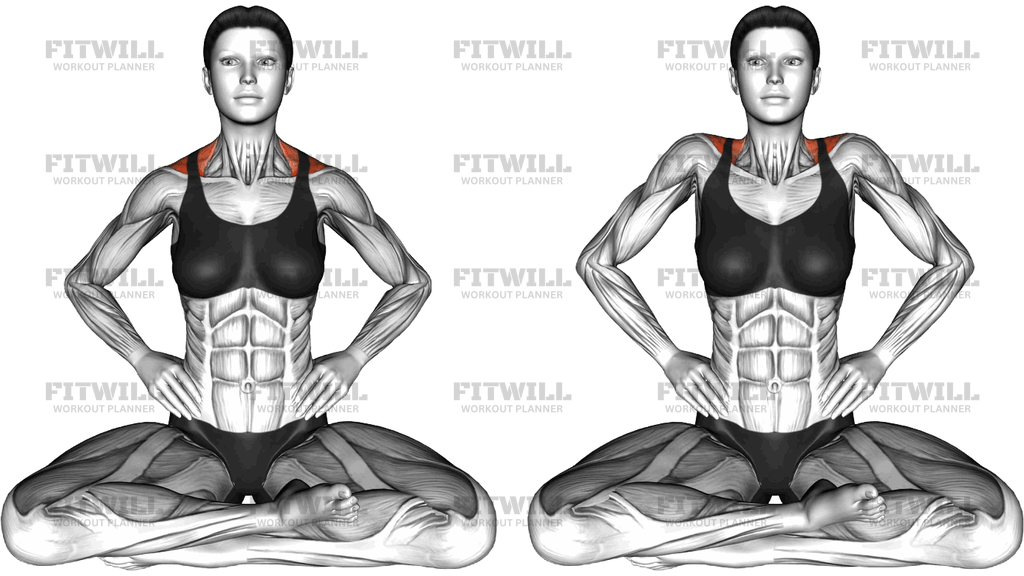
Instructions
- Sit on the floor in a cross-legged position with your sitting bones grounded and your spine tall.
- Place your hands firmly on your hips or the sides of your upper ribs, fingers pointing forward, elbows out to the sides.
- Relax your shoulders down and back so they start in a neutral, hanging position, and look straight ahead.
- Brace your core lightly to keep your torso still throughout the set.
- Exhale as you lift both shoulders straight up toward your ears, keeping your chin level and your head still.
- Squeeze briefly at the top, as if trying to touch your shoulders to your ears without tilting your neck.
- Inhale as you lower your shoulders slowly and fully back down to the relaxed starting height.
- Pause for a second at the bottom so each rep starts from a true resting position, not a partial shrug.
- Keep your hands pressing gently into your hips the whole time so the ribs and torso stay quiet while only the shoulders move.
- Complete your reps, then shake out the shoulders and gently roll them before your next set.
Tips & Tricks
- The most common mistake is letting the head slide forward or the chin tuck as the shoulders rise — keep your gaze fixed on one spot ahead of you so the neck stays neutral.
- Because there is no weight, people tend to rush; use a one-second pause at the top and a two-second lower to make the upper traps actually work.
- If your torso leans back as you shrug, lighten the effort and think about growing taller through the crown of your head instead of collapsing backward.
- Pressing your hands down into your hips creates mild opposition that helps you feel the traps contract — treat the hands as anchors, not passengers.
- Avoid rotating or rolling the shoulders in this exercise; the path is straight up and straight down, which keeps the focus on the upper traps.
- A partial range is a frequent fault — lower the shoulders all the way to a soft, hanging position between reps instead of hovering halfway.
- If you feel tension building in the neck rather than the top of the shoulders, shrink the range slightly and reset your posture before continuing.
- Sit on a folded mat or thin cushion if your hips or knees complain about the cross-legged position; a comfortable base lets you focus on the shrug.
- Breathe steadily rather than holding your breath at the top — exhale up, inhale down keeps the shoulders from tensing around the neck.
Frequently Asked Questions
Which muscles does the Seated Shoulder Shrug work?
The upper trapezius is the primary muscle, lifting the shoulder blades toward the ears. The levator scapulae assists, and the mid-back and core muscles stabilize your upright seated posture.
Why is the Seated Shoulder Shrug done cross-legged instead of standing?
Sitting removes the legs and hips from the equation, so you cannot bounce or use momentum to drive the shrug. The cross-legged position also gives you a stable base and makes it easier to keep the torso still.
Is the Seated Shoulder Shrug good for beginners?
Yes, it is one of the best ways to learn the shrugging pattern because the body weight resistance lets you focus purely on feeling the upper traps. Once the movement feels clear, the same pattern transfers directly to dumbbell or barbell shrugs.
What should my hands be doing during the Seated Shoulder Shrug?
Rest them firmly on your hips or the sides of your upper ribs and press down gently as the shoulders rise. This anchors the torso and gives you tactile feedback that only the shoulders are moving.
How can I tell if I am doing the Seated Shoulder Shrug incorrectly?
The clearest warning signs are a jutting chin, a rocking torso, or shoulders that roll instead of lifting straight up. If you notice any of these, slow down, reset your posture, and use a smaller, cleaner range.
Can the Seated Shoulder Shrug help with tight shoulders from desk work?
Slow, controlled reps can help you become aware of habitual shoulder tension and retrain relaxed, full-range movement. Keep the effort light and comfortable rather than forcing a big shrug.
What can I use instead of the Seated Shoulder Shrug?
A standing body weight shrug or a dumbbell shrug trains the same pattern with more load. Seated dumbbell shrugs on a bench are the closest loaded substitute since they also remove leg drive.
How many reps of the Seated Shoulder Shrug should I do?
Because the resistance is your own body weight, higher reps with slow tempo work well, typically 10 to 20 controlled repetitions per set. Focus on the quality of the lift and lower rather than squeezing out extra reps.
Is it safe to do the Seated Shoulder Shrug every day?
Light, unloaded shrugs are generally fine to perform frequently, especially as a warm-up or desk-break movement. If you notice persistent soreness or discomfort in the neck area, reduce the volume and let the area recover.
Should my shoulders roll backward during the Seated Shoulder Shrug?
No, keep the motion strictly vertical — straight up toward the ears and straight back down. Rolling adds uncontrolled rotation of the shoulder blades and shifts work away from the upper traps.