Standing Y Up
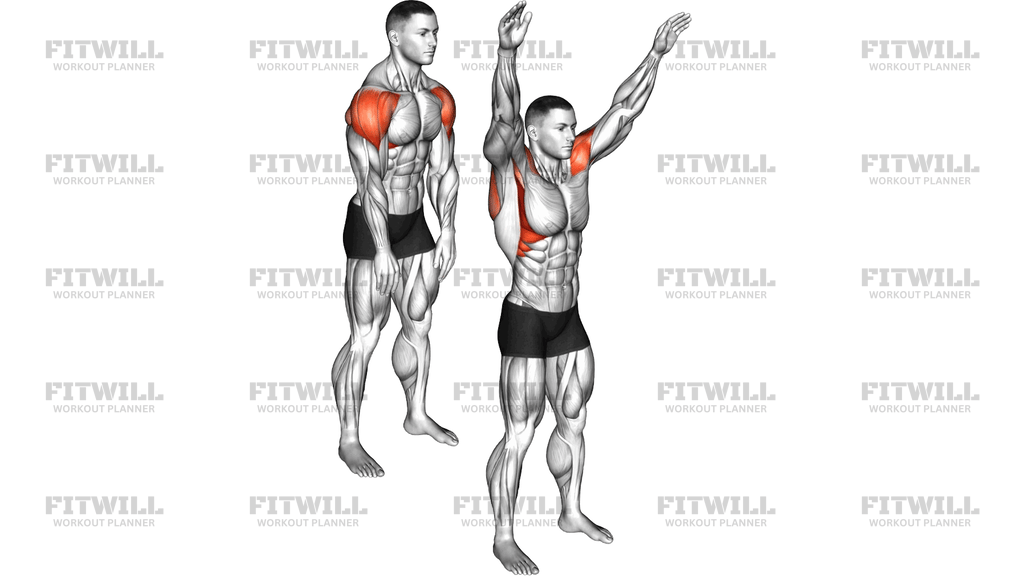
The Standing Y Up is a bodyweight shoulder exercise performed from an upright stance with the arms sweeping from your sides up into a wide Y position overhead. Unlike a standard front raise or lateral raise, the Y path places your arms roughly forty-five degrees out from your head, which spreads the work across the side delts while pulling the lower traps and scapular stabilizers into the lift. Because you are standing and moving both arms at once, your core and low back also work to keep your torso from swaying as the arms travel.
This movement suits a wide range of lifters. Beginners can use it to learn overhead arm control without any load, and more experienced trainees often use it as a warm-up before pressing days or as a high-rep finisher when the shoulders are already fatigued. It is also a practical choice for people with limited equipment, since all you need is floor space to stand.
The setup matters more than it looks. With no weight in your hands, it is easy to rush the reps and let momentum do the work, so an intentional stance, a braced trunk, and a deliberate arm path are what turn this from a casual arm swing into a real training stimulus. Feet about hip-width apart, ribs stacked over the pelvis, and shoulders pulled gently back create a stable base for the arms to move from.
To execute it well, think about leading with the hands and letting the shoulder blades ride up naturally as the arms rise. The end position has both arms extended overhead in a wide V, thumbs pointing up or palms facing forward, without shrugging aggressively toward the ears. The return is just as important: lower the arms under control along the same path rather than letting them drop, so the shoulders stay engaged through the whole range.
You will see the Standing Y Up in general shoulder warm-ups, posture-focused routines, and rehab-adjacent programming where overhead control is being rebuilt gradually. The main cautions are simple: keep the range within what your shoulders allow without pain, avoid arching your low back to chase extra height, and stop the set if you feel any pinching at the top of the movement.
[ Workout Log & Planner ]
Put your next workout in Fitwill
Keep your plan and training log ready when you are.


Instructions
- Stand with your feet about hip-width apart, weight spread evenly across both feet, and let your arms hang relaxed at your sides.
- Set your posture by drawing the shoulder blades gently back and down, stacking your ribs over your pelvis, and softening your knees slightly.
- Brace your abdominals lightly as if preparing for a gentle push to the stomach, and keep your gaze straight ahead.
- Begin the raise by sweeping both arms out to the sides and forward at the same time, following a diagonal path toward a forty-five degree angle above your shoulders.
- Continue lifting until both arms are nearly straight overhead, forming a wide Y shape with your body, palms facing forward or thumbs angled up.
- At the top, reach slightly through the fingertips without shrugging your shoulders up toward your ears.
- Pause for a beat, then lower your arms back to your sides along the same controlled diagonal path.
- Exhale as the arms rise, inhale as they lower, keeping the breath steady throughout the set.
- Reset your posture between reps if you feel your torso lean back or your shoulders creep upward.
Tips & Tricks
- The most common mistake is turning the Y Up into a fast arm swing. If your torso rocks or your heels shift, slow the tempo down and treat each rep as a deliberate reach rather than a throw.
- Avoid arching your lower back to get the arms higher. If you feel your ribs flare and your low back tighten at the top, shorten the range slightly and brace your abs harder before each raise.
- Watch for shrugging. If your traps bunch up toward your ears mid-rep, cue yourself to keep length in your neck and let the shoulder blades move, not climb.
- Keep a small bend in the elbows if your arms feel locked out and tense; straighten gradually as control improves.
- Your hands do not need to touch overhead. A wide Y is the target; forcing the arms together shifts work away from the side delts and can pinch the shoulder.
- If one arm rises faster or higher than the other, which is common, do a few extra single-arm reps on the weaker side before returning to the bilateral version.
- Use this before pressing exercises as an activation drill with slow, smooth reps, or at the end of a session for higher reps when the delts are warm.
- Breathe out on the way up instead of holding your breath; holding your air tends to increase the back arch you are trying to avoid.
Frequently Asked Questions
What muscles does the Standing Y Up work?
The main work comes from the side delts, with the front delts assisting as the arms travel forward. The upper and lower traps, along with the muscles that move the shoulder blades, control the scapular motion, and the core stabilizes your upright torso.
Is the Standing Y Up good for beginners?
Yes. With no external load, beginners can practice overhead arm control and learn what proper shoulder blade movement feels like before adding weight to any raise or press.
How is the Standing Y Up different from a lateral raise?
A lateral raise moves the arms straight out to the sides, while the Y Up follows a diagonal path to roughly forty-five degrees above shoulder level. That angle brings the lower traps and scapular muscles into the lift more than a pure lateral raise does.
Why do my shoulders shrug when my arms go overhead?
That usually means the upper traps are compensating for limited overhead range or a fatiguing scapular setup. Reset with the shoulder blades drawn gently back and down, reduce the range slightly, and focus on reaching through the fingertips rather than lifting with the shoulders.
Can I add weight to the Standing Y Up?
You can hold very light dumbbells or a light plate once your bodyweight form is consistent, but start unloaded. The Y position is easy to cheat in, and even small loads magnify any momentum or back arch.
How many reps and sets should I do?
For warm-up activation, two sets of ten to fifteen slow reps works well. As a finisher or standalone shoulder drill, three sets of fifteen to twenty reps with a brief pause at the top is a solid target.
Should my palms face forward or my thumbs point up during the Y?
Both are acceptable. Thumbs-up is often more comfortable for people who feel pinching with palms facing forward, so experiment and use whichever grip lets your arms travel smoothly overhead.
Can I do the Standing Y Up if overhead pressing bothers my shoulders?
Many people tolerate the Y Up better because it is unloaded and self-paced, but discomfort during any overhead motion is a signal to shorten the range or check with a qualified professional before continuing.
Can the Standing Y Up replace overhead pressing?
No. It trains shoulder elevation and scapular control, but it does not provide the same loading stimulus as a press. Treat it as a complement to pressing work, not a substitute.