Kneeling Reach And Thread
The Kneeling Reach And Thread is a body-weight mobility drill performed from an all-fours position. You start in a quadruped stance, sweep one arm out to the side and up toward the ceiling to open the chest, then bring that same arm down and thread it under your torso, resting the shoulder and side of the head on the floor. The two halves of the movement rotate the mid spine in opposite directions, which is exactly why it feels so effective on tight backs and locked-up shoulders.
This drill is one of the simplest ways to work rotational mobility through the thoracic spine. Most people lose rotation in the mid back from long hours of sitting, and that stiffness often shows up as lower back discomfort during lifting, throwing, or swinging movements. Because the knees and supporting arm anchor the hips and torso, the rotation is forced to come from the upper spine rather than being cheated out of the pelvis, making it a precise and self-limiting exercise.
The reach phase lengthens and loads the chest, front shoulders, and side body, while the thread phase stretches the muscles between the shoulder blades, the back of the shoulder, and the near-side obliques. The supporting arm and stacked knees also ask for quiet, steady control from the deep core, so you get a mild stability demand alongside the stretch. It is a genuine two-for-one for the trunk.
Setup matters here because the anchor points decide where the movement comes from. Keep the knees directly under the hips and the supporting hand under the shoulder. If the hips drift backward or the supporting elbow bends and drops, the rotation leaks into the lumbar spine and the stretch loses its target. Move slowly enough that you can feel the rotation happening in the ribcage, not just the arm swinging.
The Kneeling Reach And Thread fits naturally into warm-ups before strength training, cooldowns after workouts, and desk-break mobility routines. Desk workers with stiff mid backs, lifters preparing for squats or overhead presses, and golfers or racket-sport players who need rotation all benefit from a couple of controlled rounds per side. It requires no equipment and very little space, so it travels well.
Keep the movement pain-free and smooth. A mild stretch across the shoulder blade or along the side of the waist is the goal; sharp sensations in the neck, shoulder joint, or lower back mean you are forcing range you do not yet own. Small, clean rotations beat big, ragged ones every time.
[ Workout Log & Planner ]
Put your next workout in Fitwill
Keep your plan and training log ready when you are.


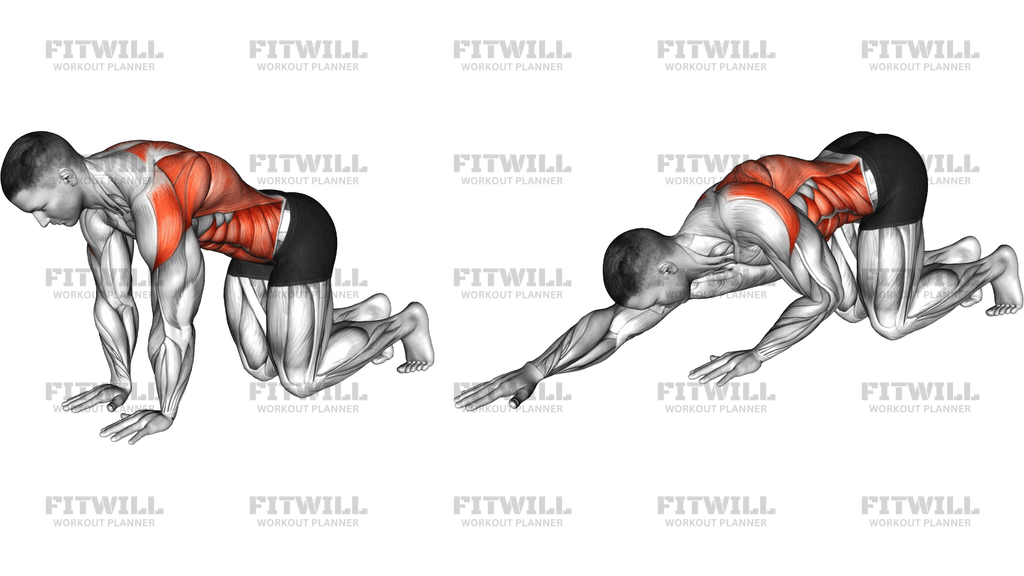
Instructions
- Kneel on the floor and place your hands under your shoulders and knees under your hips, shins resting flat behind you with feet in line with the knees.
- Set your head in line with your spine and look down at the floor so your neck stays long.
- Brace lightly by drawing the lower ribs down and keeping the hips stacked over the knees; this locks the pelvis so rotation comes from the mid back.
- On an inhale, sweep your right arm out to the side and reach it up toward the ceiling, letting your chest and eyes rotate toward that hand.
- Pause briefly at the top of the reach, feeling the stretch across the chest and front of the shoulder.
- Exhale and lower the same arm, feeding it through the gap between your left arm and left knee, palm facing up.
- Continue until your right shoulder and the right side of your head rest on the floor and you feel a stretch in the upper back and right obliques.
- Breathe steadily for a breath or two in the threaded position, letting each exhale soften you slightly deeper.
- Press through the left hand to reverse the path, pulling the right arm back out, reaching it up again, then returning it to the floor under the shoulder.
- Complete the desired repetitions on the right side, then switch to the left arm and repeat.
Tips & Tricks
- If your shoulder cannot comfortably rest on the floor in the threaded position, lower only as far as you can while keeping the neck relaxed rather than dropping the head to force contact.
- Keep the supporting elbow soft but not collapsed; a locked supporting arm encourages you to sag into the shoulder instead of rotating through the ribs.
- The most common mistake is pushing the hips back toward the heels, which turns the drill into a side bend. Imagine a glass of water balanced on your tailbone and keep the hips vertical.
- Follow the moving hand with your eyes. The neck is part of the rotation, and tracking the hand keeps the turn from stalling in the shoulder.
- Do not yank the arm through the thread. Slow the descent until you feel the shoulder blade muscles of the upper back spreading apart.
- If your knees are uncomfortable on a hard surface, kneel on a folded towel or mat; discomfort there will distract you from the rotation itself.
- Breathe out as the arm threads under and breathe in as it reaches up. Coordinating the breath with the two phases keeps the ribs from flaring and the lower back from arching.
- Match the range on both sides instead of chasing extra range on your looser side. A noticeable difference between sides is useful information, not a problem to rush past.
- For a deeper opening after the reach, hold the top position for three to five breaths before threading, letting the ribcage settle over the extended arm.
Frequently Asked Questions
What muscles and areas does the Kneeling Reach And Thread target?
It targets rotational mobility of the thoracic spine while stretching the obliques, the muscles between the shoulder blades, and the rear and front of the shoulder. The deep core also works quietly to keep the hips and supporting arm stable.
Is the Kneeling Reach And Thread a strength exercise or a stretch?
It is primarily a mobility and stretching drill, though the all-fours position requires modest core and shoulder stability to hold the hips still while the torso rotates.
Can beginners do the Kneeling Reach And Thread?
Yes, and it is actually a great beginner mobility drill because your knees and one hand anchor you, which limits how far you can over-rotate. Beginners should simply work within a comfortable range and let it expand gradually.
Why do my hips keep shifting backward during the thread?
Shifting the hips back is a way of borrowing range from a side bend instead of rotating the mid spine. Keep the knees stacked under the hips and think about turning the ribcage, not dragging the arm under.
Should my head rest on the floor in the threaded position?
Only if it happens comfortably. The side of the head resting lightly on the floor helps relax the neck, but forcing it down can strain the neck, so let the arm determine the depth.
What can I substitute if kneeling is uncomfortable?
A standing bent-over reach and rotate, or a seated thoracic rotation with arms crossed, works the same mid-back rotation. The kneeling version is preferred because the knees anchor the pelvis, but both alternatives train a similar pattern.
How many repetitions and how long should I hold each reach and thread?
Five to eight slow cycles per side works well in a warm-up, with a one- to two-breath pause at both the reach and the thread. On days focused purely on mobility, extend each pause to three to five breaths.
My shoulder pinches when I reach overhead in this drill. What should I change?
Reduce the reach so the arm travels only to shoulder height or slightly above, and turn the palm toward the ceiling a bit earlier. If pinching continues, skip the top reach and use only the threading phase until you can assess it further.
Can I use the Kneeling Reach And Thread before heavy lifting?
Yes, it makes an excellent early warm-up drill for squats, presses, or rotational sports because it frees up mid-back rotation without fatiguing anything. Keep the reps moderate and treat it as preparation, not a workout.
How do I know if the rotation is coming from the right place?
Your hips should stay square and the stretch should be felt in the upper back, shoulder blades, or side of the waist. If you feel it mostly in the lower back, the pelvis is rotating and you need to firm up the brace and slow the tempo.