Overhead Knee Raise
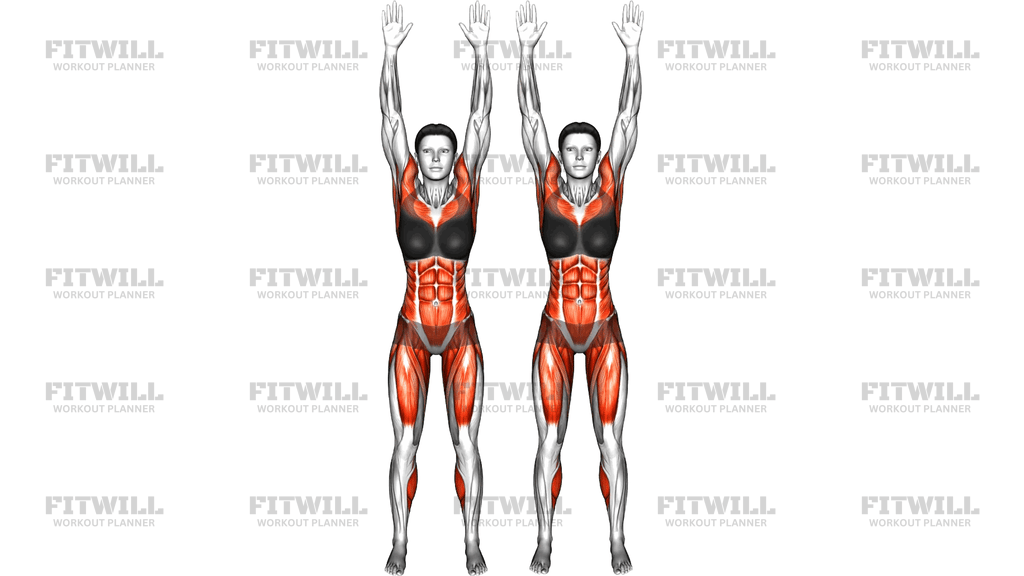
The Overhead Knee Raise is a standing bodyweight core exercise performed with both arms extended straight above your head. From that tall, stretched position, you drive one knee up toward your chest while keeping your arms locked overhead, then lower the leg back down with control. Because your arms stay raised throughout, your trunk has to work harder to stay upright, which makes this a more demanding version of a standard standing knee raise.
The overhead arm position is what separates this movement from an ordinary standing knee lift. Raising your arms lengthens the space between your hands and your working knee, so the knee has to travel further and your abdominal wall has to control your ribcage and spine the entire time. The lower abs and hip flexors power the knee drive, the obliques resist any sideways lean, and the shoulders and upper back hold the arms in place against gravity.
This exercise suits anyone who wants to train the core without getting on the floor, and it fits well into warm-ups, circuit training, or standing ab sessions. It is also a practical stepping stone toward hanging knee raises, since it teaches the same hip-flexion and bracing pattern while your feet still touch the ground. People who spend long hours sitting often find it useful for waking up the hip flexors and trunk in a lengthened position.
To perform it well, stand with your feet about hip-width apart and press your arms straight up so your biceps sit close to your ears. Before moving, brace your midsection as if preparing for a light push, and keep your ribs stacked over your pelvis rather than flaring them upward. As you lift one knee, aim it toward your chest or slightly across your body, hold briefly at the top, and lower it under control so your foot kisses the floor rather than slams it.
The most common breakdown points are leaning the torso back to cheat the knee higher, letting the arms drift forward, and rushing the reps so momentum does the lifting. Keep the movement slow enough that your abs, not your swing, raise the knee. If balance is a struggle, widen your stance slightly or stand near a wall for a light fingertip touch until your stability improves.
Because it requires no equipment, the Overhead Knee Raise travels well. It can be done at home, in a hotel room, or as a station in a larger conditioning circuit, and reps can be scaled easily by adjusting knee height, adding a pause at the top, or slowing the lowering phase.
Fitwill
Log Workouts, Track Progress & Build Strength.
Achieve more with Fitwill: explore over 9600 exercises with images and videos, access built-in and custom workouts, perfect for both gym and home sessions, and see real results.
Start your journey. Download today!




Instructions
- Stand with your feet hip-width apart, toes pointing forward, and your weight spread evenly across both feet.
- Raise both arms straight overhead so they are fully extended and roughly in line with your ears, palms facing each other or forward.
- Tighten your midsection by drawing your belly button in slightly and stacking your ribs down over your pelvis before you start moving.
- Shift your weight slightly onto one leg and lift your opposite knee up toward your chest as high as you can without leaning your torso backward.
- Keep both arms locked overhead and your shoulders down away from your ears as the knee rises.
- Pause for a beat at the top of the raise, squeezing your lower abs to hold the knee in its highest controlled position.
- Lower the leg slowly back to the floor, resisting gravity rather than dropping the foot.
- Exhale as you drive the knee up, and inhale as you lower it back to standing.
- Repeat on the same leg for your planned reps, or alternate legs, then reset your stance and brace before the next set.
Tips & Tricks
- If your lower back arches every time the knee lifts, shorten the range and raise the knee only as high as you can keep your ribs down.
- Do not let your arms fall forward during the raise. If they drift, your lats and shoulders are fatiguing and the core loses the lengthened challenge of the position.
- A slow two-second lowering phase turns this into a much stronger ab exercise than a fast, swinging knee drive.
- Keep the standing foot flat. Rolling onto the outside edge of the support foot is a common balance mistake that destabilizes the whole movement.
- Aim the knee slightly toward the opposite elbow if you want extra oblique involvement, but keep the torso square rather than twisting.
- If you cannot stay balanced, stand beside a wall and let one fingertip rest on it, or widen your stance to give yourself a larger base.
- Squeezing the glute of the standing leg helps lock the pelvis in place and prevents the hip from sagging sideways.
- Stop the set when your shoulders tire and your arms start dropping, not just when your abs burn, so you keep training the intended pattern.
Frequently Asked Questions
Which muscles does the Overhead Knee Raise work the most?
The lower abs and hip flexors do the main work of driving the knee up. The obliques stabilize against side lean, while the shoulders and upper back hold the arms overhead for the full set.
Is the Overhead Knee Raise good for beginners?
Yes, it is a beginner-friendly standing exercise, though some people need to start with a smaller knee height or a light wall touch for balance. Once the basic version feels stable, the range and tempo can be progressed.
How is the Overhead Knee Raise different from a regular standing knee raise?
Keeping the arms overhead increases the distance the knee travels relative to your hands and forces your trunk to control your ribcage in a stretched position. This makes the abs work noticeably harder than in a standard knee raise with arms down.
Why do I lean backward when I lift my knee, and how do I fix it?
Leaning back is a compensation that lets the hip flexors shorten further without the abs doing their job. Cue your ribs down over your pelvis, brace your midsection before each rep, and lift the knee only as high as you can without tilting your torso.
Can the Overhead Knee Raise help me prepare for hanging knee raises?
It is a solid precursor because it trains the same hip-flexion and abdominal-bracing pattern while your feet remain on the floor. Once you can control it smoothly with a pause at the top, the hanging version becomes a more realistic next step.
How many reps should I do?
Eight to fifteen controlled reps per side works well for most training goals, focusing on a deliberate pause at the top. Add difficulty by slowing the lowering phase rather than chasing higher, faster reps.
Should my arms stay completely straight the whole time?
Yes, the point of the exercise is to keep the arms locked overhead with your biceps near your ears. If your elbows bend or your arms drift forward, the challenge of the overhead position is lost.
Is it safe for people with lower back sensitivity?
The movement is generally gentle because your feet stay grounded and your spine stays neutral, but the key is avoiding an arched lower back as the knee lifts. Keep the range moderate, brace consistently, and reduce the range if you feel any strain.
What can I use instead if I struggle with balance?
A standing knee raise with hands at chest height or hands on your hips is an easier substitute. You can also perform the same overhead pattern with a fingertip on a wall or the back of a sturdy chair for light support.
Can I add weight to the Overhead Knee Raise?
Yes, holding a light dumbbell or weight plate in the raised hands increases the demand on the shoulders and core, but only add load once the bodyweight version is smooth and stable. Ankle weights on the lifting leg are another way to progress.