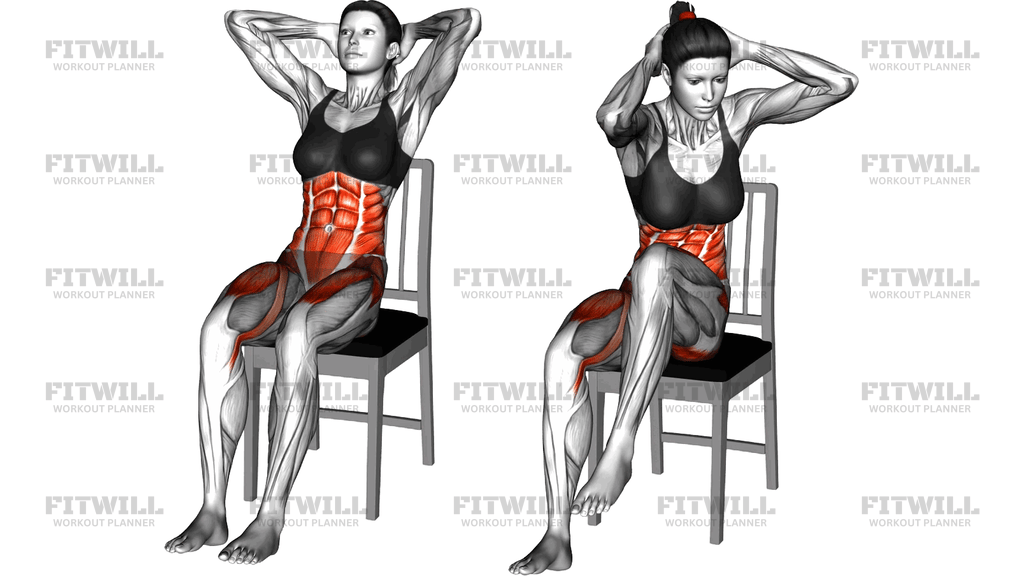
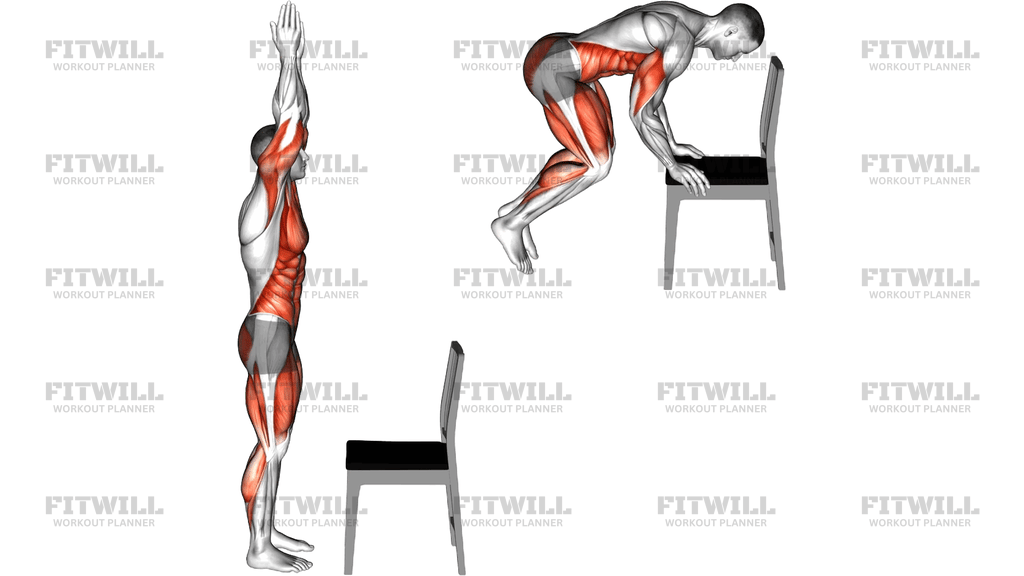
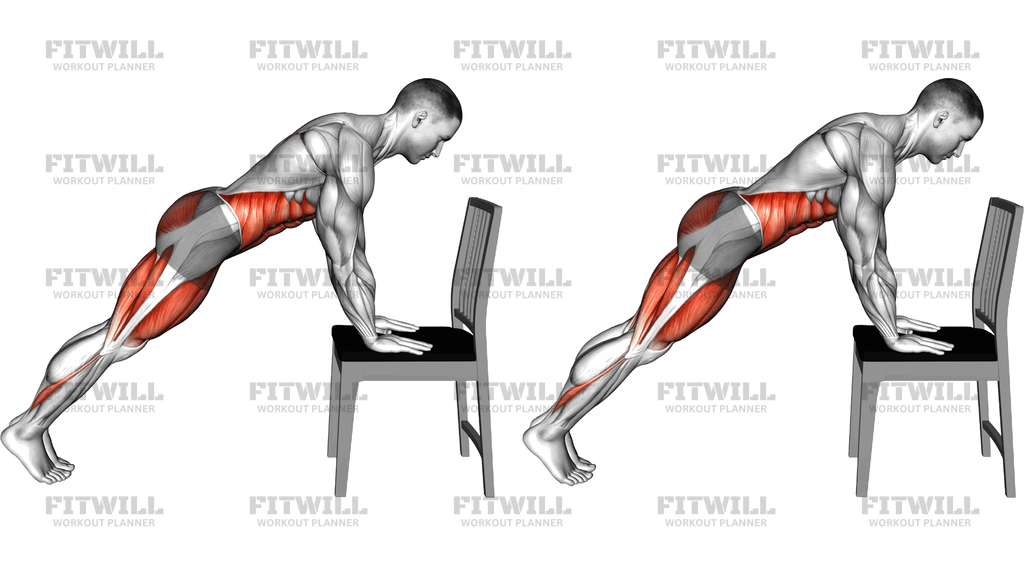
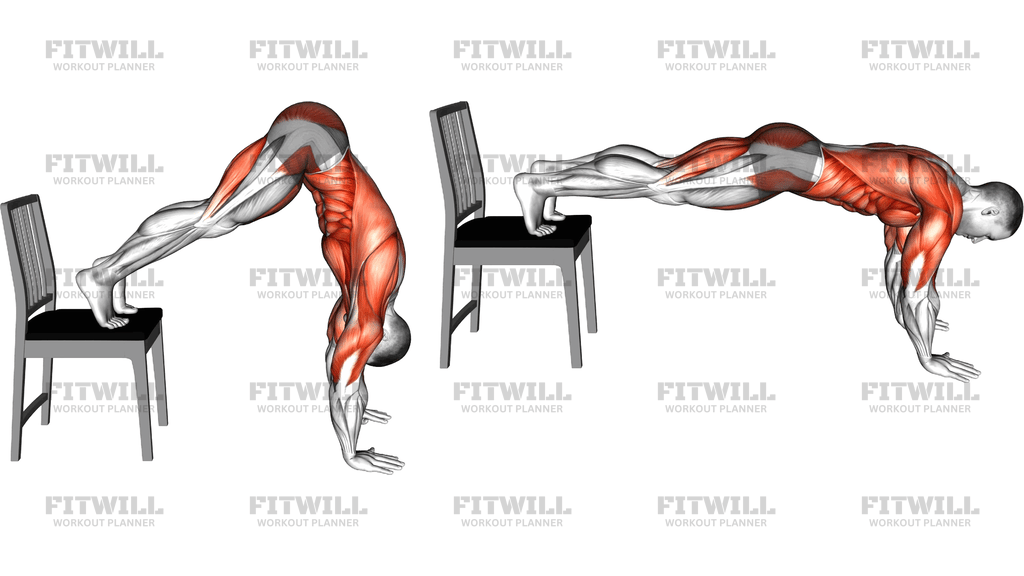
Sitting Alternate Overhead Under Knee Clap On A Ch
Sitting Alternate Overhead Under Knee Clap On A Chair is a seated coordination drill that combines a controlled overhead arm swing with a clap under each lifted knee. You sit upright on a standard chair with your arms extended out to the sides, then alternately raise one knee and bring your hands together beneath the thigh before sweeping the arms back overhead and switching sides. Because everything happens from a seated position, the movement demands trunk stability at the same time as it challenges hip mobility and upper-body coordination.
The main work comes from the abdominal wall, which has to brace and shorten slightly every time a knee lifts, and from the hip flexors, which drive the leg up toward the torso. The shoulders and upper back stay busy holding the arms out wide and controlling the sweep overhead and down. There is also a strong timing element: the clap only lands cleanly under the knee if the arm path and the knee lift arrive together, which makes this a useful drill for rhythm and cross-body control.
This exercise suits people who train at home with minimal equipment, older adults looking for a safe seated option, and anyone rehabilitating back into more dynamic standing movements. Office workers can use it as a movement break, and coaches often use it as a warm-up to wake up the hips, shoulders, and core before heavier training. Because the chair removes the balance requirement, you can focus entirely on smooth timing instead of worrying about falling.
The setup matters more than it looks. Sit tall on the front half of the chair with both feet flat, rather than slumping back against the backrest, so your torso stays vertical and your hips are free to lift the knee. Starting with the arms extended at shoulder height or overhead gives you a consistent swing path; if your arms drift forward or your chest collapses, the clap under the knee becomes sloppy and the abdominal work decreases.
To execute it well, lift one knee toward your chest, sweep both hands down and together to clap under that thigh, then return the foot to the floor and the arms to the starting position before repeating on the other side. Keep the movement deliberate rather than rushed. The chair should stay planted and your torso should not rock side to side as you alternate.
Use moderate tempo and steady breathing throughout. If your hamstrings or hips are tight, the knee will not come very high at first; a lower, controlled knee lift with a clean clap beats a forced high knee with a rounded back. Stop the set when your timing deteriorates or your lower back starts to take over the work.
[ Workout Log & Planner ]
Put your next workout in Fitwill
Keep your plan and training log ready when you are.


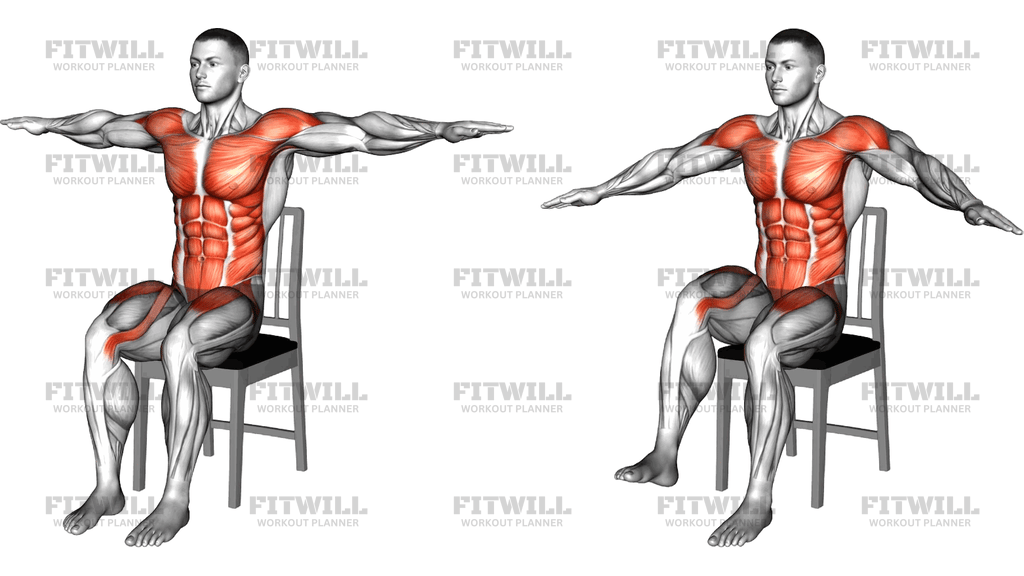
Instructions
- Sit on the front half of a sturdy chair with your feet flat on the floor about hip-width apart and your torso upright.
- Extend both arms straight out to the sides at roughly shoulder height, or sweep them overhead to set the starting path, with your palms facing forward or down.
- Brace your abdominal wall lightly and keep your ribcage stacked over your pelvis before you begin.
- Lift your right knee up toward your chest while keeping your torso tall and your lower back neutral.
- As the knee rises, sweep both hands down and inward so they clap together underneath the right thigh.
- Separate the hands, lower the right foot back to the floor, and swing the arms back out to the starting position.
- Repeat the same knee lift and under-knee clap on the left side, keeping the timing even.
- Exhale as the knee lifts and the hands clap, then inhale as the leg and arms return to the start.
- Continue alternating sides for your target number of total claps, resting when your timing or posture starts to slip.
Tips & Tricks
- Sit forward on the seat, not against the backrest; leaning back tilts your pelvis and turns the knee lift into a lower-back strain instead of an abdominal action.
- If the clap under the thigh keeps missing, slow the knee lift down rather than reaching with the hands early, since the timing problem usually comes from the leg arriving late.
- Keep the knee tracking straight up toward the same-side shoulder; letting it flop outward drops the hip work and makes the under-knee space too small for a clean clap.
- Do not let your head and chest chase the knee. Rounding forward shortens the abdominal range on paper but removes the tension that makes the drill worth doing.
- Keep the chair from sliding by placing it against a wall or on a non-slip surface, especially on a smooth floor where the legs can skid during the knee lift.
- If tight hamstrings stop the knee from coming high enough, use a slightly lower knee lift with a crisp clap rather than forcing height with a rounded back.
- Match the arm sweep to the knee; arms that hang or drift forward between reps break the rhythm and unload the shoulders.
- Breathe out on every clap instead of holding your breath, since the repeated bracing plus breath-holding builds pressure quickly in a seated position.
Frequently Asked Questions
Which muscles does Sitting Alternate Overhead Under Knee Clap On A Chair work most?
The abdominal wall and hip flexors do most of the work as you lift each knee, while the shoulders and upper back control the arm sweep and hold the arms out wide. The obliques assist as you alternate sides.
Why is the clap performed under the knee instead of in front of the chest?
Clapping under the lifted thigh forces the knee to rise high enough and the hands to travel a longer, more controlled path, which raises the demand on the hip flexors and abs and sharpens the timing of the movement.
Is Sitting Alternate Overhead Under Knee Clap On A Chair suitable for beginners?
Yes. The chair removes the balance challenge, so a beginner can focus on sitting tall and coordinating the knee lift with the clap. Start with a modest knee height and a slow tempo.
Can I do this exercise if I have tight hips or hamstrings?
Usually, yes, but use a lower knee lift that still allows a clean clap under the thigh. Forcing a high knee with a rounded lower back shifts the work away from the abs and into the spine.
What kind of chair should I use?
Any stable chair without wheels and without armrests works well. Armrests block the knee and hand path, and a rolling chair is unsafe when you lift a knee.
How is this different from seated knee raises without the clap?
The arm sweep and clap add shoulder work and a coordination demand that plain knee raises lack. The under-thigh clap also gives you a clear target, so it is easier to judge whether each rep was complete.
How many repetitions should I aim for?
A common starting point is 10 to 20 total claps, counting each side as one, for two or three rounds. Stop the set when your timing gets sloppy, because the value of the drill depends on clean coordination.
What is the most common mistake with this movement?
Slumping back and rocking the torso side to side as the knees alternate. Keep your seat bones planted and your chest tall, and reduce the knee height if you cannot do that.
Can this exercise replace standing cardio or core training?
It is a useful low-impact option and a good warm-up, but it works best alongside other movements rather than as a full replacement, since the seated position limits how much load and range you can use.
Should I keep my arms overhead the whole time?
No. The arms sweep from the wide or overhead position down to clap under the knee, then return. Holding them statically overhead on every rep would defeat the timing element that makes the drill work.