Kneeling Leg Out Side Walk
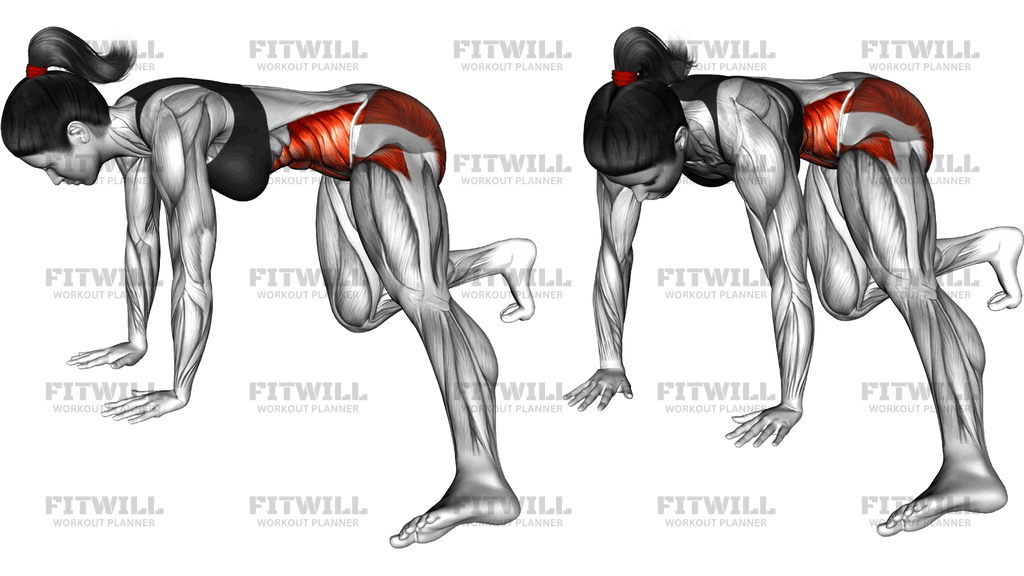
The Kneeling Leg Out Side Walk is a quadruped body weight exercise that targets the side of the hips, especially the gluteus medius, while challenging your trunk to stay stable as the leg moves away from the body. You set up on your hands and knees, extend one leg straight out to the side with the foot on the floor, and then walk sideways by stepping your supporting knee and the extended foot along the ground. The result is a slow, deliberate lateral crawl on three points of contact that lights up the outer hip of the extended leg and the stabilizing hip of the kneeling leg at the same time.
This movement is especially useful for people whose side glutes tend to be sleepy: desk workers with hips that never get asked to work sideways, runners and lifters who want better knee tracking, and anyone rehabbing or prehabbing around hip stability. Because the extended leg moves in a wide arc away from your midline, the gluteus medius and surrounding hip muscles have to both move the leg and control it, which is exactly the role they play when you walk, run, or stand on one leg.
The setup matters more here than in most floor exercises. Your hands sit directly under your shoulders, your working knee sits directly under your hip, and the extended leg reaches straight out to the side at roughly hip height with the foot flat. If your supporting knee drifts behind your hip or your hand position slides wide, your lower back starts twisting to fake the motion and the target muscles stop doing the work. A neutral spine with a lightly braced core keeps the movement in the hip where it belongs.
To execute it well, move like you are carrying something fragile on your lower back. Step the extended foot a few inches further out, then step the kneeling leg sideways to follow, keeping your hips square to the floor the whole time. Small steps beat big lunges here; the goal is constant tension on the outer hip, not covering distance. Walk several steps in one direction, then reverse and walk back so both sides of the body get balanced work.
You will see this drill in warm-ups, glute-focused circuits, Pilates-style sessions, and physical therapy programs for hip and knee control. It needs no equipment and very little space, which makes it a practical choice for home training. Move within a range where your hips stay level, stop if you feel pinching in the hip or stress in the kneeling knee, and treat it as a quality exercise: slow, tidy steps with a steady trunk will do far more than fast, wobbly ones.
[ Workout Log & Planner ]
Put your next workout in Fitwill
Keep your plan and training log ready when you are.


Instructions
- Kneel on the floor and place your hands flat under your shoulders so you are in a stable quadruped position, fingers spread and elbows soft.
- Extend your left leg straight out to the side so it forms roughly a right angle with your torso, foot flat on the floor and toes pointing forward.
- Stack your right knee directly under your right hip and brace your abdominal muscles to lock your ribcage and pelvis in a neutral position.
- Press your hands into the floor and keep your hips level with each other; do not let them rotate or hike toward the extended leg.
- Step your extended left foot a few inches further to the left, keeping the leg straight and the foot flat on the ground.
- Step your kneeling right leg sideways to follow, landing the knee under the hip again so your posture stays identical to the start.
- Continue walking sideways for several small steps, keeping the movement smooth and the core braced throughout.
- Exhale gently as you step, inhale as you settle into each new position, and avoid holding your breath.
- To change direction, reverse the sequence: step the kneeling leg first, then follow with the extended foot, walking back to the starting point.
- Complete all steps on one side, then reposition and repeat the same number of steps with the other leg extended.
Tips & Tricks
- If your lower back starts twisting, shorten your steps; the pelvis should face forward and stay level even as the leg swings out wide.
- A common mistake is letting the extended foot turn inward or collapse onto its inner edge; keep the toes pointing forward and the whole foot in contact with the floor.
- Check the kneeling knee: it should stay under the hip, not drift behind you, or the hip flexors will take over the stabilizing job.
- Do not drop your head between your shoulders; keep the neck long and your gaze down and slightly forward so the upper back stays neutral.
- If the kneeling knee feels uncomfortable on a hard floor, kneel on a mat or folded towel rather than shifting your weight away from the working hip.
- Keep pressure even across both hands; many people unload the arm on the same side as the extended leg, which rotates the whole torso.
- Aim for a mild burn along the side of the extended hip; if you feel it mostly in the front of the hip, you are likely arching instead of bracing.
- Move slower than feels necessary on the first set; speed is the most common reason this drill loses its effect on the outer glutes.
- Match the number of steps in each direction so the walking loop finishes where it started and both hips get equal exposure.
Frequently Asked Questions
Which muscles does the Kneeling Leg Out Side Walk work?
The main work comes from the gluteus medius and the other muscles along the outer hip of the extended leg. The kneeling leg's hip stabilizes your base, and the core, especially the obliques, works to keep your trunk from twisting as the leg moves.
Why is the leg extended out to the side instead of tucked under in a normal crawl?
Extending the leg sideways puts the hip into abduction, which loads the side glutes in a way a normal hands-and-knees crawl cannot. It also forces the kneeling hip to stabilize against sideways pull, training both legs at once.
Is the Kneeling Leg Out Side Walk suitable for beginners?
Yes, it is body weight and low impact, so beginners can learn it quickly. Start with short walks of four to six steps per direction and focus on keeping the hips level before adding more distance or sets.
How far out should the extended leg reach?
Reach the leg straight out to the side at roughly a right angle to your torso, or slightly less if that feels awkward in the hip. The exact width matters less than keeping the leg straight, the foot flat, and your pelvis square.
My lower back aches when I do this exercise. What am I doing wrong?
Your trunk is likely twisting or arching to compensate for a hip that is not moving on its own. Brace your abs before each step, shorten your step length, and double-check that your hands and supporting knee are stacked under your shoulder and hip.
Can I do the Kneeling Leg Out Side Walk if my knees are sensitive?
Kneeling on a mat or folded towel usually solves surface discomfort. If the bent knee itself complains during the stepping motion, switch to a standing side leg raise or a band lateral walk, which train the same outer hip muscles without kneeling.
How many steps and sets should I do?
A practical starting dose is a walk of six to ten steps each way for two to three rounds per side. Since the goal is control rather than exhaustion, stop the set as soon as your hips start rotating or your steps get sloppy.
Where should this exercise fit into my workout?
It works well as an activation drill before squats, lunges, or running, or as a focused glute and hip exercise in a home circuit. Doing it early in a session is smart because it teaches the side hips to switch on before heavier loading.
Should the extended foot stay flat on the floor during each step?
Yes, keep the whole foot in contact with the floor as you step sideways. Lifting the toes or rolling onto the outside edge of the foot changes the leg's angle and reduces the steady tension on the outer hip you are trying to train.